

What is Required Run Rate (RRR)?
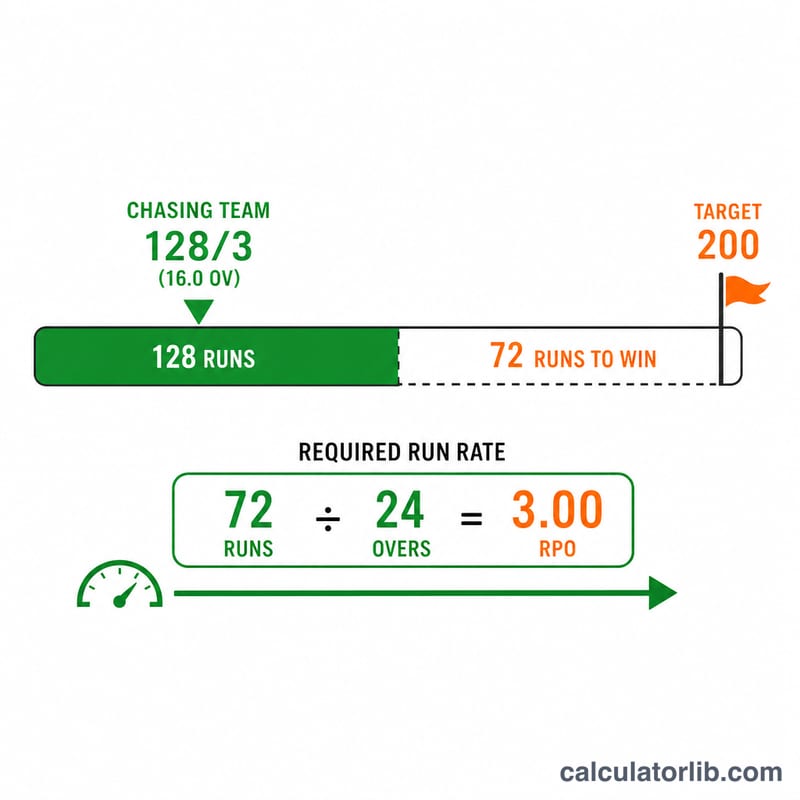
In limited-overs cricket, the Required Run Rate (RRR) is the average number of runs per over that the batting (chasing) team must score in the remaining overs to reach the target and win the match. It is one of the most-watched live statistics in ODI and T20 cricket because it instantly tells you how hard the chase is.
How to use this calculator
Enter three values: the target score (the total the chasing team needs to win, which is the first innings total plus one), the current score of the chasing team, and the overs remaining. Overs are entered in standard cricket notation — for example 4.3 means 4 overs and 3 balls remaining. The calculator returns the RRR in runs per over, along with the runs still required and the balls left.
The formula explained
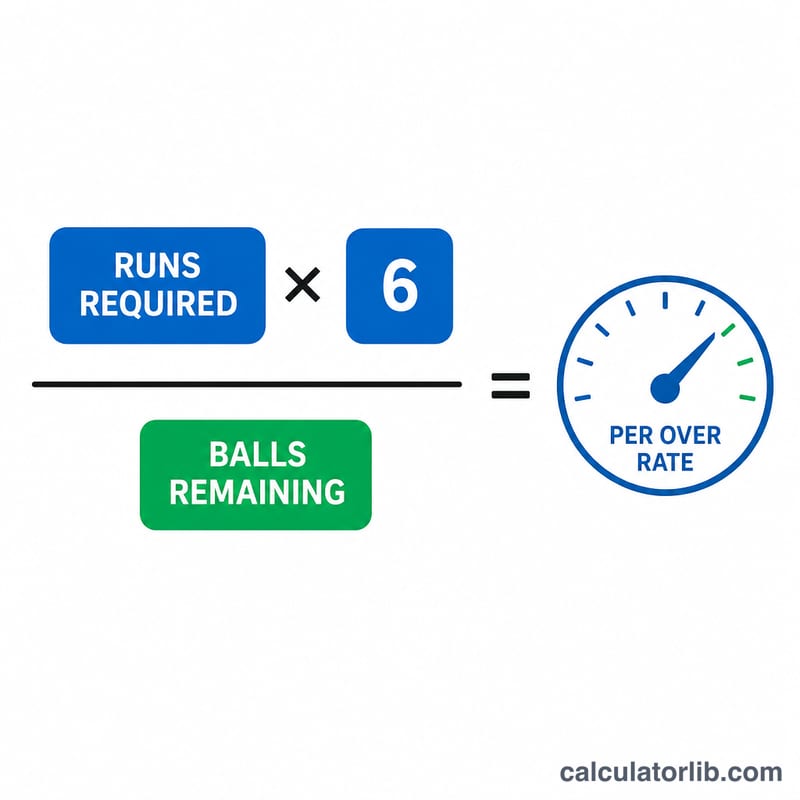
The calculation is simple: take the runs still required (target minus current score), multiply by 6 (the number of balls in an over), then divide by the number of balls remaining.
$$\text{RRR} = \frac{\text{Runs Required} \times 6}{\text{Balls Remaining}}$$
Because overs are written as overs.balls, the calculator first converts them to total balls: \(4.3\) overs becomes \(4 \times 6 + 3 = 27\) balls.
Worked example
Suppose the target is 300, the chasing team is on 150, and there are 25 overs (150 balls) remaining. Runs required = \(300 - 150 = 150\). $$\text{RRR} = \frac{150 \times 6}{150} = 6.00 \text{ runs per over}$$ The team needs to maintain six an over to win.
FAQ
What is the difference between RRR and current run rate? The current run rate (CRR) is what you have scored so far per over; RRR is what you still need per over to win.
Why is the target one more than the first-innings total? To win, the chasing team must surpass the first-innings score, so the target equals that score plus one.
How do I enter 3 balls left? Enter 0.3 overs remaining — 0 overs and 3 balls.