
What This Calculator Does
The speed of sound in air depends mainly on temperature. This calculator returns the speed of sound for any air temperature you enter, giving the result in meters per second (m/s), kilometers per hour (km/h), and miles per hour (mph). It uses the standard approximation for dry air at sea level and is suitable for physics homework, acoustics, audio engineering, and general curiosity.
How to Use It
Enter the air temperature in degrees Celsius and read off the speed of sound. Negative temperatures are allowed (for example −20 °C on a cold day). The calculator handles values across the normal atmospheric range.
The Formula Explained
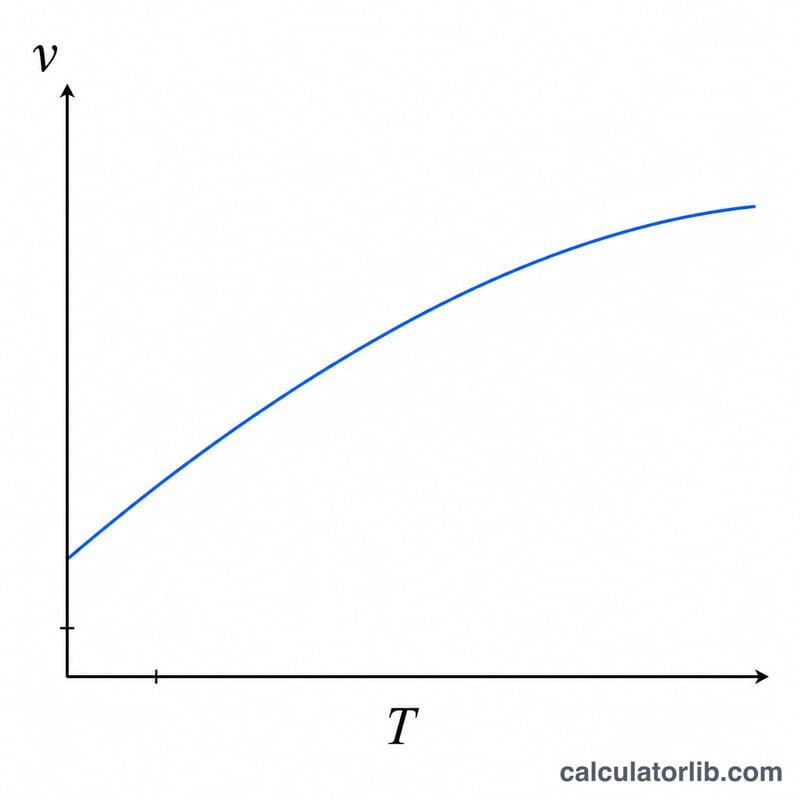
The relationship is $$v = 331.3 \times \sqrt{1 + \dfrac{T}{273.15}}$$ where T is the temperature in °C. The constant 331.3 m/s is the speed of sound at 0 °C. The term \(\left(1 + \dfrac{T}{273.15}\right)\) converts the Celsius temperature into a ratio against absolute zero (in kelvin, \(T + 273.15\)), and the square root captures how sound speed scales with the square root of absolute temperature. A common simpler linear approximation is \(v \approx 331.3 + 0.606 \cdot T\), which agrees closely near room temperature.
Worked Example
At T = 20 °C: \(1 + \dfrac{20}{273.15} = 1.07322\). The square root is 1.03597, so $$v = 331.3 \times 1.03597 \approx 343.2 \text{ m/s}$$ That equals about 1,235.6 km/h or 767.8 mph — the familiar room-temperature figure for the speed of sound.
FAQ
Does humidity affect the result? Slightly. Humid air is a little faster than dry air, but the effect is small (a few m/s). This calculator assumes dry air.
What about altitude or pressure? For an ideal gas, pressure changes alone don't change the speed of sound — temperature is the dominant factor, which is why this formula uses only T.
Why is the speed at 0 °C exactly 331.3 m/s? It is the measured speed of sound in dry air at 0 °C and standard pressure, used as the reference baseline.