
What is an elastic collision?
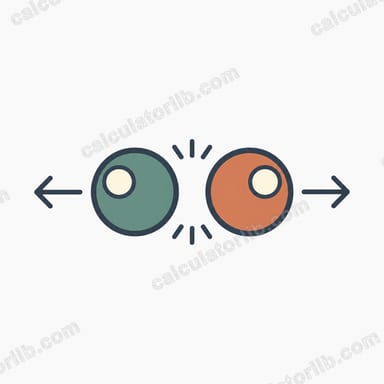
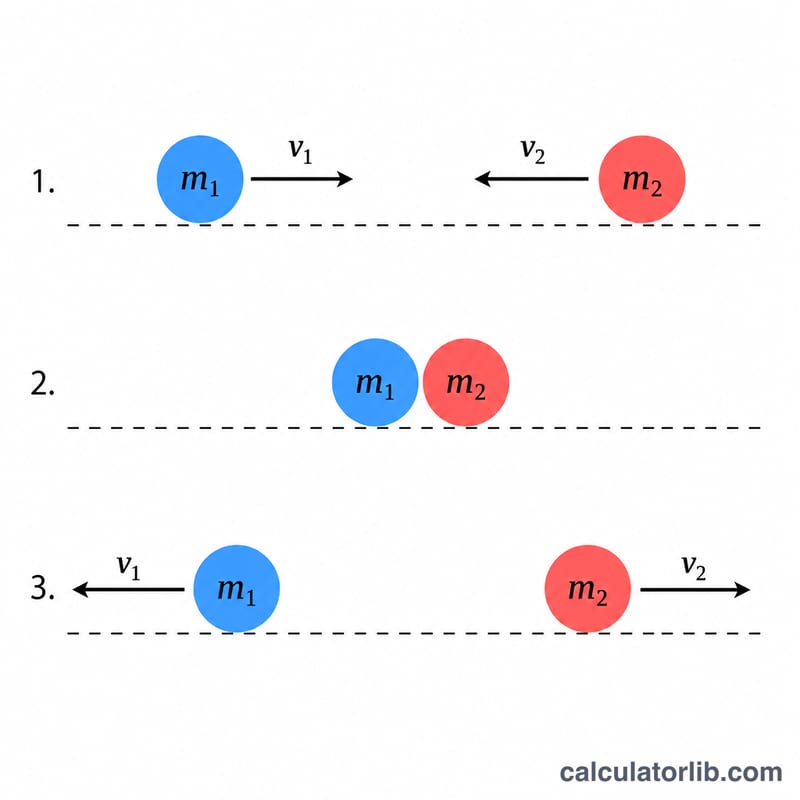
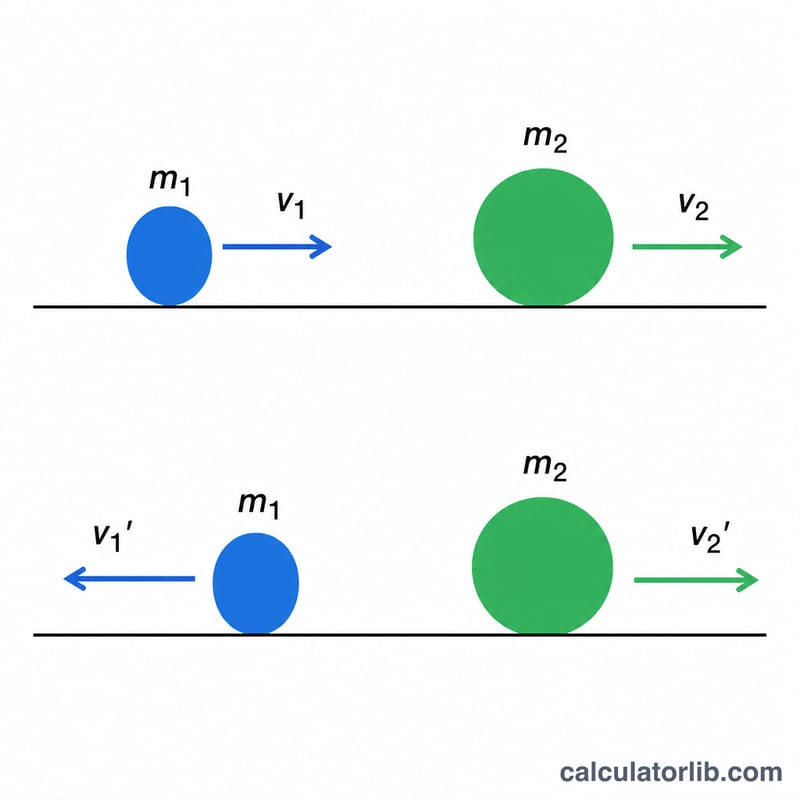
An elastic collision is a collision in which both momentum and kinetic energy are conserved. No energy is lost to heat, sound, or permanent deformation. Real examples that come close include billiard balls, atomic and molecular collisions, and idealized physics problems. This calculator solves the standard one-dimensional case for the two final velocities given the two masses and two initial velocities.
How to use it
Enter the mass of each object (\(m_1\) and \(m_2\)) and their initial velocities along the line of motion (\(v_1\) and \(v_2\)). Use positive values for motion in one direction and negative values for the opposite direction. The calculator returns the velocities of both objects immediately after the collision, along with the total momentum and kinetic energy, which should remain unchanged before and after.
The formula explained
For a 1D elastic collision, solving the conservation equations simultaneously gives closed-form results:
$$v_1' = \frac{(m_1 - m_2)v_1 + 2 m_2 v_2}{m_1 + m_2}$$$$v_2' = \frac{(m_2 - m_1)v_2 + 2 m_1 v_1}{m_1 + m_2}$$Notice the symmetry: swapping the two objects' labels swaps the formulas. When the masses are equal, the objects simply exchange velocities.
Worked example
Suppose \(m_1 = 2\) kg moving at \(v_1 = 5\) m/s strikes \(m_2 = 3\) kg moving at \(v_2 = -2\) m/s. Then $$v_1' = \frac{(2-3)(5) + 2 \cdot 3 \cdot (-2)}{2+3} = \frac{-5 - 12}{5} = -3.4 \text{ m/s},$$ and $$v_2' = \frac{(3-2)(-2) + 2 \cdot 2 \cdot 5}{5} = \frac{-2 + 20}{5} = 3.6 \text{ m/s}.$$ Total momentum \(= 2 \cdot 5 + 3 \cdot (-2) = 4\) kg·m/s is unchanged.
FAQ
What if the masses are equal? The two objects exchange velocities exactly.
What's the difference from an inelastic collision? In an inelastic collision kinetic energy is not conserved (some is lost), so these formulas do not apply.
Does direction matter? Yes — this is a signed, one-dimensional model. Use negative numbers for objects moving in the opposite direction.