
What this calculator does
The Divide Fractions Calculator divides one fraction by another and returns the answer as a fully simplified fraction plus its decimal equivalent. Dividing fractions trips up many students because the steps feel counterintuitive — you don't divide straight across. Instead you flip the second fraction and multiply. This tool does that automatically and reduces the result to lowest terms.
How to use it
Enter the first fraction as numerator a over denominator b, and the second fraction as numerator c over denominator d. Press calculate and you'll see the simplified fraction, the unreduced product, and the decimal value.
The formula explained
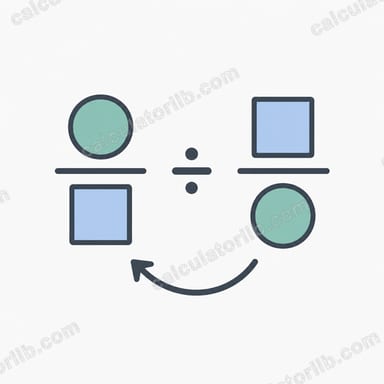
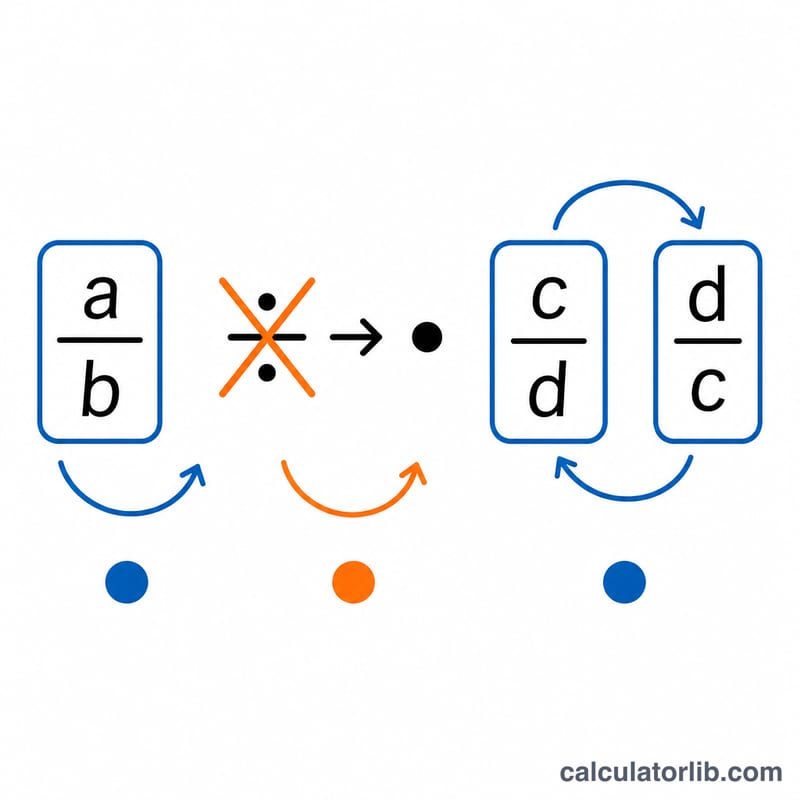
To divide fractions, use the keep, change, flip rule: keep the first fraction, change division to multiplication, and flip (take the reciprocal of) the second fraction:
$$\frac{a}{b} \div \frac{c}{d} = \frac{a}{b} \times \frac{d}{c} = \frac{a \cdot d}{b \cdot c}$$
After multiplying the numerators and denominators, divide both by their greatest common divisor (GCD) to simplify.
Worked example
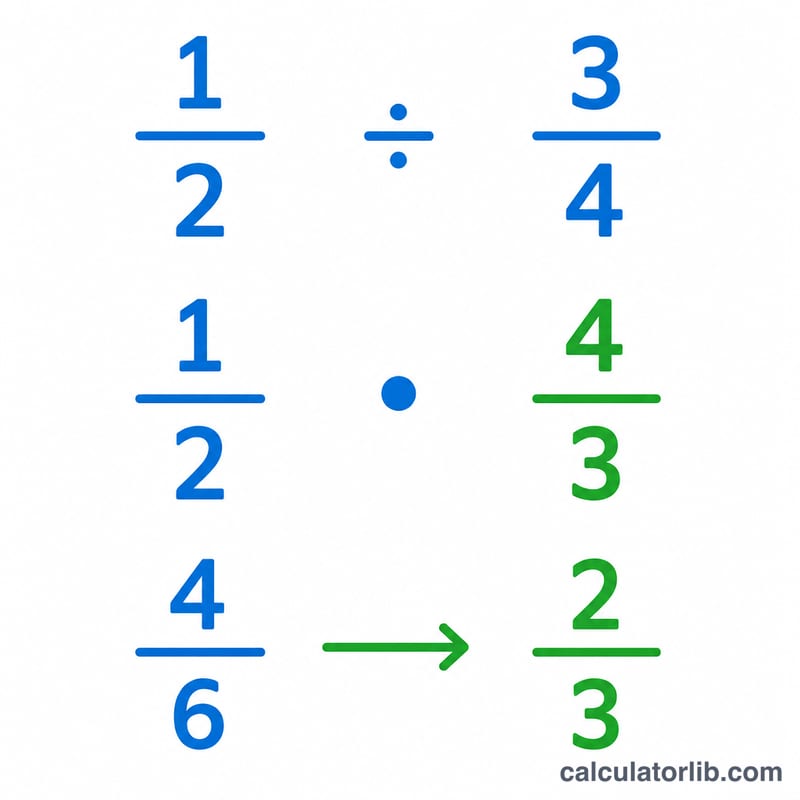
Divide 1/2 by 3/4. Flip the second fraction to 4/3 and multiply: $$\frac{1 \cdot 4}{2 \cdot 3} = \frac{4}{6}.$$ The GCD of 4 and 6 is 2, so 4/6 reduces to 2/3, which equals about 0.6667 as a decimal.
FAQ
Why do you flip the second fraction? Dividing by a number is the same as multiplying by its reciprocal. Since c/d's reciprocal is d/c, division becomes multiplication.
Can I divide whole numbers? Yes — write a whole number n as n/1. For example, 6 becomes 6/1.
What if a denominator is zero? Fractions are undefined when the denominator is zero, and you cannot divide by a fraction whose numerator is zero. The calculator returns 0 in those undefined cases.