
What Is an Egyptian Fraction?
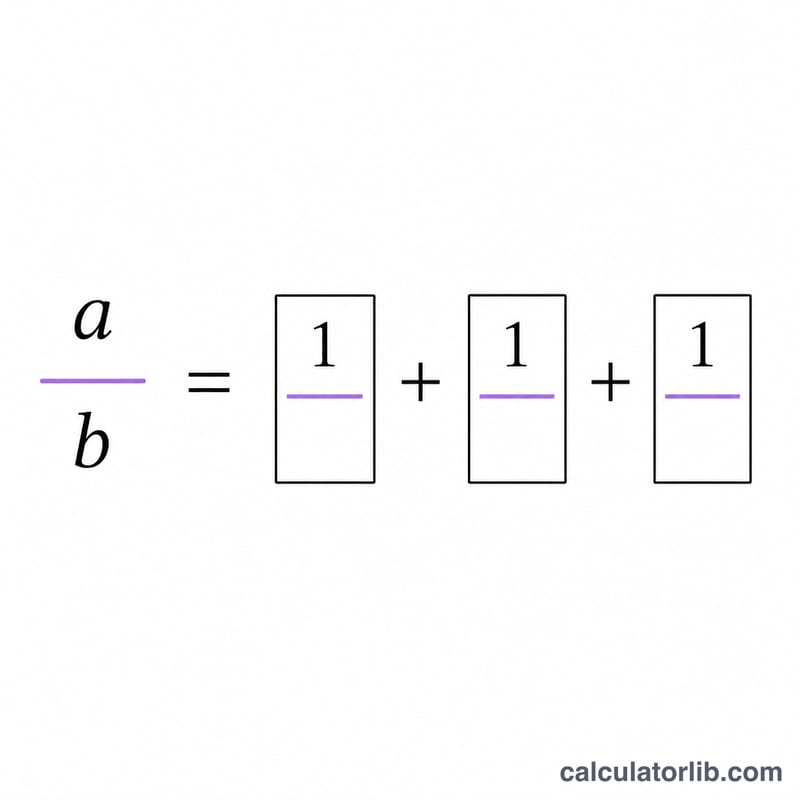
An Egyptian fraction expresses a positive rational number as a sum of distinct unit fractions — fractions whose numerator is 1, such as \(\frac{1}{2}\), \(\frac{1}{3}\) or \(\frac{1}{7}\). The ancient Egyptians wrote all fractions this way (except for a special symbol for \(\frac{2}{3}\)). This calculator converts any proper fraction you enter into such a sum automatically.
How to Use the Calculator
Enter the numerator and denominator of a proper fraction (numerator smaller than denominator). The calculator first reduces the fraction to lowest terms, then applies the greedy algorithm and shows the full expansion plus how many unit fractions it contains.
The Formula Explained
The greedy method, attributed to Fibonacci and Sylvester, repeatedly removes the largest possible unit fraction. For a remainder \(\frac{a}{b}\), the next denominator is \(d = \left\lceil \frac{b}{a} \right\rceil\). Subtracting \(\frac{1}{d}\) gives a new fraction \(\frac{a \cdot d - b}{b \cdot d}\), which is reduced and processed again. Because the numerator strictly decreases at each step, the process always terminates.
$$\frac{\text{Numerator } a}{\text{Denominator } b} = \frac{1}{d_1} + \frac{1}{d_2} + \cdots + \frac{1}{d_k}, \qquad d_i = \left\lceil \frac{b}{a} \right\rceil$$
Worked Example
Take \(\frac{5}{6}\). Here \(d = \left\lceil \frac{6}{5} \right\rceil = 2\), so we take \(\frac{1}{2}\). The remainder is $$\frac{5}{6} - \frac{1}{2} = \frac{2}{6} = \frac{1}{3}.$$ That is already a unit fraction, so the expansion is \(\frac{1}{2} + \frac{1}{3}\), using 2 unit fractions. You can verify: $$\frac{1}{2} + \frac{1}{3} = \frac{3}{6} + \frac{2}{6} = \frac{5}{6}. \checkmark$$
FAQ
Are Egyptian fraction expansions unique? No. A fraction can be written as unit fractions in many ways; the greedy algorithm produces just one valid representation.
Why must the fractions be distinct? By definition Egyptian fractions use different denominators, which is what makes the greedy approach interesting rather than simply writing \(\frac{1}{b}\) repeatedly.
Can the denominators get very large? Yes. The greedy method can produce surprisingly large denominators even for simple fractions, which is one of its known drawbacks.