
What This Calculator Does
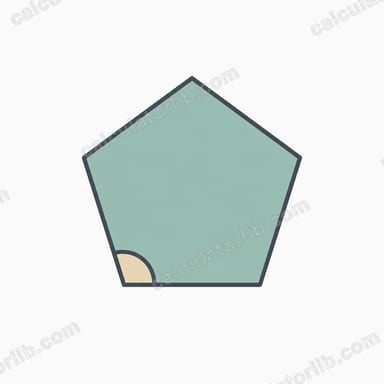
This tool finds the sum of the interior angles of any simple polygon. Just enter the number of sides (n), and it returns the total in degrees, along with the size of each angle if the polygon is regular (all sides and angles equal).
The Formula
The sum of the interior angles of an n-sided polygon is given by:
$$\text{Sum} = \left(\text{Sides }(n) - 2\right) \times 180^{\circ}$$
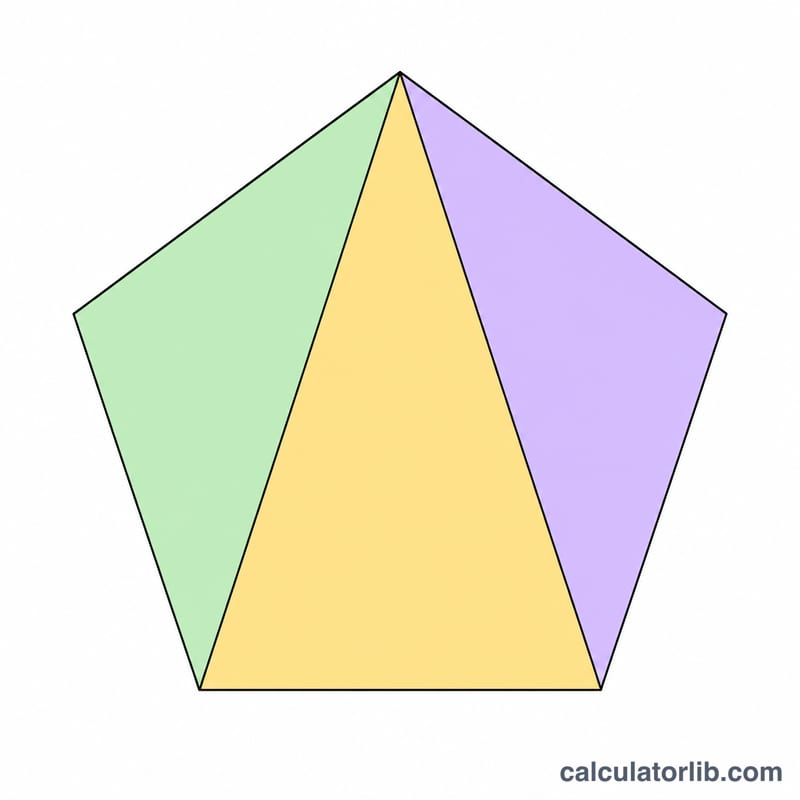
This works because any polygon can be split into \((n - 2)\) triangles by drawing diagonals from a single vertex, and each triangle contributes \(180^{\circ}\). For a regular polygon, each individual interior angle equals the sum divided by \(n\).
How to Use It
Enter the number of sides — for example 3 for a triangle, 4 for a quadrilateral, 5 for a pentagon, 6 for a hexagon, and so on. The value must be a whole number of at least 3, since a polygon needs at least three sides.
Worked Example
For a hexagon (n = 6): $$\text{Sum} = (6 - 2) \times 180 = 4 \times 180 = 720^{\circ}.$$ If the hexagon is regular, each interior angle is \(720 \div 6 = 120^{\circ}\).

FAQ
Does this work for irregular polygons? Yes — the sum of interior angles depends only on the number of sides, not the shape. The "each angle" figure, however, assumes a regular polygon.
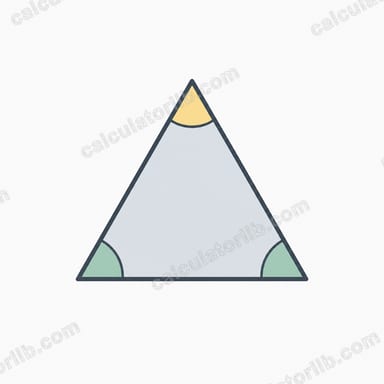
What is the smallest polygon? A triangle with 3 sides, whose interior angles always sum to \(180^{\circ}\).
What about concave polygons? The formula still holds for any simple (non-self-intersecting) polygon, including concave ones.