
What is the Grams per Liter Calculator?
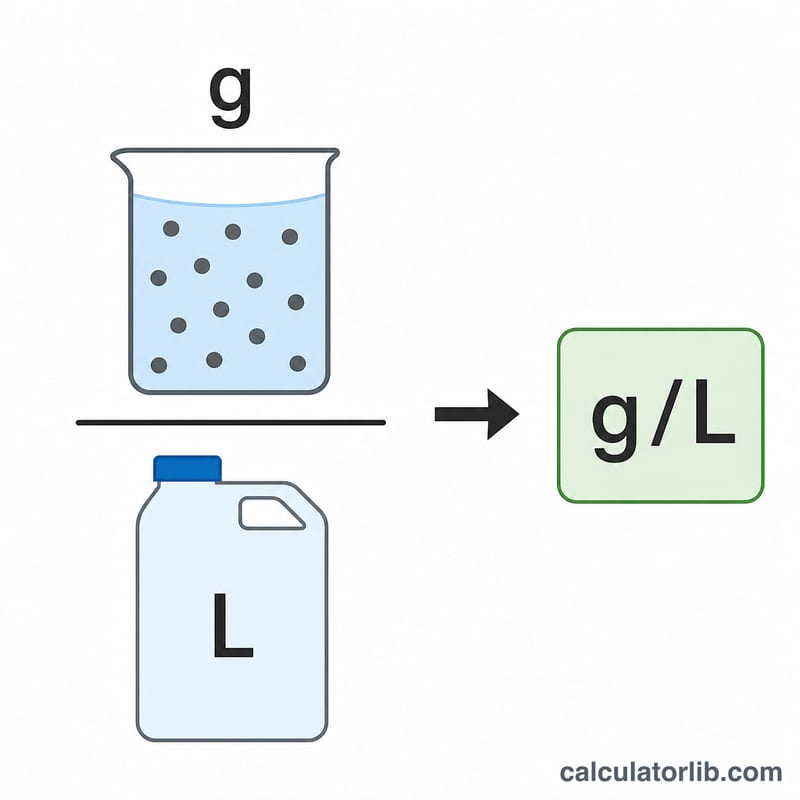
This calculator finds the mass concentration of a substance expressed in grams per liter (g/L). It simply divides the mass of solute (in grams) by the volume of solution (in liters). Grams per liter is one of the most common ways to report concentration in chemistry, biology, water treatment, and food science because it is intuitive and unit-friendly.
How to use it
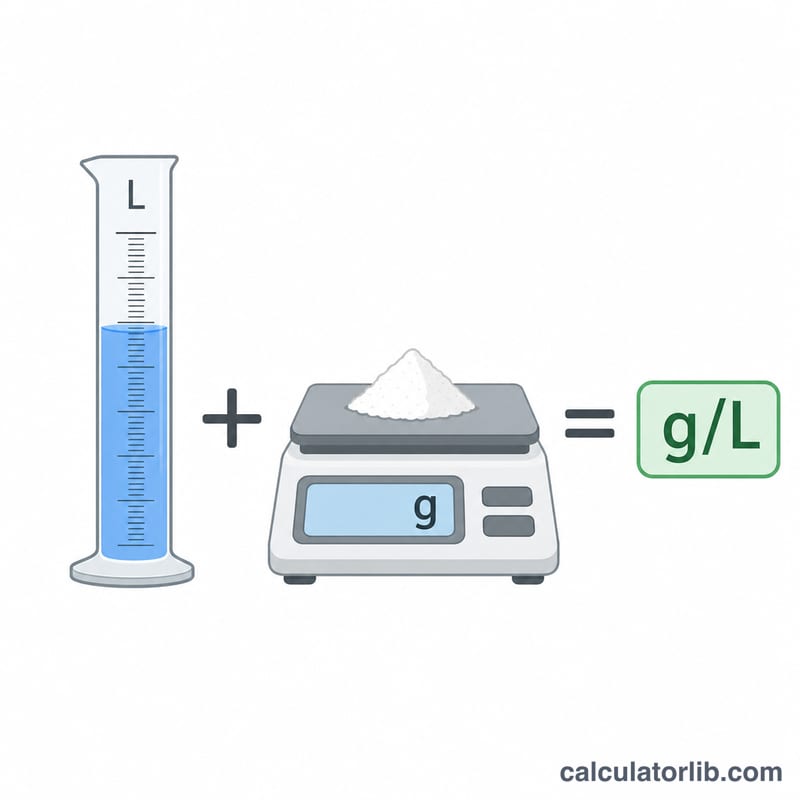
Enter the mass of your dissolved substance in grams and the total volume of the solution in liters. The calculator instantly returns the concentration in g/L. If your volume is in milliliters, divide by 1000 first (e.g. 250 mL = 0.25 L).
The formula explained
The relationship is straightforward:
$$\text{g/L} = \frac{\text{Mass (g)}}{\text{Volume (L)}}$$
Note that 1 g/L is also equal to 1 mg/mL and to 1000 mg/L (ppm in dilute water solutions). This makes g/L easy to convert into other concentration units.
Worked example
Suppose you dissolve 50 grams of salt in 2 liters of water. The concentration is:
$$50 \text{ g} \div 2 \text{ L} = 25 \text{ g/L}$$
So every liter of the solution contains 25 grams of salt.
FAQ
Is g/L the same as g/mL? No. \(1 \text{ g/mL}\) equals \(1000 \text{ g/L}\) because there are 1000 mL in a liter.
How do I convert g/L to mg/L? Multiply by 1000. So \(5 \text{ g/L} = 5000 \text{ mg/L}\).
What if my volume is zero? Concentration is undefined when volume is zero, so the calculator returns 0 — make sure to enter a positive volume.