
What Is Deadweight Loss?
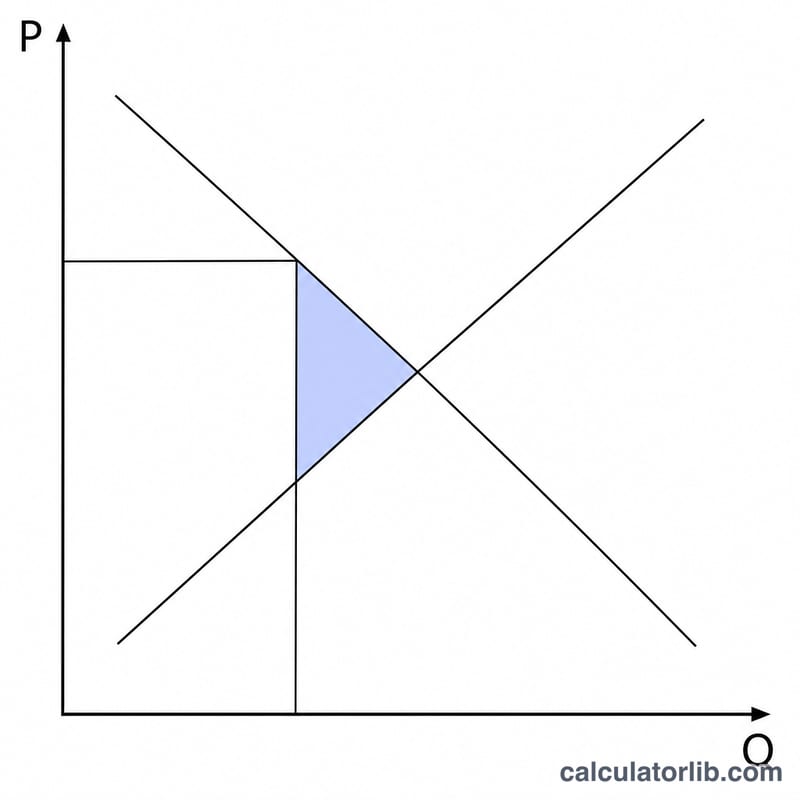
Deadweight loss (DWL) is the loss of total economic welfare — the combined surplus of buyers and sellers — that occurs when a market is not in its free-market equilibrium. It typically arises from taxes, subsidies, price floors, price ceilings, quotas, or monopoly pricing. These interventions push the price up (or down) and reduce the quantity traded, so some mutually beneficial transactions never happen. The value of those lost trades is the deadweight loss.
How to Use This Calculator
Enter the original equilibrium price and quantity (before the intervention) and the new price and quantity (after it). The calculator computes the area of the welfare-loss triangle. A positive result represents lost surplus; the size depends on how far price and quantity moved.
The Formula Explained
The standard triangle approximation is:
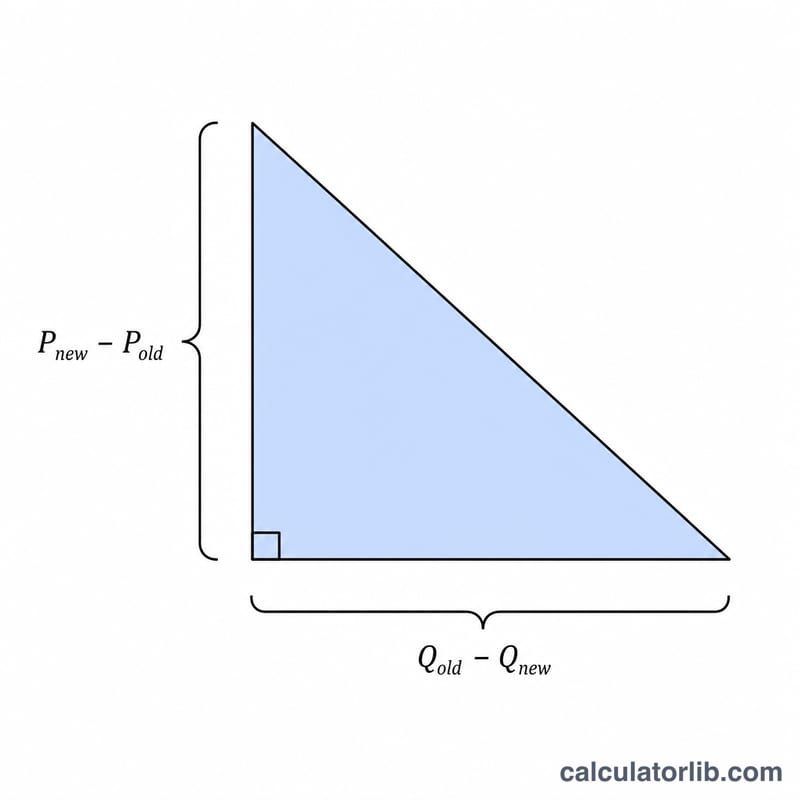
$$\text{DWL} = \frac{1}{2} \times \left( \text{P}_{\text{new}} - \text{P}_{\text{old}} \right) \times \left( \text{Q}_{\text{old}} - \text{Q}_{\text{new}} \right)$$
The base of the triangle is the reduction in quantity (\(\text{Q}_{\text{old}} - \text{Q}_{\text{new}}\)), and the height is the change in price (\(\text{P}_{\text{new}} - \text{P}_{\text{old}}\), which equals the per-unit tax or price wedge). Multiplying base by height and halving gives the area of the triangle, which equals the welfare destroyed.
Worked Example
Suppose a market trades at $10 with 100 units sold. A tax raises the effective price to $12, and quantity falls to 80 units. Then $$\text{DWL} = \frac{1}{2} \times (\$12 - \$10) \times (100 - 80) = \frac{1}{2} \times 2 \times 20 = \$20.$$ Twenty dollars of total surplus is lost — value that neither consumers, producers, nor the government captures.
FAQ
Why multiply by one half? Because the lost welfare forms a triangle in the supply-and-demand diagram, and a triangle's area is half its base times its height.
What causes deadweight loss? Anything that moves a market away from equilibrium: per-unit taxes, subsidies, binding price controls, tariffs, quotas, and monopoly markups.
Can deadweight loss be negative? In this simple model a negative number means your inputs reversed the expected direction (e.g. price fell while quantity rose). For a genuine welfare loss, enter a higher new price and a lower new quantity.