
What Is Disposable Income?
Disposable income is the amount of money you have left over after paying taxes. It represents the funds available for spending on necessities, discretionary purchases, saving, or investing. It is one of the most important figures in personal budgeting and is also a key economic indicator used to measure household financial health.
How to Use This Calculator
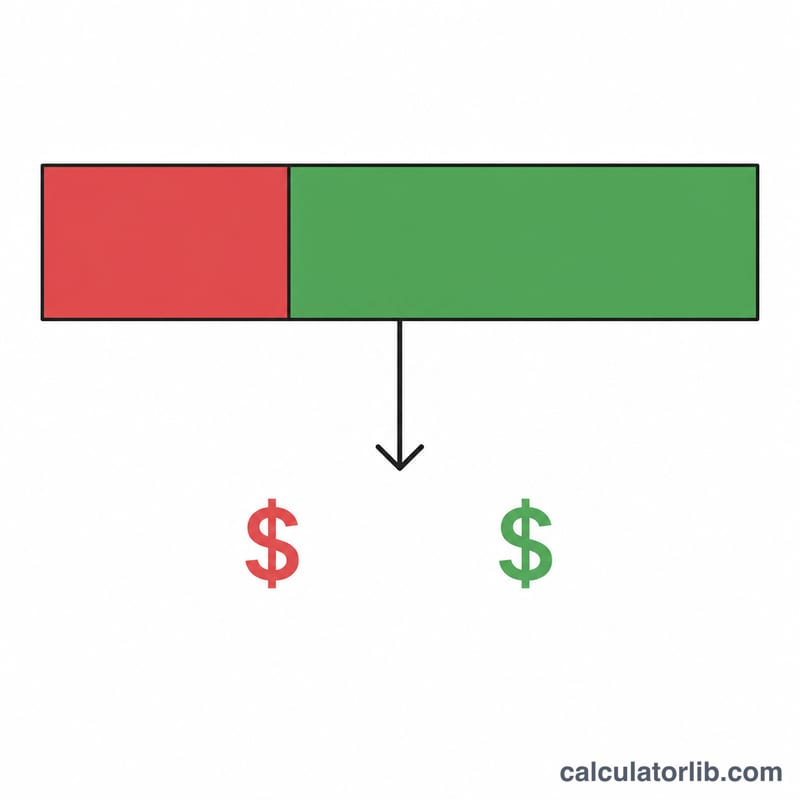
Enter your gross income (your total earnings before any deductions) and your total taxes (income tax, payroll taxes, and any other mandatory deductions). The calculator subtracts taxes from gross income to give your disposable income, and also shows your effective tax rate as a percentage of gross income. You can use any period you like — annual, monthly, or weekly — as long as both inputs use the same period.
The Formula Explained
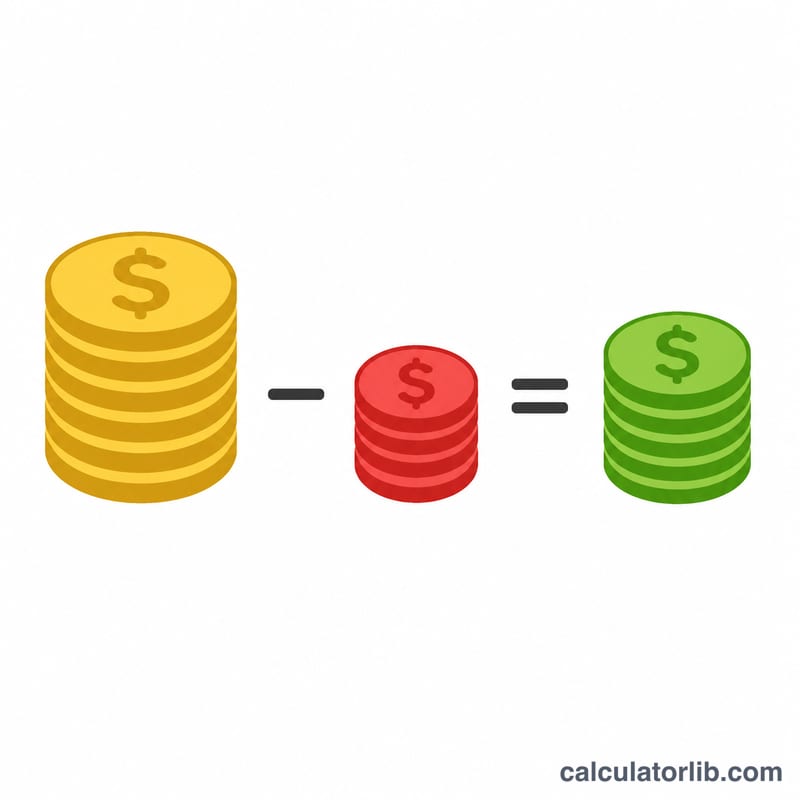
The core formula is simple: $$\text{Disposable Income} = \text{Gross Income} - \text{Taxes}$$. The effective tax rate is calculated as $$\text{Effective Tax Rate} = \frac{\text{Taxes}}{\text{Gross Income}} \times 100$$, which tells you what proportion of your earnings go to taxes.
Worked Example
Suppose your monthly gross income is $5,000 and your total taxes are $1,200. Your disposable income is $$\$5{,}000 - \$1{,}200 = \mathbf{\$3{,}800}$$. Your effective tax rate is $$(1{,}200 \div 5{,}000) \times 100 = \mathbf{24\%}$$. That $3,800 is what you actually have available each month.
FAQ
Is disposable income the same as discretionary income? No. Disposable income is what's left after taxes. Discretionary income is what remains after taxes and essential living costs like rent, food, and utilities.
Should I include retirement contributions in taxes? Only mandatory deductions count as taxes here. Voluntary contributions like 401(k) deposits reduce your take-home pay but are not taxes, so include them separately in your budget if you wish.
Can I use net pay instead? If you already know your take-home (net) pay, that figure is effectively your disposable income — you can enter your net pay as gross income and 0 as taxes to confirm.