
What Is the GDP Gap?
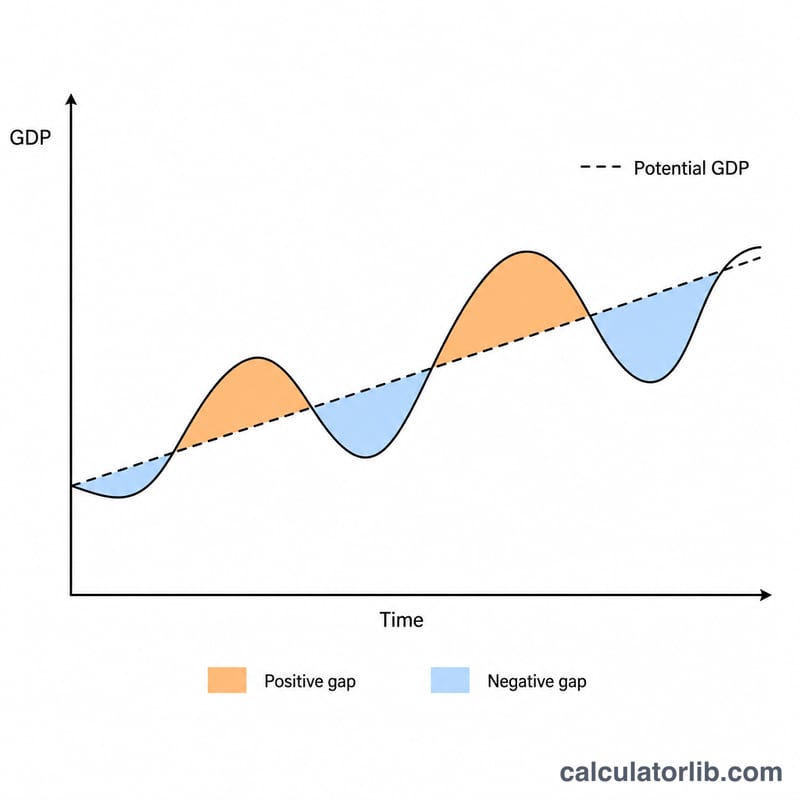
The GDP gap, also called the output gap, measures the difference between an economy's actual gross domestic product and its potential GDP — the level of output the economy could sustain at full employment without accelerating inflation. It is expressed as a percentage of potential GDP. A negative gap signals a recessionary economy operating below capacity, while a positive gap indicates an inflationary economy running above its sustainable level.
How to Use This Calculator
Enter your Actual GDP (the real, observed output) and your Potential GDP (the estimated full-employment output). The calculator returns the gap as a percentage of potential GDP along with the raw gap amount. Use consistent units and currency for both inputs — billions, trillions, or index points all work as long as both fields match.
The Formula Explained
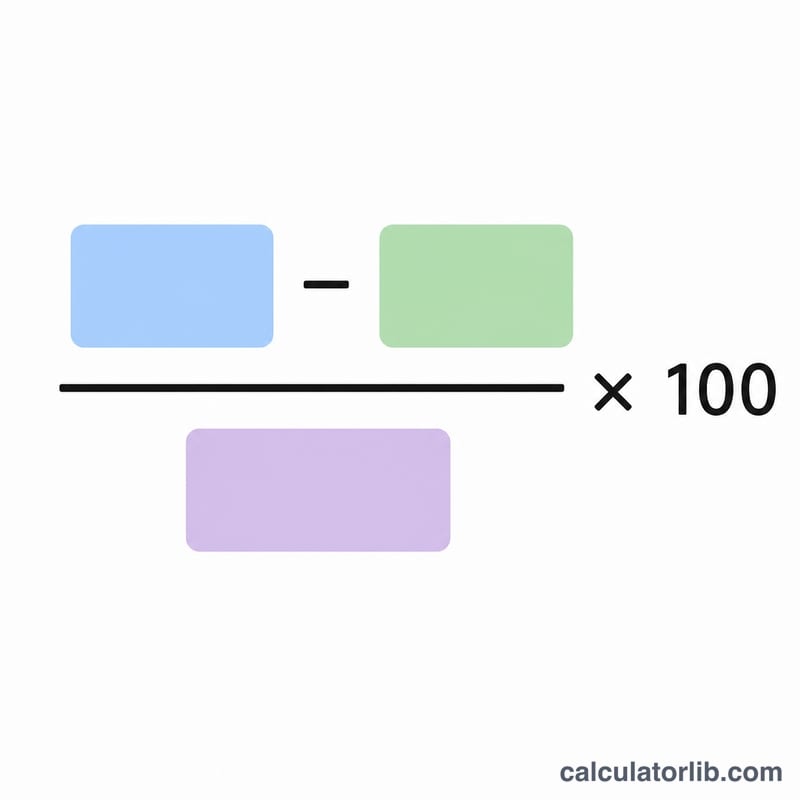
The GDP gap is calculated as $$\text{GDP Gap} = \frac{\text{Actual GDP} - \text{Potential GDP}}{\text{Potential GDP}} \times 100\%$$ Subtracting potential from actual GDP gives the absolute shortfall or excess; dividing by potential GDP scales it relative to the economy's size, and multiplying by 100 converts it to a percentage. A result of \(-2.5\%\) means actual output is 2.5% below potential.
Worked Example
Suppose actual GDP is 19,500 and potential GDP is 20,000. The gap amount is \(19{,}500 - 20{,}000 = -500\). Dividing by 20,000 gives \(-0.025\), and multiplying by 100 yields a GDP gap of −2.5%. $$\text{GDP Gap} = \frac{19{,}500 - 20{,}000}{20{,}000} \times 100\% = -2.5\%$$ The economy is operating 2.5% below its potential, suggesting underused resources and room for expansionary policy.
FAQ
What does a negative GDP gap mean? It means actual output is below potential — a recessionary gap with idle capacity and likely higher unemployment.
What does a positive GDP gap mean? Actual output exceeds potential — an inflationary gap where the economy may overheat.
Where do I get potential GDP? Agencies like the Congressional Budget Office or central banks publish estimates; it is modeled, not directly observed.