
What Is the Labor Force Participation Rate?
The labor force participation rate (LFPR) measures the percentage of the working-age population that is actively engaged in the labor market — meaning they are either employed or unemployed but actively seeking work. It is one of the most widely watched indicators of an economy's labor supply and is published by statistical agencies worldwide. Unlike the unemployment rate, the LFPR captures everyone who participates in the workforce, offering insight into how many people are available to produce goods and services.
How to Use This Calculator
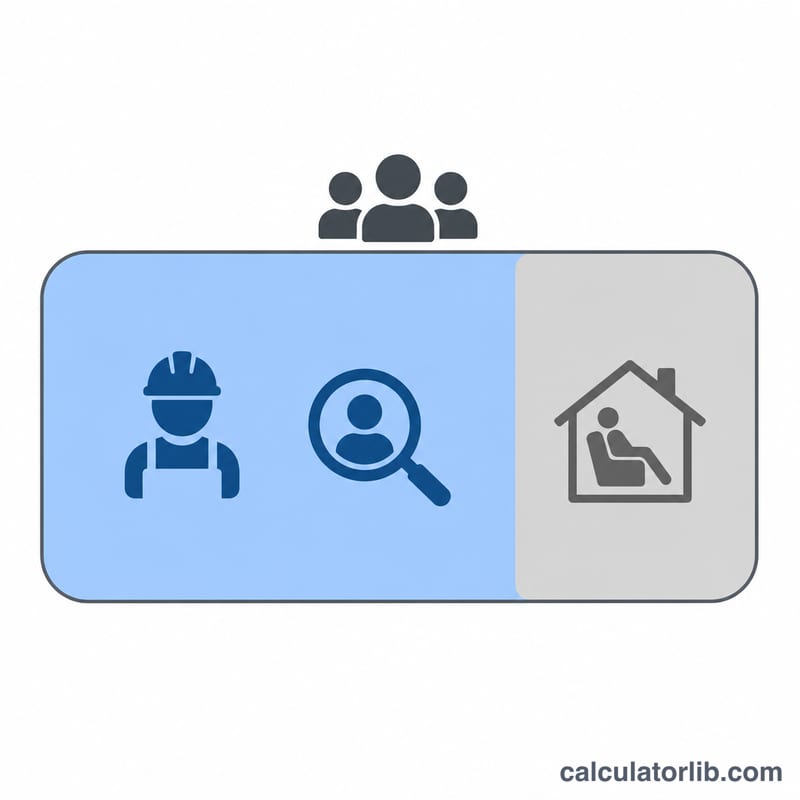
Enter two numbers: the size of the labor force (all employed plus all unemployed-but-looking people) and the working-age population (typically people aged 16 and over, or 15+ in many countries, who are not institutionalized). Click calculate and the tool returns the participation rate as a percentage, along with how many people are not in the labor force.
The Formula Explained
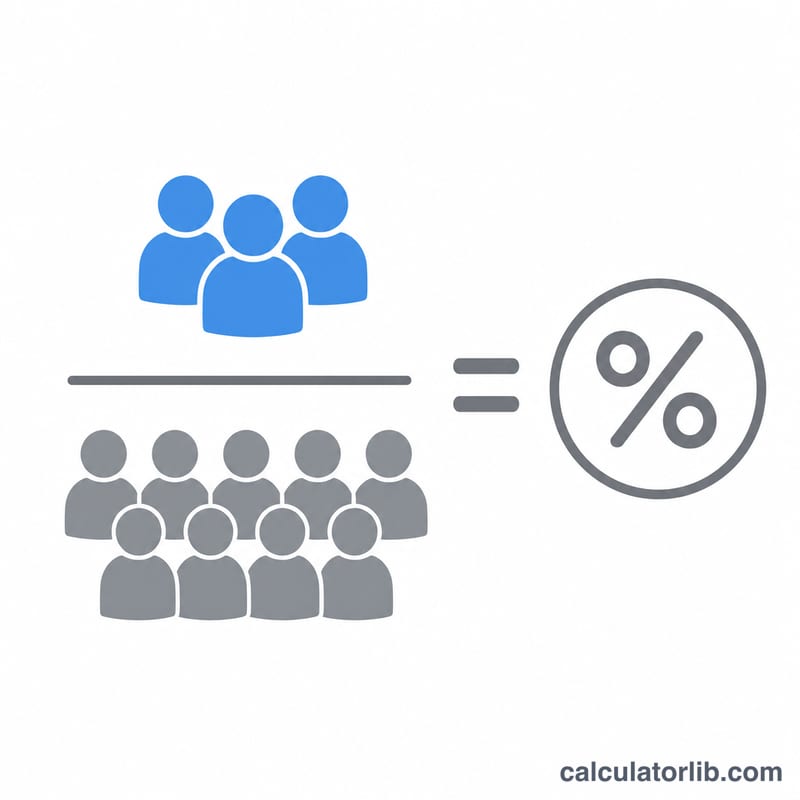
The calculation is a simple ratio expressed as a percentage:
$$\text{LFPR} = \frac{\text{Labor Force}}{\text{Working-Age Population}} \times 100\%$$
The numerator is the active labor force. The denominator is the total pool of people old enough to work. Multiplying by 100 converts the ratio into a percentage. People who are retired, full-time students, homemakers, or otherwise not seeking work are excluded from the labor force and lower the rate.
Worked Example
Suppose a country has a labor force of 165,000,000 people and a working-age population of 262,000,000. The participation rate is:
$$165{,}000{,}000 \div 262{,}000{,}000 = 0.62977 \rightarrow \times 100 = \mathbf{62.98\%}$$
This means roughly 63 out of every 100 working-age people are participating in the labor market, while about 97,000,000 are not in the labor force.
FAQ
What counts as "working age"? Definitions vary by country — the US uses age 16 and older, while many others use 15+. Always use a consistent population figure.
Does it include the unemployed? Yes. The labor force includes both employed people and unemployed people who are actively searching for a job.
Why does the rate fall when people retire? Retirees remain in the working-age population but leave the labor force, so the numerator shrinks while the denominator stays large, lowering the rate.