
What Is the GDP Deflator?
The GDP deflator is a broad measure of price levels across an entire economy. Unlike the Consumer Price Index (CPI), which tracks a fixed basket of consumer goods, the GDP deflator covers every good and service counted in Gross Domestic Product. It is calculated by comparing nominal GDP (measured in current prices) with real GDP (measured in constant base-year prices). This calculator works for any country or currency — just enter the two GDP figures in the same units.
How to Use This Calculator
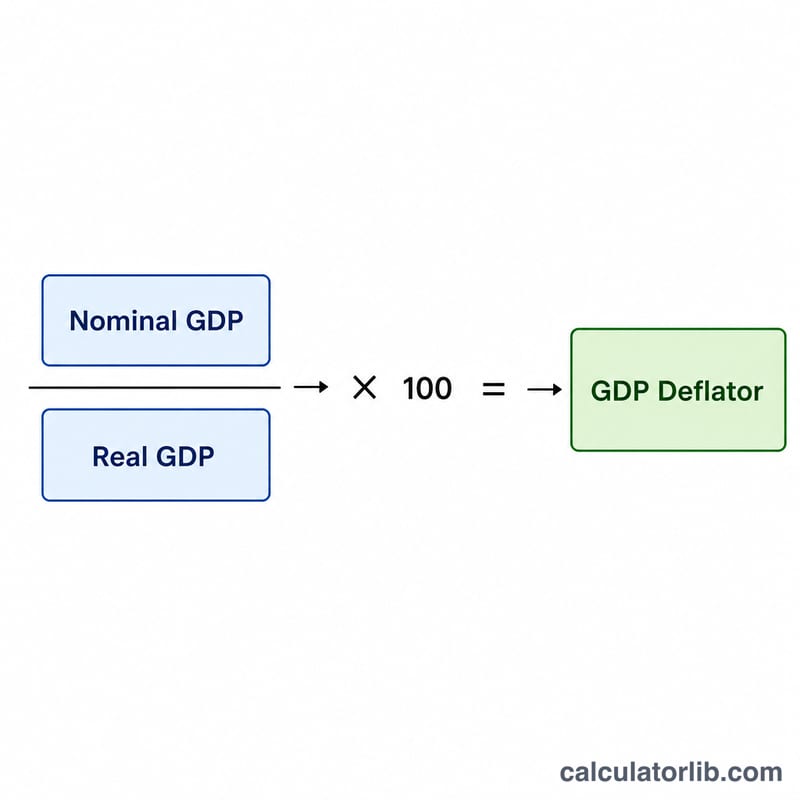
Enter your Nominal GDP and Real GDP in the same currency and units (for example, billions of dollars). Both figures should refer to the same period. The calculator divides nominal GDP by real GDP and multiplies by 100 to produce the deflator index. A base year always has a deflator of exactly 100, since nominal and real GDP are equal then.
The Formula Explained
The equation is straightforward:
$$\text{GDP Deflator} = \frac{\text{Nominal GDP}}{\text{Real GDP}} \times 100$$
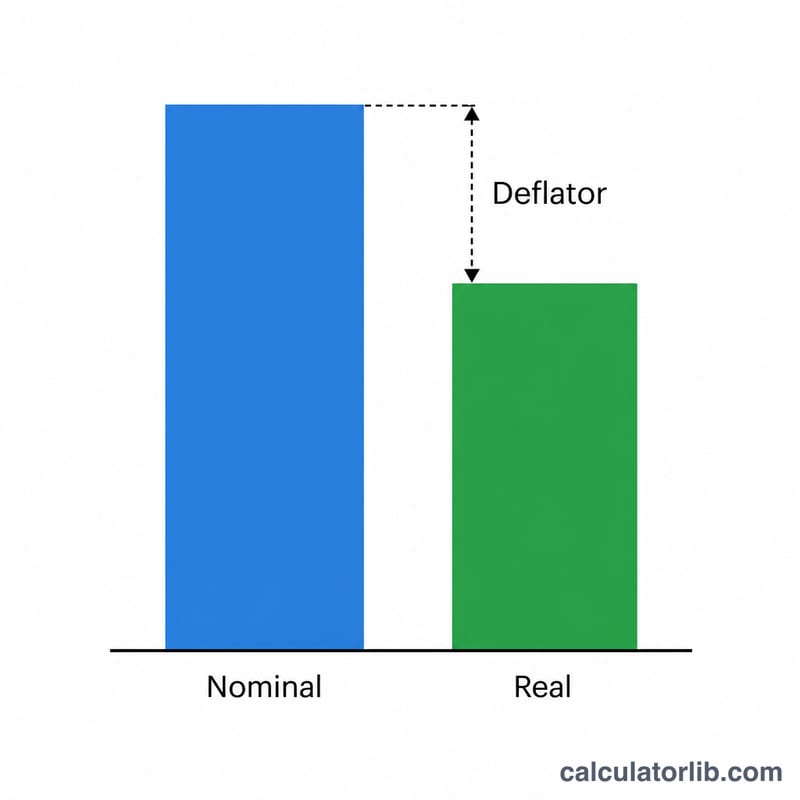
Nominal GDP reflects today's prices, while real GDP strips out price changes by valuing output at base-year prices. When the deflator rises above 100, the overall price level has increased since the base year (inflation). A value below 100 indicates prices have fallen (deflation).
Worked Example
Suppose a country has a nominal GDP of $22,000 billion and a real GDP of $20,000 billion. The deflator is $$(22{,}000 / 20{,}000) \times 100 = 1.1 \times 100 = \mathbf{110}.$$ This means overall prices are 10% higher than in the base year.
FAQ
What does a GDP deflator of 110 mean? It means the general price level is 10% above the base year, when the index equals 100.
How is the GDP deflator different from CPI? The deflator covers all domestically produced goods and services and updates its weighting each period, while CPI uses a fixed consumer basket.
Can the deflator be used to find real GDP? Yes. Rearranging the formula, \(\text{Real GDP} = (\text{Nominal GDP} / \text{GDP Deflator}) \times 100\).