What is GDP?
Gross Domestic Product (GDP) is the total monetary value of all finished goods and services produced within a country's borders during a specific period — usually a calendar quarter or year. It is the most widely used summary measure of an economy's size and overall health. GDP captures only output produced inside the country, regardless of who owns the producing firms; income earned abroad by domestic citizens is excluded.
Why GDP Matters
Policymakers, central banks, investors, and businesses all watch GDP because changes in its growth rate signal whether an economy is expanding, stagnating, or contracting. A common rule of thumb defines a recession as two consecutive quarters of negative real GDP growth. GDP is also used for international comparisons, trade negotiations, and as a denominator for ratios such as government debt-to-GDP and trade-to-GDP.
The Three Approaches
National statistical agencies compute GDP three different ways. In theory, all three should yield the same number; in practice, small statistical discrepancies exist.
- Expenditure approach: sum of everything spent on final goods and services in the economy.
- Income approach: sum of all incomes earned in producing those goods and services.
- Output (production) approach: sum of value added at each stage of production, totaled across all industries.
This calculator implements the first two. The output approach requires industry-by-industry data and is rarely used outside official statistics.
Expenditure Approach
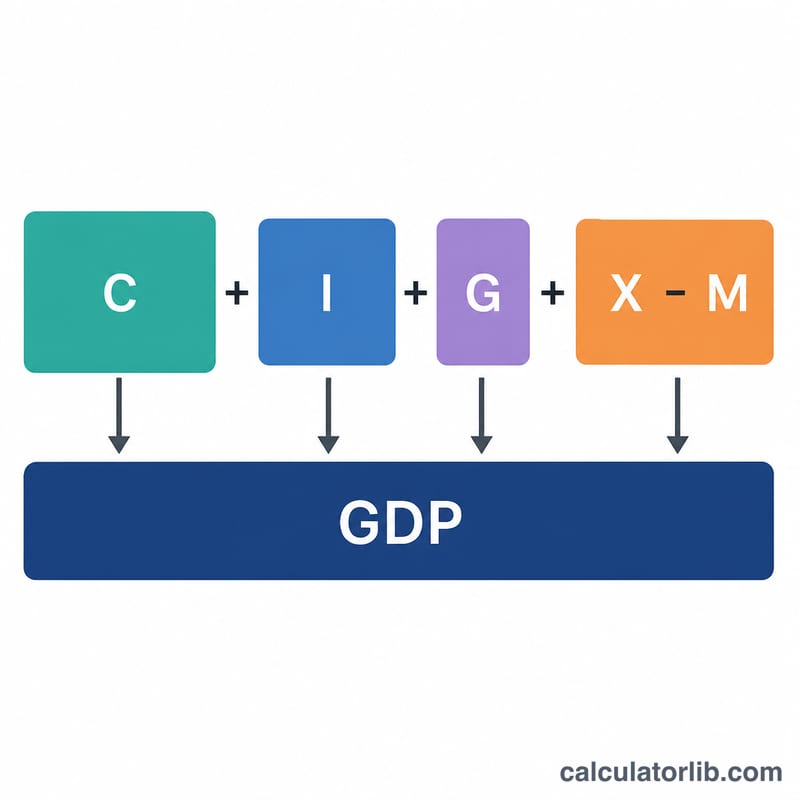
The expenditure approach groups all spending in the economy into four mutually exclusive categories:
$$\text{GDP} = C + I + G + (X - M)$$
- C — Personal Consumption. Household spending on goods (food, clothing, cars) and services (rent, healthcare, education). Typically the largest component, often 60–70% of GDP in developed economies.
- I — Gross Investment. Business spending on equipment, structures, and inventories, plus residential construction. Excludes financial investments such as stock purchases.
- G — Government Consumption. Federal, state, and local government spending on goods and services (e.g., military, public schools, roads). Excludes transfer payments such as Social Security or unemployment benefits, since those don't represent current production.
- X − M — Net Exports. Exports (X) of goods and services to other countries, minus imports (M). A trade deficit makes this term negative.
Income Approach
The income approach measures GDP by summing the incomes paid to factors of production, plus a few adjustments to reconcile national income with the GDP basis:
$$\begin{aligned}\text{GDP} =\ & \text{Compensation} + \text{Proprietors} + \text{Rents} \\ &+ \text{Profits} + \text{Interest} + \text{Indirect Tax} \\ &+ \text{Depreciation} + \text{NIF}\end{aligned}$$
- Compensation of Employees: wages, salaries, and fringe benefits paid to workers — the largest single component.
- Proprietors' Income: earnings of unincorporated businesses (sole proprietorships, partnerships).
- Rents: income earned by landlords from leasing property.
- Corporate Profits: net earnings of incorporated businesses before dividend distribution.
- Net Interest: interest received by domestic residents minus interest paid.
- Indirect Business Taxes: sales tax, excise duties, and similar taxes embedded in market prices but not paid to factors of production.
- Depreciation (capital consumption allowance): the portion of investment that replaces worn-out capital rather than expanding productive capacity.
- Net Income of Foreigners: reconciles GDP (output produced inside the country) with national income (income earned by domestic residents).
Worked Example — Expenditure Approach
Suppose an economy has the following figures (in trillions of dollars):
- Personal consumption: 13.5
- Gross investment: 4.0
- Government consumption: 3.5
- Exports: 2.5
- Imports: 3.5
$$\text{GDP} = 13.5 + 4.0 + 3.5 + 2.5 - 3.5 = \textbf{20.0 trillion}$$
Nominal vs Real GDP
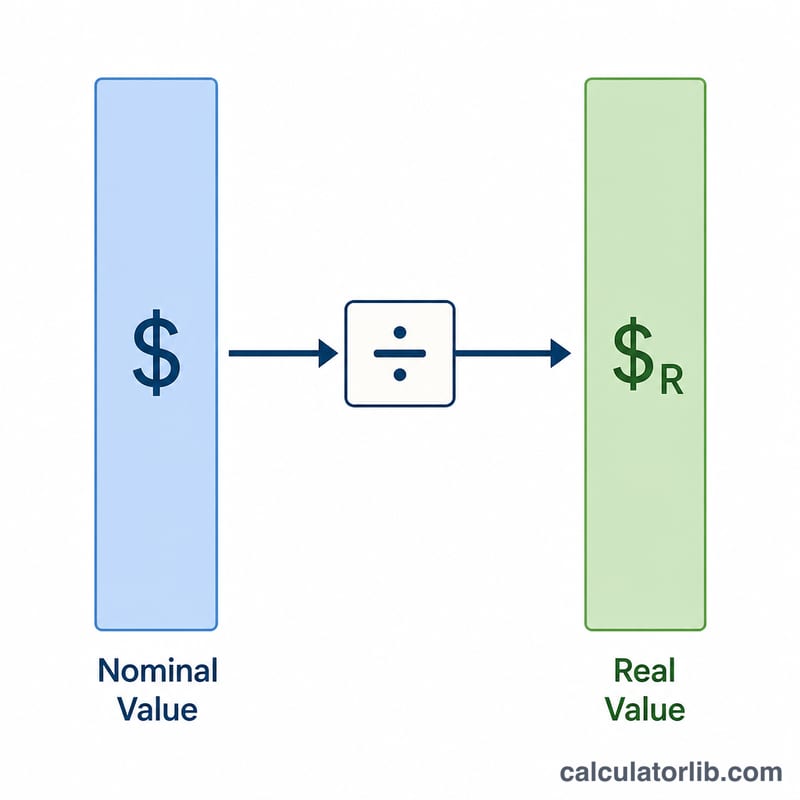
The number this calculator produces is nominal GDP — measured in current-period prices. To compare GDP across years and isolate genuine growth from price inflation, economists deflate nominal GDP using a price index to obtain real GDP, expressed in the prices of a chosen base year. The ratio of nominal to real GDP is known as the GDP deflator and is itself a closely watched inflation indicator.
GDP Per Capita
Dividing GDP by total population gives GDP per capita, a rough proxy for living standards. Comparing per-capita GDP across countries (especially when adjusted to purchasing power parity, or PPP) is a more meaningful measure of economic prosperity than comparing total GDP, since the latter is heavily influenced by population size.
Limitations of GDP
GDP is a powerful indicator but far from a complete measure of well-being or economic health.
- Excludes non-market activity: unpaid household labor, volunteer work, and the informal economy aren't captured even though they produce real value.
- Ignores inequality: two countries with identical GDP per capita may have vastly different distributions of income and wealth.
- Indifferent to externalities: environmental degradation, pollution, and resource depletion don't reduce GDP — sometimes the cleanup costs are even added to it.
- Replacement counts as production: repairing damage from natural disasters or wars boosts GDP without raising long-run welfare.
- Quality changes: when products get better but the price stays similar (e.g., smartphones), standard GDP figures may understate true progress.
For these reasons, modern economists supplement GDP with measures such as the Human Development Index (HDI), the Genuine Progress Indicator (GPI), and natural capital accounts.