
What Is Real GDP?
Real Gross Domestic Product (Real GDP) measures the value of all goods and services an economy produces, adjusted for changes in the price level. While nominal GDP mixes together changes in output and changes in prices, real GDP strips out inflation so you can compare economic output across different years on an equal footing. It is one of the most widely used indicators of genuine economic growth.
How to Use This Calculator
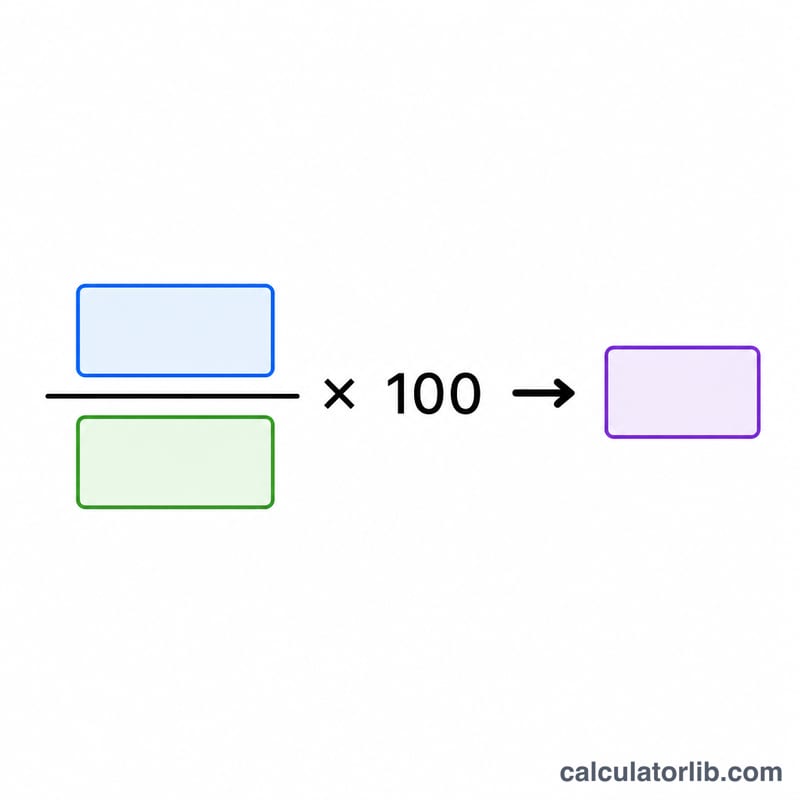
Enter the Nominal GDP (the GDP measured at current-year prices) and the GDP Deflator (a price index where the base year equals 100). The calculator divides nominal GDP by the deflator and multiplies by 100 to express output in base-year prices. The "inflation adjustment" row shows how much of the nominal figure was due to price increases.
The Formula Explained
The relationship is: $$\text{Real GDP} = \frac{\text{Nominal GDP}}{\text{GDP Deflator}} \times 100$$ The deflator is itself defined as \(\frac{\text{Nominal GDP}}{\text{Real GDP}} \times 100\), so the two are inverses of each other. A deflator above 100 means prices have risen since the base year, making real GDP smaller than nominal GDP. A deflator below 100 means prices have fallen, making real GDP larger.
Worked Example
Suppose a country's nominal GDP is $21,000 billion and the GDP deflator is 110. Then $$\text{Real GDP} = \frac{21{,}000}{110} \times 100 = 190.909 \times 100 = 19{,}090.91 \text{ billion}$$ The $1,909.09 billion difference reflects the inflation embedded in the nominal number.
FAQ
What is the GDP deflator? It is a price index covering every good and service in GDP, scaled so the base year equals 100.
Why is real GDP usually lower than nominal GDP? Because in most periods prices rise over time, pushing the deflator above 100 and shrinking the inflation-adjusted figure.
What units should I use? Any consistent currency unit works (dollars, billions, etc.); real GDP comes out in the same units, expressed in base-year prices.