
What This Calculator Does
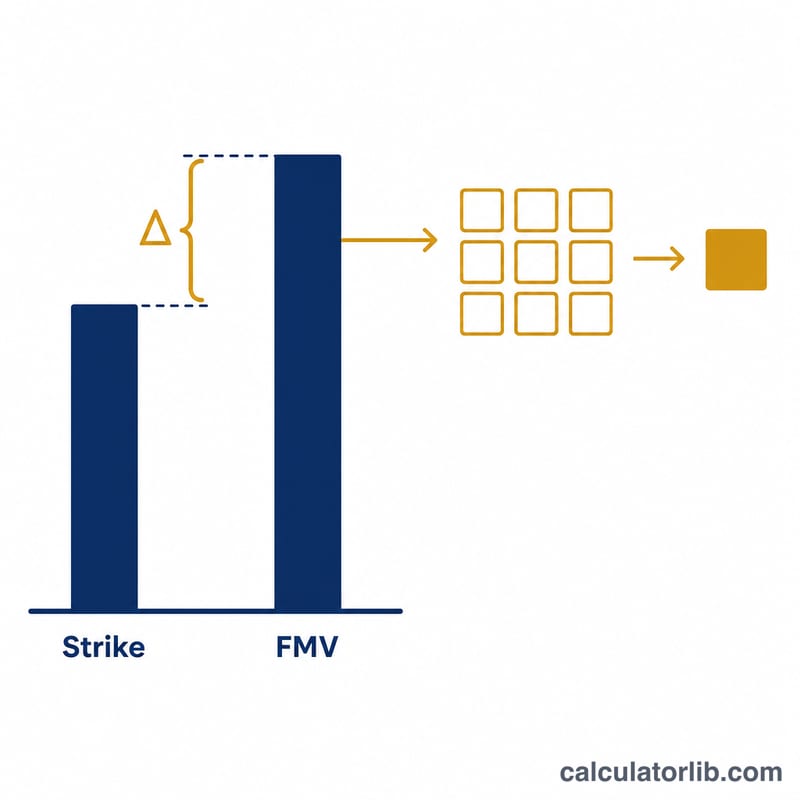
This tool estimates the tax you may owe when you exercise employee stock options in the United States. When you exercise, the difference between the fair market value (FMV) of the shares and your strike (exercise) price is called the bargain element or spread. For Non-Qualified Stock Options (NSOs), this spread is taxed as ordinary income in the year of exercise. For Incentive Stock Options (ISOs), the spread is generally not subject to regular income tax at exercise but may trigger the Alternative Minimum Tax (AMT) — this calculator uses the simple ordinary-income model, which is the standard treatment for NSOs.
How to Use It
Enter the number of shares you plan to exercise, your strike price per share (set in your grant), the current fair market value per share, and your marginal tax rate. The calculator returns the per-share spread, total ordinary income, estimated tax, your cash exercise cost, and the spread net of tax.
The Formula Explained
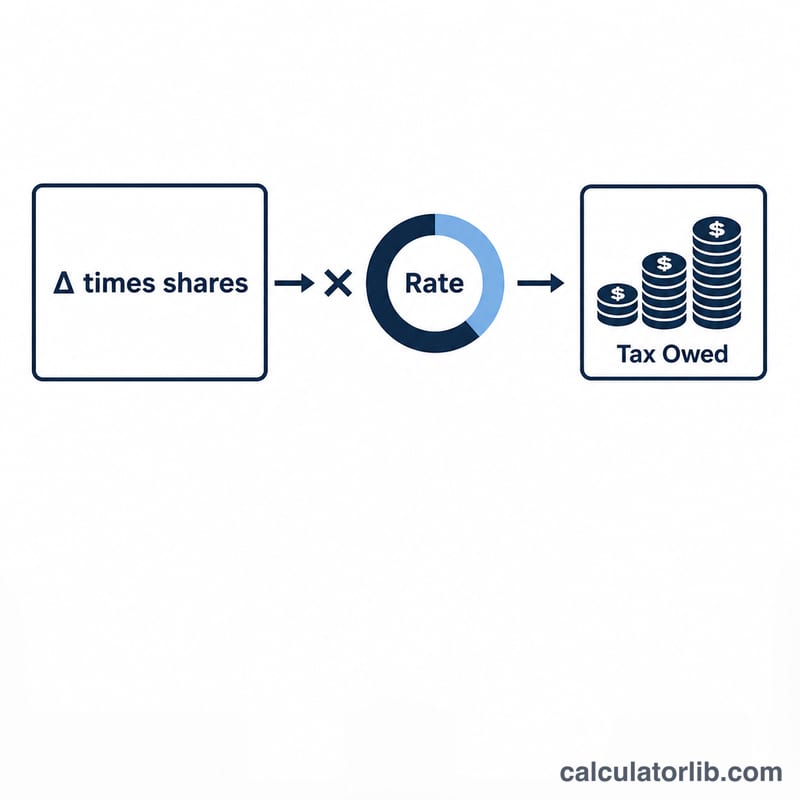
The core math is straightforward: $$\text{Income} = \left(\text{FMV} - \text{Strike}\right) \times \text{Shares}$$ and $$\text{Tax} = \text{Income} \times \text{Rate}$$ The exercise cost — the cash you actually pay to buy the shares — is \(\text{Strike} \times \text{Shares}\) and is shown separately so you can budget for it.
Worked Example
Suppose you exercise 1,000 shares with a strike price of $1.00 when the FMV is $10.00, and your marginal rate is 32%. The spread per share is $9.00, total ordinary income is $9,000, and the estimated tax is $$\$9{,}000 \times 0.32 = \mathbf{\$2{,}880}$$ Your cash exercise cost is $1,000.
FAQ
Does this include AMT for ISOs? No. ISO exercises typically avoid regular income tax but can create an AMT preference item. Consult a tax advisor for AMT modeling.
Is the spread the same as my gain? The spread is the taxable income at exercise. Any further appreciation after exercise is a capital gain taxed when you sell.
What rate should I enter? Use your combined marginal federal (and state, if applicable) rate. For supplemental wages, employers often withhold at a flat 22% federal rate, but your true rate may differ.
This estimate is for planning only and is not tax advice.