What this calculator does
This calculator picks the smallest AWG conductor for a single-phase 240V two-wire circuit (for example an EV charger, electric range, water heater, well pump or welder). It checks two limits at once: the wire must carry the current safely (ampacity), and the voltage drop over the run must stay under your chosen percentage. Ampacities use the 75°C column of the common NEC table for copper and aluminum. Always confirm with the local code and your electrician, as breaker size, insulation type, conduit fill and temperature derating can change the answer.
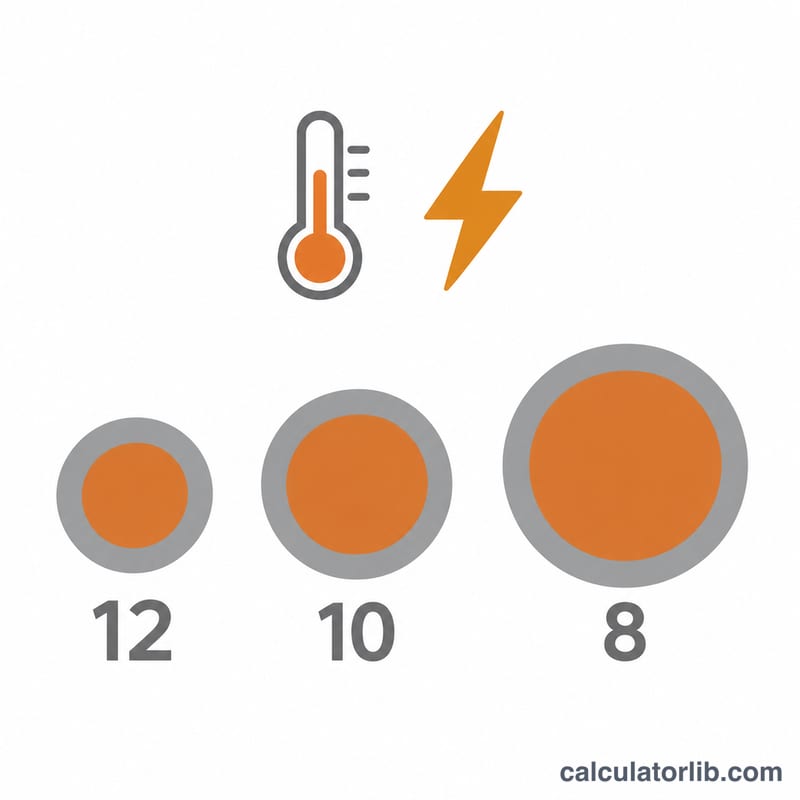
How to use it
Enter the load current, the one-way distance from the panel to the load in feet, the maximum voltage drop (3% is the usual recommendation for a branch circuit), the conductor material, and whether the load is continuous. Continuous loads running three hours or more are sized at 125% of the current.
The formula explained
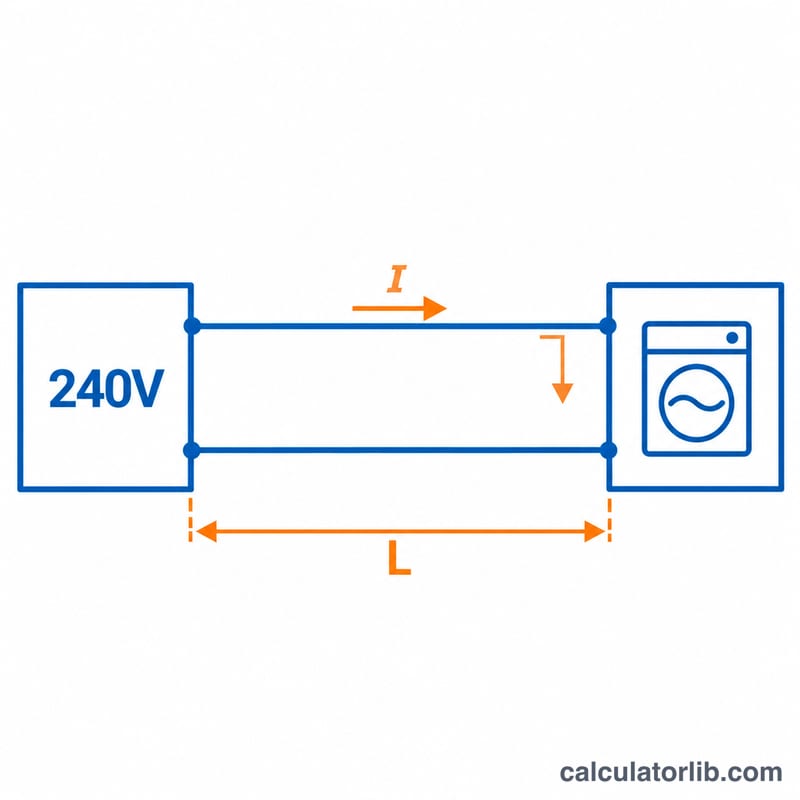
Voltage drop depends on the round-trip length, so the length is doubled:
$$CM = \frac{2 \times K \times I \times L}{V_d}$$Here \(K\) is the resistivity constant (12.9 for copper, 21.2 for aluminum), \(I\) is the current in amps, \(L\) is the one-way length in feet, and \(V_d = 240 \times p/100\) is the allowed drop in volts. The result is compared with the circular mil area of each AWG size, and the first size that also meets the ampacity requirement is selected.
Worked example
A 30 A load, 50 ft away, with a 3% drop limit on copper:
$$V_d = 240 \times 0.03 = 7.2\,\text{V}$$$$CM = \frac{2 \times 12.9 \times 30 \times 50}{7.2} = 5{,}375$$12 AWG (6,530 cmil) satisfies the drop, but its 25 A ampacity is below 30 A, so the answer is 10 AWG (35 A). Its actual drop is \(38{,}700 / 10{,}380 = 3.73\) V, about 1.55%.
AWG Size, Circular Mils and Ampacity Table (75°C)
This table lists the 75°C ampacities from the US National Electrical Code (NEC) Table 310.16 for copper and aluminum conductors, with the circular mil (CM) area of each AWG size. The calculator picks the smallest size whose ampacity is at least the required current and whose CM area is at least the CM needed to meet the voltage drop limit.
| AWG | Circular mils (CM) | Copper ampacity at 75°C (A) | Aluminum ampacity at 75°C (A) |
|---|---|---|---|
| 14 | 4,110 | 20 | not made |
| 12 | 6,530 | 25 | 20 |
| 10 | 10,380 | 35 | 30 |
| 8 | 16,510 | 50 | 40 |
| 6 | 26,240 | 65 | 50 |
| 4 | 41,740 | 85 | 65 |
| 3 | 52,620 | 100 | 75 |
| 2 | 66,360 | 115 | 90 |
| 1 | 83,690 | 130 | 100 |
| 1/0 | 105,600 | 150 | 120 |
| 2/0 | 133,100 | 175 | 135 |
| 3/0 | 167,800 | 200 | 155 |
| 4/0 | 211,600 | 230 | 180 |
Note on small conductors: NEC 240.4(D) (United States) caps the overcurrent protection for the smallest sizes below their table ampacity. For copper this is 15 A for 14 AWG, 20 A for 12 AWG and 30 A for 10 AWG. For aluminum it is 15 A for 12 AWG and 25 A for 10 AWG. So a 10 AWG copper conductor, listed at 35 A in Table 310.16, is normally protected at no more than 30 A. The values above come from NEC Table 310.16 (75°C column). Other countries use different standards and tables, so check your local rules.
Typical 240V Loads: Wire Size by Amps and Distance
Each entry was computed with the page's formula \(\text{CM}_{req} = \frac{2kIL}{V_d}\), where \(k = 12.9\) for copper and \(k = 21.2\) for aluminum, and \(V_d = 240 \times 3/100 = 7.2\) V. The ampacity check uses the 75°C values from the table above. Continuous loads (the 40 A EV charger) are checked at 125%, so the required ampacity is 50 A. The voltage drop calculation uses the actual load current. The gauge is the smaller size that passes both checks. Each cell shows copper / aluminum AWG, with distance as the one-way run.
| Load | Required ampacity (A) | 25 ft | 50 ft | 100 ft | 150 ft |
|---|---|---|---|---|---|
| 30 A dryer or water heater (non-continuous) | 30 | 10 / 10 | 10 / 10 | 8 / 6 | 8 / 4 |
| 40 A EV charger (continuous) | 50 | 8 / 6 | 8 / 6 | 8 / 6 | 6 / 4 |
| 50 A range (non-continuous) | 50 | 8 / 6 | 8 / 6 | 6 / 4 | 4 / 3 |
| 60 A subpanel (non-continuous) | 60 | 6 / 4 | 6 / 4 | 6 / 4 | 4 / 2 |
Worked check (30 A, 100 ft, copper): \(\text{CM}_{req} = \frac{2 \times 12.9 \times 30 \times 100}{7.2} = 10{,}750\). That is above the 10,380 CM of 10 AWG, so the size steps up to 8 AWG (16,510 CM, 50 A ampacity).
Worked check (60 A, 150 ft, aluminum): \(\text{CM}_{req} = \frac{2 \times 21.2 \times 60 \times 150}{7.2} = 53{,}000\). That is just above the 52,620 CM of 3 AWG, so the size steps up to 2 AWG (66,360 CM).
These figures are examples for a 3% voltage drop using NEC 75°C ampacities (United States). Verify the final wire size, the terminal temperature rating, the conduit and ambient adjustments, and the overcurrent protection against your local code and a qualified electrician.
FAQ
Do I use the one-way or round-trip distance?
Enter the one-way distance. The calculator doubles it internally.
Does 240V need a neutral?
A pure 240V load needs only two hot conductors plus a ground; the formula here covers those two current-carrying wires.
Why is aluminum larger?
Aluminum has higher resistivity, so it needs a bigger cross-section for the same drop and ampacity.