What Is the 12V Wire Gauge Calculator?
This tool sizes copper wire for low-voltage 12-volt DC circuits such as automotive, marine, RV, and solar systems. Because 12V systems draw high current for a given power level, undersized wire loses voltage and generates heat. The calculator returns the recommended American Wire Gauge (AWG) that keeps voltage drop within a limit you choose.
How to Use It
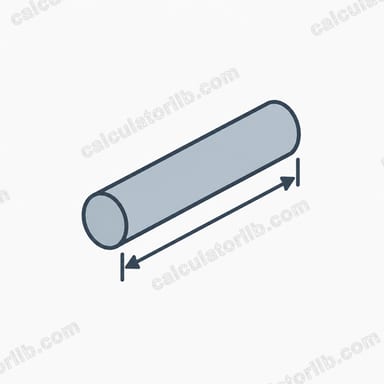
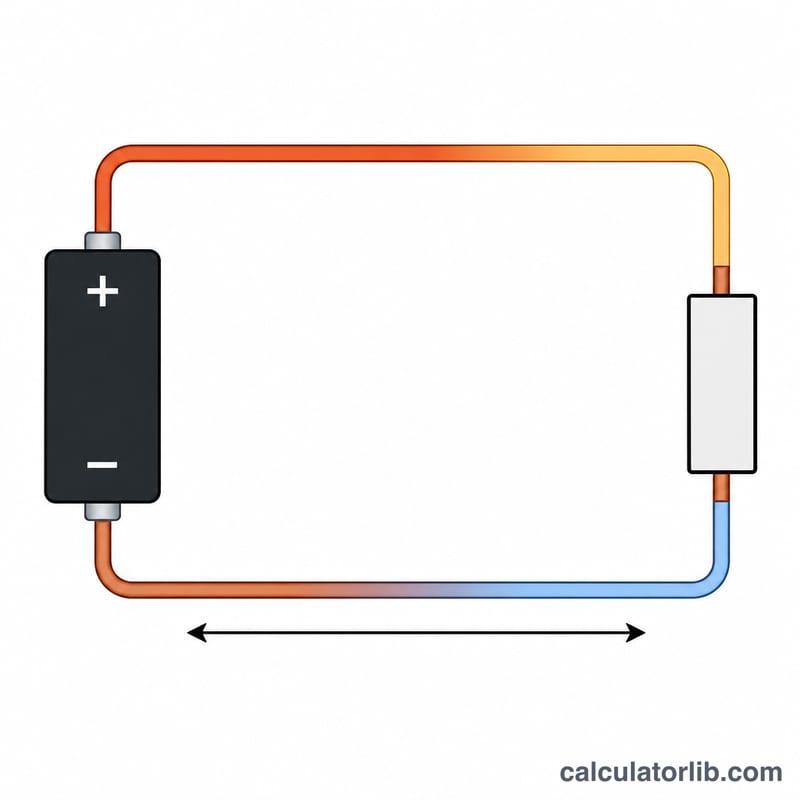
Enter the circuit current in amps, the one-way cable length in feet (the distance from the source to the load, not the round trip), and the allowable voltage drop as a percentage. A 3% drop is common for critical circuits, while 10% is acceptable for non-critical loads. The calculator reports the required circular mils and the recommended gauge.
The Formula Explained
The wire is sized by the voltage-drop method. First the allowable drop in volts is \(V_d = V \times \tfrac{\text{drop\%}}{100}\) with \(V = 12\). The required cross-section in circular mils is:
$$\text{CM} = \frac{2 \times K \times I \times L}{V_d}$$where \(K \approx 10.75\) is the resistivity of copper in ohm-circular-mils per foot, \(I\) is current in amps, and \(L\) is one-way length in feet. The gauge is then \(n = 36 - 19.5\,\frac{\log_{10}(\text{CM}/25)}{\log_{10}(92)}\), rounded down to a thicker wire.
Worked Example
For \(20\) A over \(10\) ft at a 3% drop:
$$V_d = 12 \times 0.03 = 0.36\,\text{V}$$$$\text{CM} = \frac{2 \times 10.75 \times 20 \times 10}{0.36} \approx 11944\,\text{cmil}$$$$n = 36 - 19.5\,\frac{\log_{10}(11944/25)}{\log_{10}(92)} \approx 9.4$$Rounding down gives a recommended 9 AWG copper conductor.
FAQ
Should I use one-way or round-trip length? Enter the one-way distance; the formula already doubles it for the return path.
Why does 12V need thick wire? Low voltage means high current for the same power, so even small resistance causes a large percentage voltage drop.
Is this for copper or aluminum? It uses copper. Aluminum needs roughly two gauge sizes larger for the same current.