What this calculator does
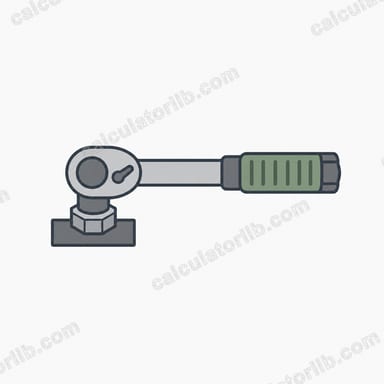
When you add a crowfoot, offset adapter or extension bar to a torque wrench, the effective lever arm gets longer. The wrench clicks at the dial value, but the fastener sees more torque than the dial shows. This calculator gives the lower dial setting that makes the fastener receive the torque you actually want.
How to use it
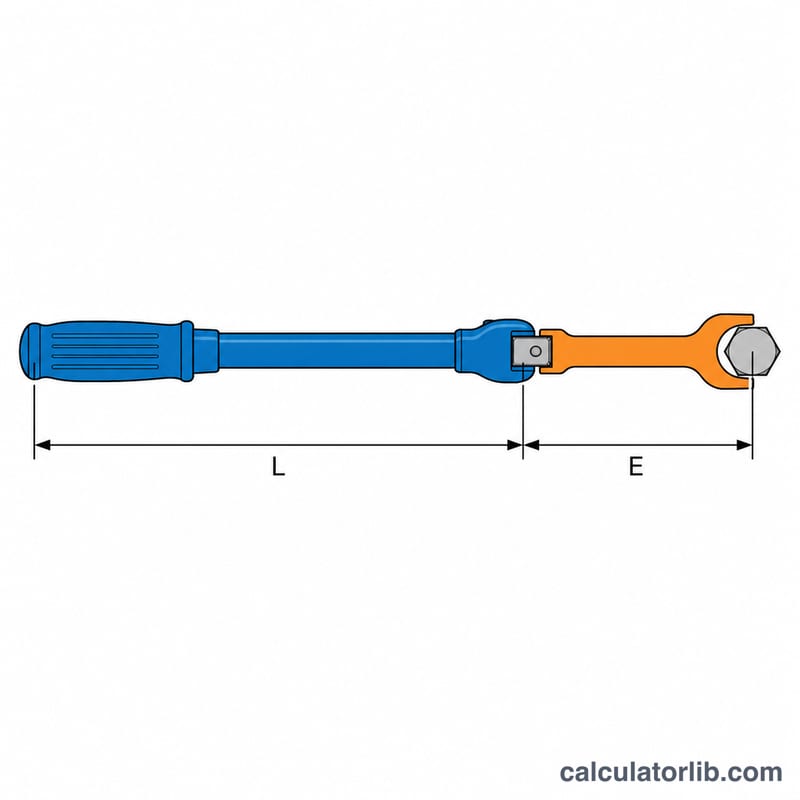
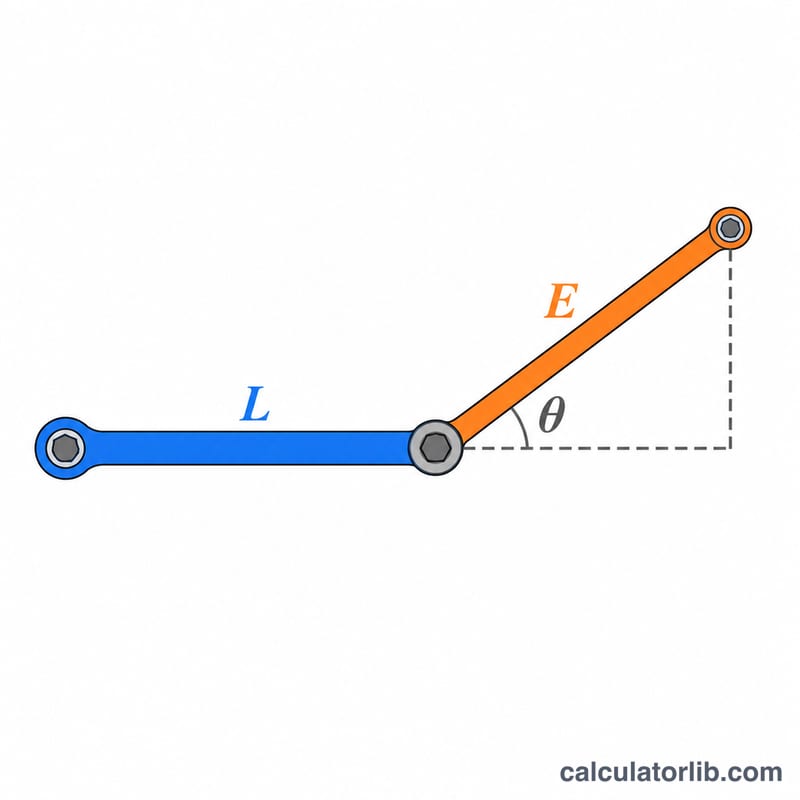
Enter the desired torque at the fastener and pick a unit. Measure the wrench length L from the center of the square drive to the center of the handle grip, and the extension length E from the center of the drive to the center of the fastener end. Use the same length unit for both. If the extension points straight along the wrench, leave the angle at 0. If it sits at an angle, enter it; only the component along the wrench matters.
The formula explained
Torque equals force times distance. The wrench clicks at a fixed force at the handle, so the torque at the fastener scales with the ratio of total length to wrench length:
$$T_{set} = T_{desired} \times \frac{L}{L + E\cos\theta}$$Here \(L\) is the wrench length, \(E\) the extension length and \(\theta\) the angle between extension and wrench. At \(\theta = 90^\circ\) the extension adds no effective length, so no correction is needed.
Worked example
You need 100 ft-lb, your wrench is 18 in and the extension is 3 in, in line:
$$T_{set} = 100 \times \frac{18}{18 + 3} = 85.71\,\text{ft-lb}$$If you left the dial at 100 ft-lb, the fastener would receive \(100 \times 21/18 = 116.67\) ft-lb, which is about 17% too much.
How Extension Length and Angle Change the Dial Setting
The table uses a target of 100 ft-lb at the fastener and an 18 in wrench (L = 18 in). Extension length E is in inches, and the angle θ is measured between the extension and the wrench axis. The adjusted setting is \(T_{set} = T \cdot \frac{L}{L + E\cos\theta}\). If you ignore the extension and dial 100 ft-lb, the fastener actually receives \(100 \cdot \frac{L + E\cos\theta}{L}\), so the over-torque is \(\frac{E\cos\theta}{L}\).
| Extension E (in) | Angle θ | Adjusted dial setting (ft-lb) | Over-torque if uncorrected |
|---|---|---|---|
| 2 | 0° | 90.0 | 11.1% |
| 2 | 45° | 92.7 | 7.9% |
| 2 | 90° | 100.0 | 0% |
| 3 | 0° | 85.7 | 16.7% |
| 3 | 45° | 89.5 | 11.8% |
| 3 | 90° | 100.0 | 0% |
| 6 | 0° | 75.0 | 33.3% |
| 6 | 45° | 80.9 | 23.6% |
| 6 | 90° | 100.0 | 0% |
Example (E = 6 in, θ = 0°): \(T_{set} = 100 \cdot \frac{18}{18 + 6\cos 0°} = 100 \cdot \frac{18}{24} = 75.0\) ft-lb. At 90° the extension is perpendicular to the wrench, so it adds no lever arm and no correction is needed.
Torque and Length Unit Conversions
| Quantity | Conversion |
|---|---|
| Torque | 1 ft-lb = 1.3558 N·m |
| Torque | 1 N·m = 0.7376 ft-lb |
| Torque | 1 in-lb = 0.11298 N·m |
| Torque | 1 ft-lb = 12 in-lb |
| Torque | 1 kgf·m = 9.80665 N·m |
| Length | 1 in = 25.4 mm |
| Length | 1 ft = 304.8 mm (12 in) |
Important: the wrench length L and the extension length E must be in the same unit (both inches, both millimetres, and so on). Only their ratio matters, so the unit itself does not change the result, but mixing units gives a wrong answer. The torque unit you choose applies to both the desired torque and the adjusted setting.
Key Terms
- Crowfoot wrench: an open-ended or flare-nut wrench head that attaches to a square drive. It lets you reach fittings a socket cannot, and it usually extends the lever arm.
- Torque adapter / extension: any extra piece between the torque wrench drive and the fastener (a crowfoot, an extension bar, an offset adapter). If it lies along the wrench axis, it changes the effective length.
- Effective lever arm: the distance from the wrench's pivot (the handle's force point) to the fastener's axis, measured along the direction of the wrench. With an extension it is \(L + E\cos\theta\).
- Dial / set torque (Tset): the value you actually set on the torque wrench so that the fastener receives the desired torque.
- Desired (fastener) torque (T): the torque specified for the fastener, which the fastener should actually receive.
- Wrench length (L): the distance from the wrench's drive center to the handle's load point, usually the center of the grip.
- Extension length (E): the distance from the wrench's drive center to the fastener's center through the extension or crowfoot.
- Angle (θ): the angle between the extension and the wrench axis. At 0° the extension adds its full length, and at 90° it adds none.
- Click vs beam wrench: a click-type wrench is preset and clicks when the set torque is reached. A beam wrench shows the torque on a pointer and scale. Both measure torque at the wrench drive, so an extension changes the torque at the fastener unless you correct for it.
FAQ
Does an extension that is straight in line with the socket change torque?
A plain extension placed between the wrench and socket, in line with the drive, does not change torque. Correction is needed only when the extension lengthens the lever arm, such as a crowfoot pointing along the wrench handle.
Where do I measure the wrench length?
From the center of the drive square to the center of the hand grip, the point where you apply force.
Does this work with click and beam wrenches?
Yes, the geometry is the same, but always follow the manufacturer specifications for critical fasteners.