What is sailboat displacement?
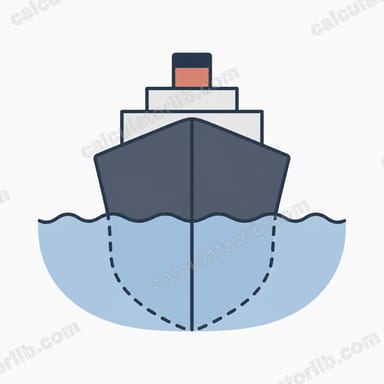
Displacement is the weight of water a floating boat pushes aside, and by Archimedes principle it equals the weight of the boat. It is one of the most important numbers in yacht design because it affects speed, stability, motion comfort and load capacity. This calculator gives a quick estimate from four basic hull dimensions when you do not have the designer figure.
How to use the calculator
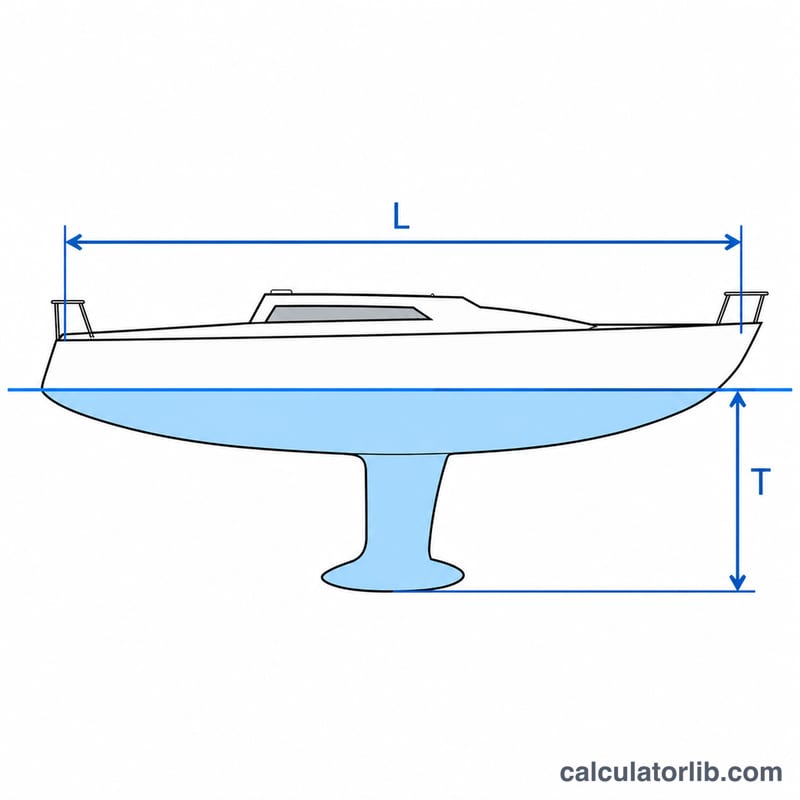
Choose metric or imperial units and the water type (salt or fresh). Enter the waterline length (LWL), the beam at the waterline, the draft of the hull body below the waterline (excluding the keel fin if you want only the hull), and the block coefficient. Typical block coefficients for sailing yachts range from about 0.30 for fin-keel racers to 0.45 or more for heavier cruisers.
The formula explained
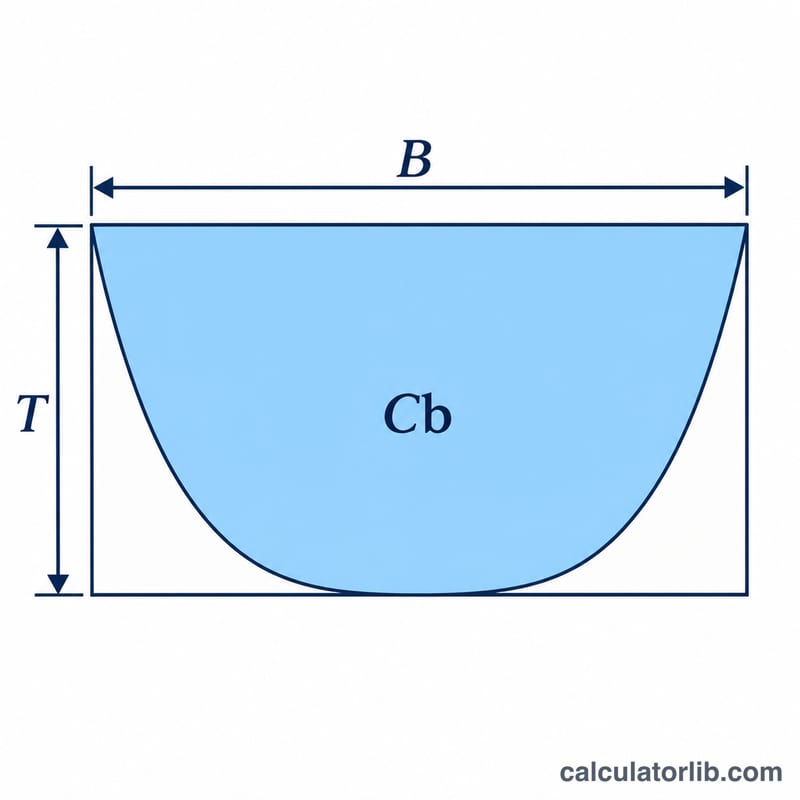
The submerged hull is approximated as a rectangular box, which is then reduced by the block coefficient to account for the hull curved shape:
$$\Delta = L_{wl} \times B \times T \times C_b \times \rho$$Here \(L_{wl}\) is waterline length, \(B\) is beam, \(T\) is draft, \(C_b\) is the block coefficient and \(\rho\) is water density (1025 kg/m³ for sea water, 1000 kg/m³ for fresh water). The displacement-length ratio is then \(D/L = \Delta_{\text{long tons}} / (0.01 \times L_{wl,ft})^3\).
Worked example
A boat has \(L_{wl}=10\) m, \(B=3\) m, \(T=1.5\) m and \(C_b=0.4\) in sea water:
$$V = 10 \times 3 \times 1.5 \times 0.4 = 18\,\text{m}^3$$$$\Delta = 18 \times 1025 = 18{,}450\,\text{kg} \approx 18.45\,\text{tonnes}$$That is roughly 40,675 lb.
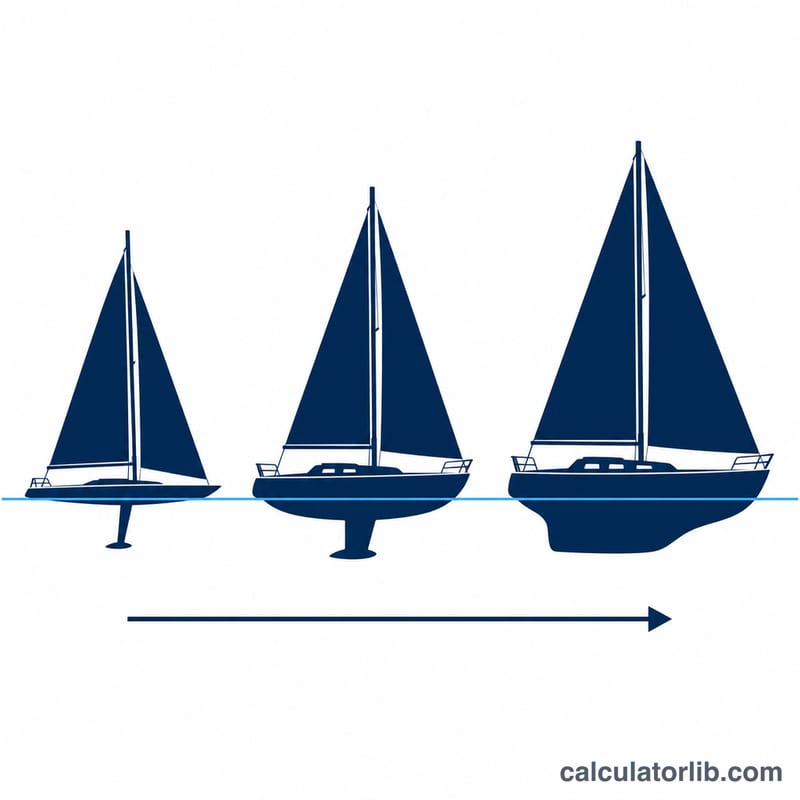
Typical Block Coefficients by Hull Type
The block coefficient \(C_b\) is the ratio of the underwater hull volume to the box formed by waterline length, waterline beam and draft: \(C_b = \nabla / (L \cdot B \cdot T)\). The values below are approximate rules of thumb, not standards. Real boats vary with keel shape, hull form and how draft is measured (with or without the keel). If the designer or builder publishes a displacement or a block coefficient for your boat, use that value instead.
| Hull type | Typical \(C_b\) | Notes |
|---|---|---|
| Ultra-light racer / planing sportboat | ~0.25–0.32 | Flat, wide-sterned, very light, with a shallow canoe body. |
| Modern fin-keel racer-cruiser | ~0.32–0.38 | Separate fin keel and spade or skeg rudder, moderate displacement. |
| Moderate cruiser | ~0.38–0.42 | Fuller sections and a more substantial keel. |
| Heavy full-keel cruiser / traditional | ~0.42–0.50+ | Deep, full-length keel and full sections; classic and long-distance designs. |
| Multihull (catamaran / trimaran) | Per hull, usually at the low end of the range | Hulls are slender. Enter the waterline beam and draft of a single hull, then multiply the result by the number of hulls. |
A higher \(C_b\) gives a heavier boat for the same overall dimensions, so the estimate is sensitive to this input. Treat the output as an estimate, not a measured weight.
Constants and Conversion Values Used
| Quantity | Value |
|---|---|
| Sea water density | 1025 kg/m³ (≈ 64.0 lb/ft³) |
| Fresh water density | 1000 kg/m³ (≈ 62.4 lb/ft³) |
| Length | 1 m = 3.28084 ft (1 ft = 0.3048 m) |
| Mass | 1 kg = 2.20462 lb |
| Long (imperial) ton | 1 long ton = 2240 lb = 1016.047 kg |
| Tonne (metric ton) | 1 tonne = 1000 kg |
| Sea water volume to mass | 1 m³ of sea water = 1025 kg |
The displacement-length ratio uses displacement in long tons and waterline length in feet:
$$\text{D/L} = \frac{ \Delta_{\text{lb}} / 2240}{(0.01 \cdot \text{LWL}_{\text{ft}})^3}$$
Here \(\Delta_{\text{lb}} = 2.20462 \cdot \Delta_{\text{kg}}\) and \(\text{LWL}_{\text{ft}} = \text{LWL}_{\text{m}} / 0.3048\). A lower D/L means a lighter boat for its length.
FAQ
How accurate is this estimate?
It depends heavily on the block coefficient you choose. Use the designer published value when available; otherwise treat the result as a rough figure within perhaps 10 to 20 percent.
Does displacement include the keel?
Only if you include the keel volume in your draft and coefficient. For a fin keel, the ballast adds weight beyond the hull box, so the estimate may run low.
What is a good displacement-length ratio?
Values under about 150 indicate ultra-light boats, 200 to 275 moderate cruisers, and above 300 heavy displacement cruisers.