What Is Ship Displacement?
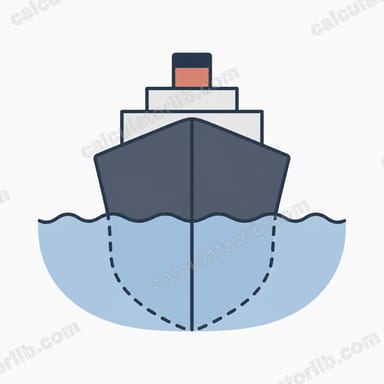
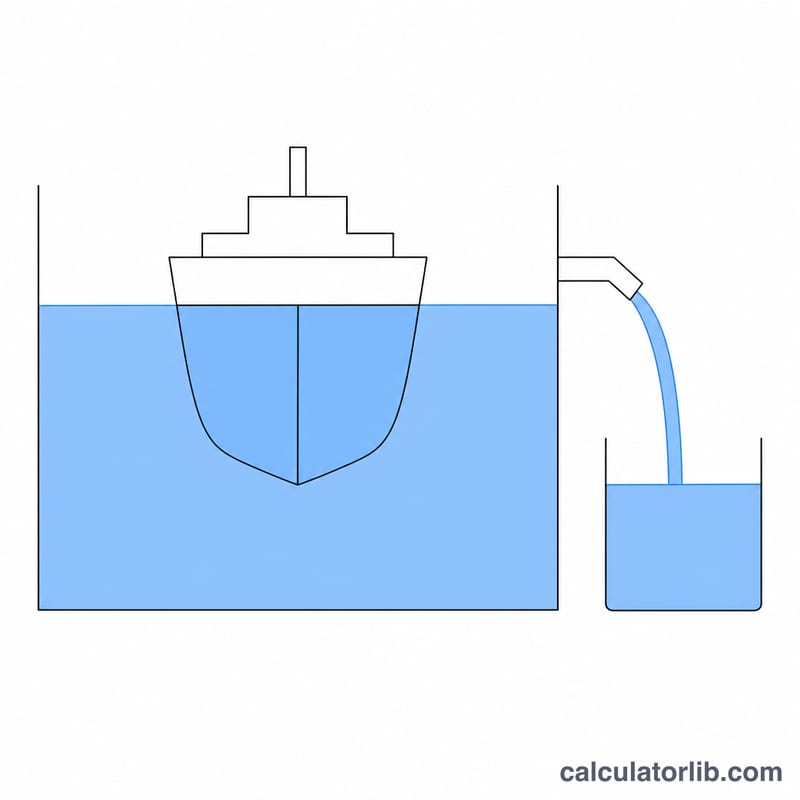
A ship's displacement is the mass of water that its hull pushes aside when it floats. By Archimedes principle, a floating vessel displaces a volume of water whose weight exactly equals the weight of the ship. Naval architects use displacement as the fundamental measure of a vessel's size, far more meaningful than length alone, because it reflects the actual load the hull supports.
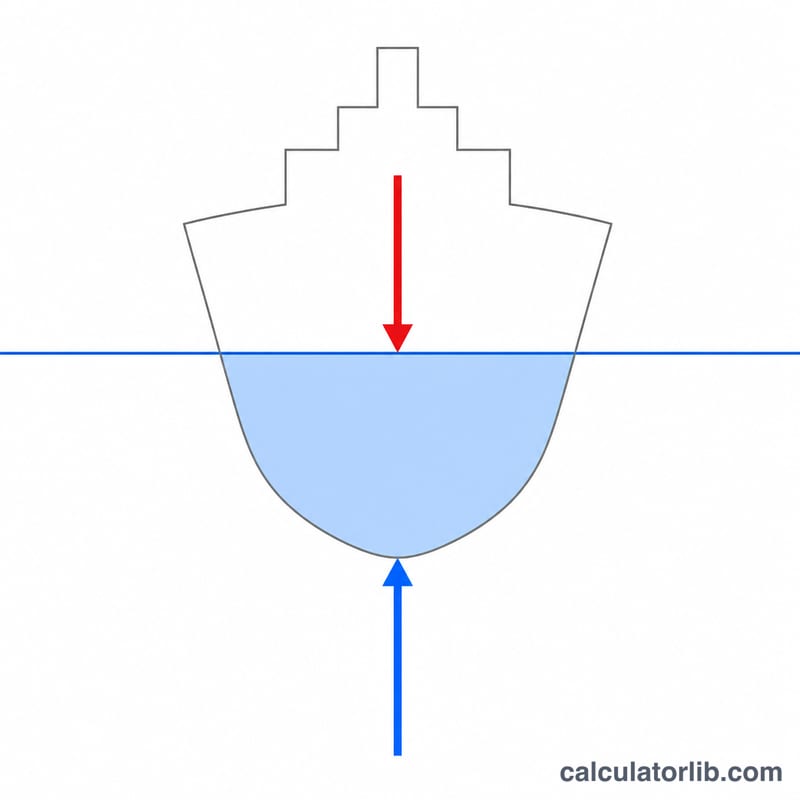
The Formula
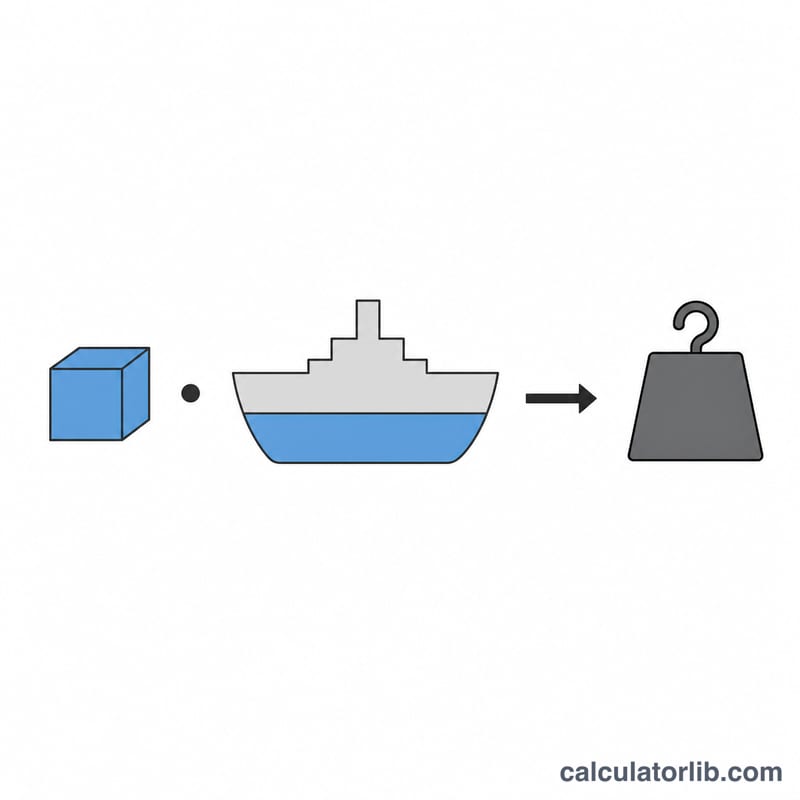
Displacement mass is the product of the water density and the submerged (underwater) hull volume:
$$W = \rho \times V$$where \(W\) = displacement mass in kilograms, \(\rho\) = water density in kg/m³, and \(V\) = submerged hull volume in m³. To express the result in metric tonnes, divide by 1000: \(W_{t} = \tfrac{\rho \times V}{1000}\). Seawater is typically taken as \(1025\) kg/m³, while fresh water is about \(1000\) kg/m³.
How to Use the Calculator
Enter the submerged hull volume in cubic metres and the density of the water the vessel floats in. The default density of \(1025\) kg/m³ represents standard seawater. The calculator returns the displacement in kilograms and in metric tonnes.
Worked Example
Suppose a hull has a submerged volume of \(1000\ \text{m}^3\) floating in seawater at \(1025\) kg/m³:
$$W = 1025 \times 1000 = 1{,}025{,}000\ \text{kg}$$Converting to tonnes gives \(W_{t} = \tfrac{1{,}025{,}000}{1000} = 1025\) metric tonnes.
Typical Water Density Values
The calculator multiplies submerged hull volume by water density. Density depends on temperature and salinity, so the values below are approximate typical figures, not exact constants.
| Water type | Approx. density (kg/m³) | Notes |
|---|---|---|
| Fresh water (at 4°C) | 1000 | Maximum density of pure water |
| Fresh water (at 20°C) | 998 | Typical lake or river temperature |
| Brackish water | 1005–1020 | Estuaries; varies with salinity |
| Standard seawater | 1025 | About 35 g/kg salinity, near surface |
| Dead Sea | 1240 | Extremely salty; roughly 1240 |
Warmer water is slightly less dense and saltier water is denser. For a precise result, use a measured density for the actual water where the vessel floats.
Example: a hull displacing 10,000 m³ in standard seawater has a displacement of \(\frac{1025 \times 10000}{1000} = \) 10250 tonnes.
Interpreting Displacement Results
By Archimedes' principle, a floating vessel displaces a mass of water equal to its own total mass. The result is therefore the ship's total mass in metric tonnes (1 tonne = 1000 kg), not a volume.
Displacement is made up of two parts:
\(\text{Displacement} = \text{Lightship weight} + \text{Deadweight}\)
- Lightship weight: the empty ship, including hull, machinery and permanent equipment, but without cargo, fuel, stores or crew.
- Deadweight: cargo, fuel, fresh water, ballast, provisions, crew and passengers.
Common displacement conditions:
- Light displacement: the vessel in lightship condition, with no deadweight.
- Loaded displacement: the vessel at any given loading condition, with the actual cargo and consumables aboard.
- Full-load displacement: the maximum, with the vessel loaded down to its maximum permitted draft (load line).
The mass of a given ship stays the same when it moves between fresh and salt water, but the submerged volume changes. In denser salt water the ship floats higher and displaces less volume. In fresh water it sinks deeper. If you enter the same hull volume with different densities, you get the displacement for that volume in each water type; it is not the same ship at the same load.
Displacement tonnage should not be confused with other ship measures. Gross tonnage is a dimensionless measure of the ship's enclosed internal volume, and deadweight tonnage is the carrying capacity (deadweight) in tonnes. Displacement is the total mass of the vessel.
FAQ
Why use seawater density of 1025? Salt raises water density, so a ship floats slightly higher and displaces the same weight in a smaller volume than in fresh water.
Is displacement the same as weight? For a freely floating vessel, yes — the displaced water weight equals the vessel weight, so displacement mass equals the ship mass.
What volume should I enter? Only the underwater portion of the hull below the waterline, since that is the part actually displacing water.