What This Calculator Does
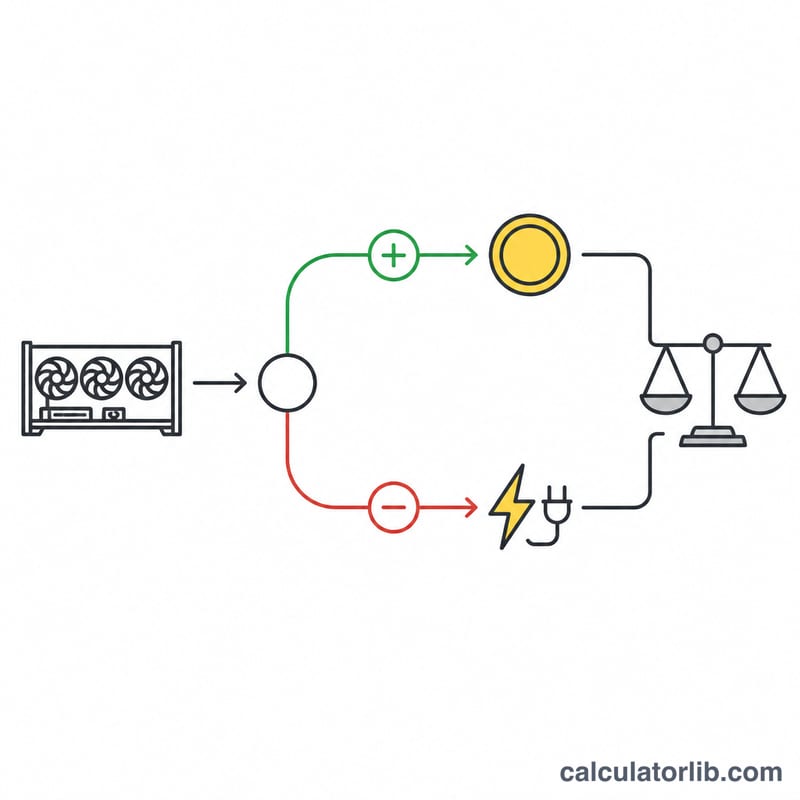
The Ethereum Mining Profitability Calculator estimates how much money a mining rig can earn after subtracting electricity costs. You enter your hardware hash rate, the network reward rate, the current ETH price, your pool fee, your power draw, and your electricity price. The tool then returns your estimated daily ETH mined, daily revenue, daily power cost, and both daily and monthly profit.
How To Use It
Set the hash rate in MH/s for your GPUs or ASIC. Enter a reward rate expressed as ETH earned per MH/s per day (this captures current network difficulty and block rewards). Add the market ETH price, your mining pool fee percentage, the total wattage your rig pulls from the wall, and your electricity cost per kilowatt-hour. Submit to see the profit breakdown.
The Formula Explained
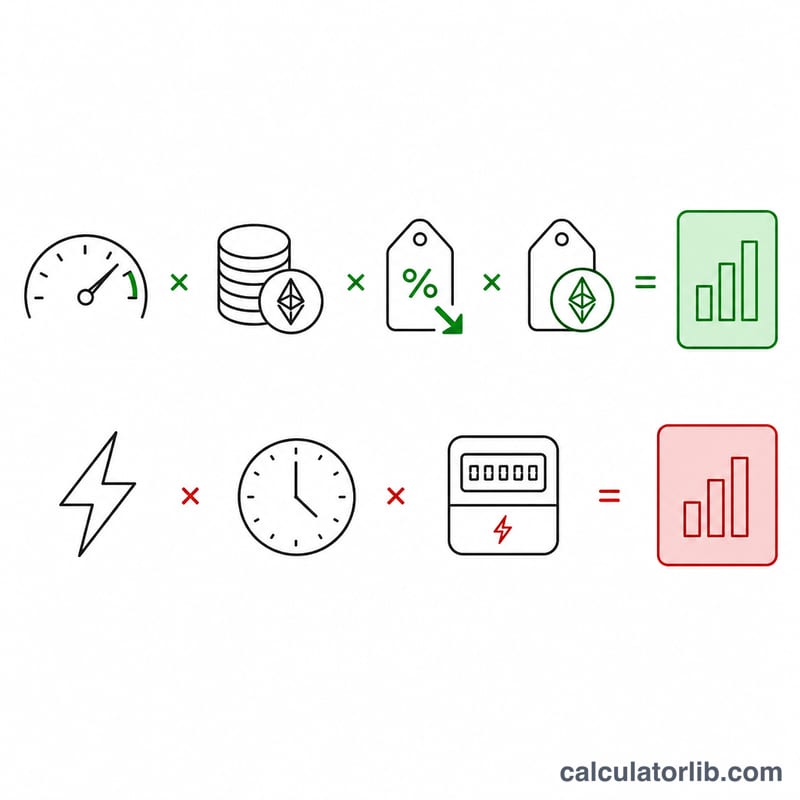
Profit is revenue minus electricity cost. Revenue depends on how much ETH you mine and its price, while cost depends on power draw and your rate. The core equation is:
$$\text{Profit} = (H \times R \times (1 - f)) \times P - \frac{W}{1000} \times 24 \times C$$
where \(H\) = hash rate in MH/s, \(R\) = ETH reward per MH/s per day, \(f\) = pool fee as a fraction, \(P\) = ETH price in USD, \(W\) = power draw in watts, and \(C\) = electricity cost per kWh.
Worked Example
Consider a rig running at 100 MH/s with a reward rate of 0.00001 ETH per MH/s per day, an ETH price of $3,000, no pool fee, 500 watts of power draw, and electricity at $0.10 per kWh. First find the ETH mined and revenue:
$$0.001\,\text{ETH} = 100 \times 0.00001 \times (1 - 0)$$
$$\text{Revenue} = 0.001 \times \$3000 = \$3.00$$
Then the electricity cost and profit:
$$\text{Cost} = \frac{500}{1000} \times 24 \times \$0.10 = \$1.20$$
$$\text{Profit} = \$3.00 - \$1.20 = \$1.80 \text{ per day}$$
Interpreting Your Result (and the 2022 Merge)
Important: Ethereum mainnet switched from proof-of-work to proof-of-stake in The Merge on 15 September 2022. Since then, the network has paid no mining rewards. Blocks are now proposed and validated by stakers, so GPU or ASIC hash power earns nothing on Ethereum. Any real ETH mining reward rate you enter today is effectively zero, and so is the revenue from it.
This calculator is still useful in three ways:
- Historical analysis: estimate what a rig earned before the Merge, using the reward rate and ETH price from that time.
- Hypothetical modelling: test how hash rate, price, pool fee and power cost interact.
- Other proof-of-work coins: model Ethash/Etchash coins such as Ethereum Classic (ETC). Enter that coin's own reward rate per unit of hash rate and that coin's price in the "ETH Price" field. Don't use Ethereum's figures.
What the output means: daily profit is revenue minus electricity cost.
- A positive result means the coins mined (after the pool fee) are worth more than the electricity used.
- A result of zero means the rig is exactly at break-even on running costs.
- A negative result means the rig costs more to run than it earns. On electricity alone, you would be better off switching it off.
Break-even electricity price. If you set profit to zero and solve for the power cost, you get the highest electricity price at which the rig still covers its running costs:
$$C_{\text{break-even}} = \frac{H \cdot R \cdot (1 - f) \cdot P}{(W / 1000) \cdot 24}$$Here \(H\) is the hash rate (MH/s), \(R\) is the reward per MH/s per day, \(f\) is the pool fee as a decimal (a 1% fee gives \(f = 0.01\)), \(P\) is the coin price, and \(W\) is the power draw in watts. The result is in currency per kWh. Example: 100 MH/s, a reward of 0.00001 per MH/s per day, a 0% fee, a $3,000 price and 500 W give:
$$C_{\text{break-even}} = \frac{100 \cdot 0.00001 \cdot (1 - 0) \cdot 3000}{(500/1000) \cdot 24} = \frac{3.00}{12} = 0.25$$So this rig breaks even at $0.25 per kWh. At any lower electricity price, it makes money on running costs.
What the result leaves out: the cost of the hardware and its depreciation, cooling and ventilation, internet and maintenance, changes in the network's difficulty and the coin's price over time, and taxes. A positive daily figure does not mean the investment is profitable overall. These figures are estimates for general information only and are not financial or tax advice.
Scenario Comparison: Electricity Cost and ETH Price
All scenarios use the same illustrative setup: 100 MH/s hash rate, a reward of 0.00001 ETH per MH/s per day, a 0% pool fee and a 500 W power draw. At 500 W the rig uses \(0.5 \text{ kW} \times 24 \text{ h} = 12\) kWh per day.
Daily revenue is \(100 \times 0.00001 \times 1 \times P = 0.001 \times P\). That gives $3.00 per day at $3,000 and $1.50 per day at $1,500. Daily cost is 12 × the electricity price. Monthly profit is daily profit × 30. These are hypothetical figures, not current Ethereum earnings: Ethereum has paid no mining rewards since the 2022 Merge.
| ETH price | Electricity ($/kWh) | Daily revenue | Daily power cost | Daily profit | Monthly profit (×30) |
|---|---|---|---|---|---|
| $3,000 | $0.05 | $3.00 | $0.60 | $2.40 | $72.00 |
| $3,000 | $0.10 | $3.00 | $1.20 | $1.80 | $54.00 |
| $3,000 | $0.20 | $3.00 | $2.40 | $0.60 | $18.00 |
| $3,000 | $0.25 (break-even) | $3.00 | $3.00 | $0.00 | $0.00 |
| $3,000 | $0.30 | $3.00 | $3.60 | −$0.60 | −$18.00 |
| $1,500 | $0.05 | $1.50 | $0.60 | $0.90 | $27.00 |
| $1,500 | $0.10 | $1.50 | $1.20 | $0.30 | $9.00 |
| $1,500 | $0.125 (break-even) | $1.50 | $1.50 | $0.00 | $0.00 |
| $1,500 | $0.20 | $1.50 | $2.40 | −$0.90 | −$27.00 |
| $1,500 | $0.30 | $1.50 | $3.60 | −$2.10 | −$63.00 |
Reading the table: the break-even rows are in bold. At $3,000 the rig covers its electricity up to $0.25/kWh (\(3.00 \div 12\)). At $1,500 the break-even point drops to $0.125/kWh (\(1.50 \div 12\)). Halving the coin price halves revenue and the break-even electricity price, but leaves the power cost unchanged. For example, at $0.10/kWh, daily profit falls from $1.80 to $0.30. That is why rigs on cheap power stay profitable through price drops that push rigs on expensive power into a loss. Adding a pool fee would lower every revenue figure, and the break-even price, by the same percentage.
FAQ
Why use a reward rate per MH/s? Ethereum network difficulty and block rewards change constantly. Expressing them as ETH per MH/s per day lets you plug in a current figure without modeling the entire network.
Does this include hardware cost? No. The calculator covers operating profit only. To find payback time, divide your rig purchase price by the daily profit.
Is monthly profit exact? It multiplies daily profit by 30 as an estimate. Real results vary with price swings, difficulty changes, and downtime.