What It Is
The Aircraft Fuel Consumption Calculator estimates how much fuel an aircraft burns over a flight by combining its average fuel flow rate with the total flight time. It is a foundational tool for flight planning, weight-and-balance work, range estimation, and cost forecasting used by pilots, dispatchers, and aviation students.
The Formula
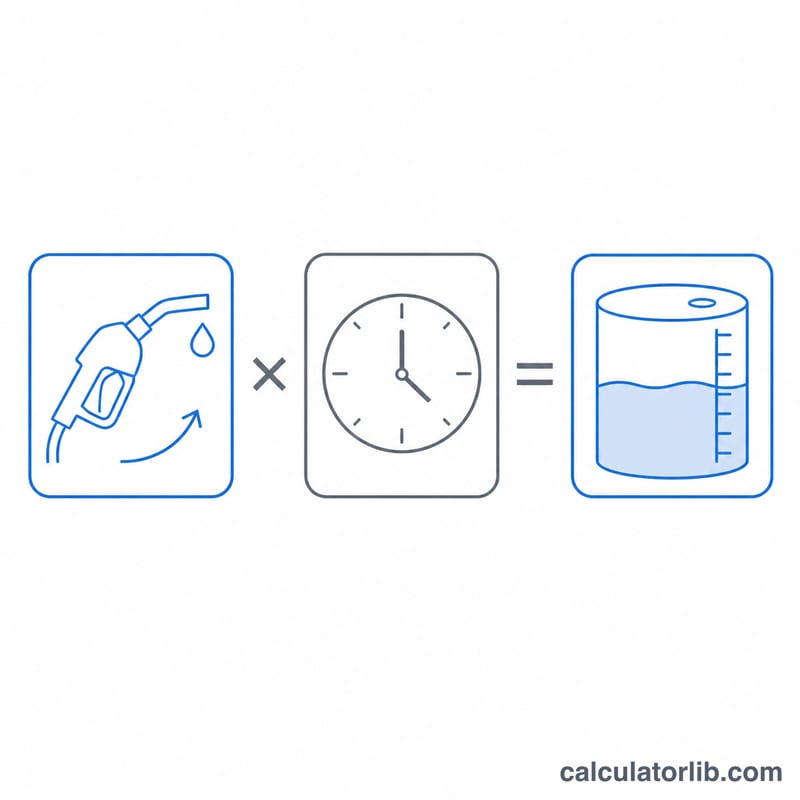
The total fuel consumed is the product of the average fuel flow rate \(\dot{m}\) (in kilograms per hour) and the flight time \(t\) (in hours):
$$\text{Fuel} = \dot{m} \times t$$
Here \(\dot{m}\) = average fuel flow rate in kg/hr and \(t\) = flight time in hours, so the result is expressed in kilograms of fuel. Because both terms are averages, the estimate assumes a steady cruise burn; real flights vary between takeoff, climb, cruise, and descent.
How to Use It
Enter the aircraft average fuel flow rate in kilograms per hour and the planned flight time in hours, then read the total fuel required. For planning, add reserve fuel (typically for 30 to 45 minutes of holding) plus taxi and contingency fuel on top of this cruise figure.
Worked Example
Suppose a turboprop burns \(\dot{m} = 2500\ \text{kg/hr}\) and the flight lasts \(t = 4\ \text{hr}\). The total cruise fuel is:
$$\text{Fuel} = 2500 \times 4 = 10{,}000\ \text{kg}$$
So roughly 10,000 kg of fuel is needed before adding reserves.
Typical Fuel Flow Rates by Aircraft Type
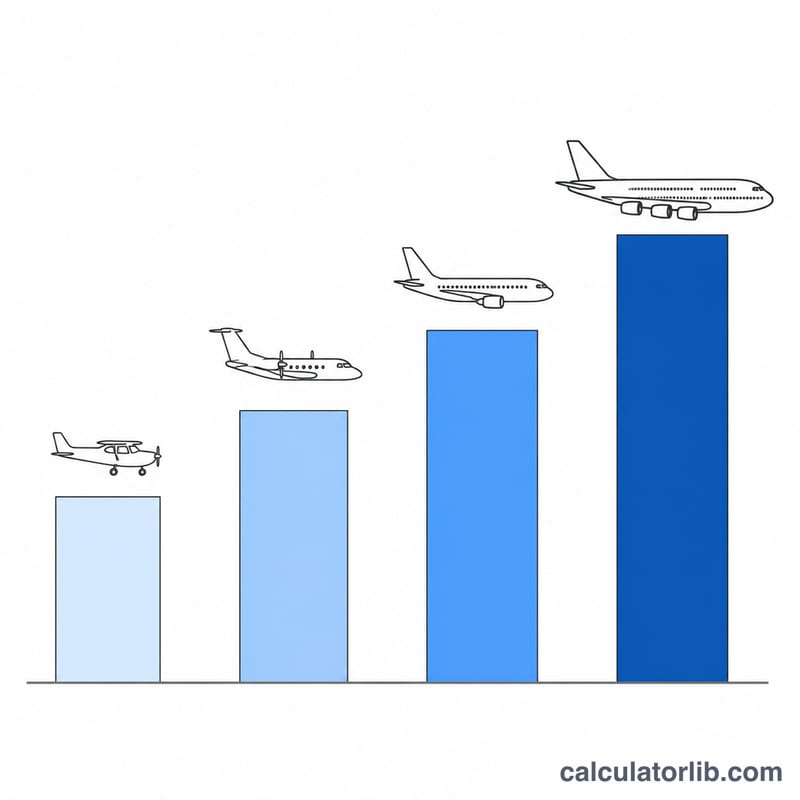
The table below lists representative average cruise fuel flow rates (total for the whole aircraft unless noted) for common aircraft classes, expressed in kilograms per hour (kg/hr). Actual fuel flow varies significantly with weight, altitude, temperature, engine type, and thrust setting, and is far higher during takeoff and initial climb than in cruise. Treat these as rough planning figures only.
| Aircraft class | Example | Approx. cruise fuel flow (kg/hr) |
|---|---|---|
| Light piston single | Cessna 172 | ~30 |
| Light piston twin | Piper Seneca / Baron | ~60–90 |
| Single-engine turboprop | Pilatus PC-12, TBM 900 | ~150–250 |
| Regional turboprop (twin) | ATR 72, Dash 8 Q400 | ~450–650 |
| Regional jet | CRJ900, Embraer E175 | ~1,300–1,800 |
| Narrowbody jet | Airbus A320, Boeing 737 | ~2,400–2,600 |
| Widebody jet | Boeing 777, Airbus A350 | ~6,000–7,000 |
To estimate trip fuel, multiply the cruise flow by the flight time: \( \text{Total Fuel (kg)} = \text{Fuel Flow (kg/hr)} \times \text{Flight Time (hr)} \). For example, an A320-class jet burning about 2,500 kg/hr on a 2.5-hour cruise leg uses roughly \( 2{,}500 \times 2.5 \) = 6,250 kg of cruise fuel. Real flight planning must add taxi, climb, descent, contingency, alternate, and final reserve fuel on top of this cruise burn.
Fuel Unit Conversions
Aviation fuel is measured both by mass (kg, lb) and by volume (liters, US gallons). Mass-based planning is common for jets because engine performance and weight-and-balance depend on mass, while volume is used at the pump. Converting between mass and volume requires the fuel's density. For Jet A (common in the United States) and Jet A-1 (the international grade), a standard reference density of about 0.80 kg/L (roughly 6.7 lb per US gallon) is widely used.
Mass and volume conversions (exact)
| From | To | Multiply by |
|---|---|---|
| kilograms (kg) | pounds (lb) | 2.20462 |
| pounds (lb) | kilograms (kg) | 0.453592 |
| US gallons | liters (L) | 3.78541 |
| liters (L) | US gallons | 0.264172 |
Mass ↔ volume (Jet A / Jet A-1, density ≈ 0.80 kg/L)
| From | To | Approx. factor |
|---|---|---|
| liters (L) | kilograms (kg) | × 0.80 |
| kilograms (kg) | liters (L) | × 1.25 |
| US gallons | kilograms (kg) | × 3.03 |
| US gallons | pounds (lb) | × 6.7 |
The volume-based factors are derived from the density: 1 L × 0.80 kg/L = 0.80 kg, and 1 US gal × 3.78541 L/gal × 0.80 kg/L ≈ 3.03 kg (≈ 6.7 lb). Note that mass conversions (kg ↔ lb) and volume conversions (L ↔ US gal) are exact and fuel-independent, but any conversion between mass and volume depends on the actual fuel type and its temperature. Jet fuel density typically ranges from about 0.775 to 0.840 kg/L and decreases as temperature rises, so use the density shown on the actual fuel receipt or fueling order for accurate planning rather than the 0.80 kg/L nominal value.
FAQ
Does this include reserve fuel? No. It gives the trip burn only; always add regulatory reserve, taxi, and contingency fuel.
Can I use different units? Yes, as long as they are consistent. If flow is in liters per hour, the result is in liters.
Why is my real burn higher? Climb, weather, weight, and air traffic delays raise consumption above a flat cruise-rate estimate.