What this calculator does
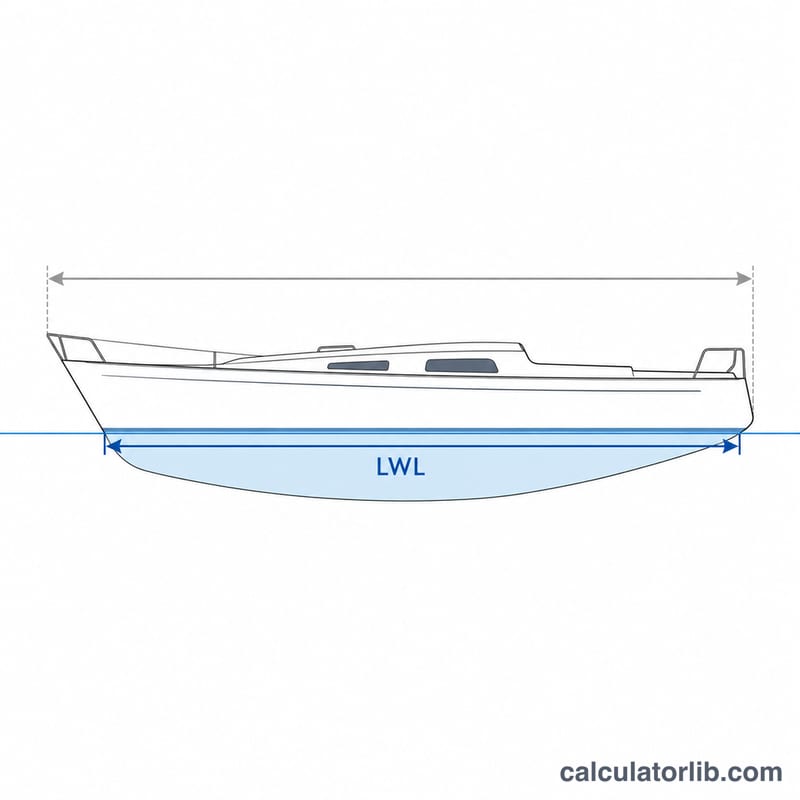
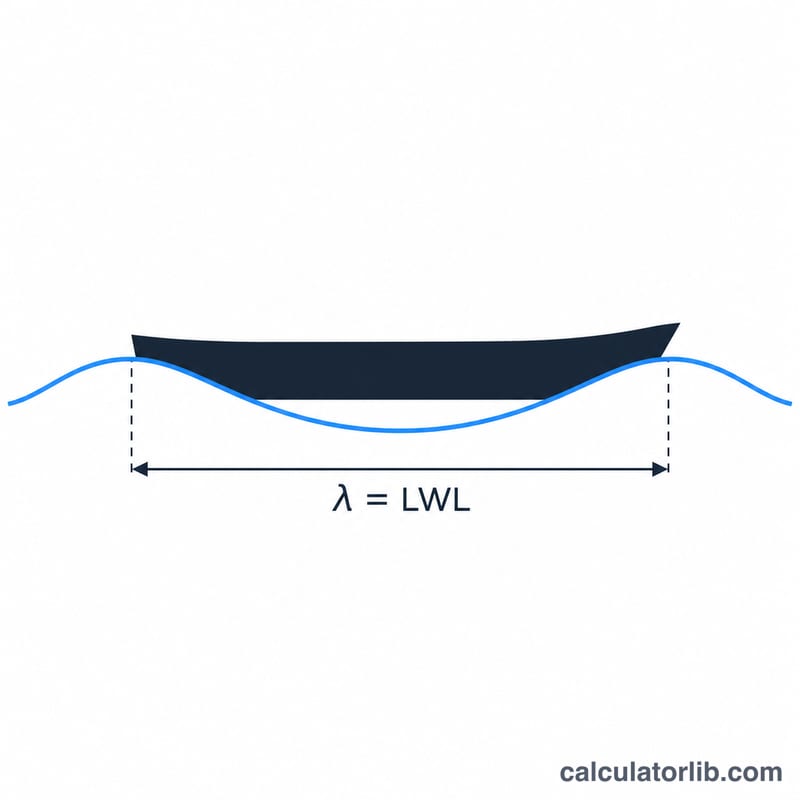
A displacement boat moves by pushing water aside rather than lifting onto it. As it speeds up, the wave it generates gets longer, and when that wave is as long as the hull itself the boat sits in a trough of its own making. The speed at which this happens is called hull speed, and it is the practical top speed of any non-planing sailboat, trawler, canal boat or traditional launch. This tool computes it from the one dimension that matters: length at the waterline (LWL), not overall length.
The formula explained
Hull speed follows from wave mechanics in deep water, where wave speed is proportional to the square root of wave length:
$$V_{\text{hull}} = C \times \sqrt{L_{WL}}$$Here \(V_{\text{hull}}\) = speed in knots, \(L_{WL}\) = waterline length in feet, and \(C\) = the speed-length ratio, classically \(1.34\). Heavy, full-ended hulls behave more like \(C = 1.2\); light, fine displacement hulls can stretch to \(C = 1.4\) or \(1.5\). If you enter meters, the calculator converts first using \(1\,\text{m} = 3.28084\,\text{ft}\).
Worked example
Take a cruising sailboat with a 25 ft waterline and the standard coefficient:
$$V_{\text{hull}} = 1.34 \times \sqrt{25} = 1.34 \times 5 = 6.7\,\text{knots}$$Converting: \(6.7 \times 1.15078 = 7.71\,\text{mph}\) and \(6.7 \times 1.852 = 12.41\,\text{km/h}\). Over a full day of motoring that is \(6.7 \times 24 = 160.8\) nautical miles, a useful number for passage planning.
Speed-Length Ratio (C) by Hull Type
The hull-speed formula \(V_{\text{hull}} = C \times \sqrt{L_{WL}}\) (knots, with \(L_{WL}\) in feet) is not a single fixed law — the coefficient \(C\) is the speed-length ratio at which a given hull stops being able to climb its own bow wave economically. Fuller, heavier, blunter-ended hulls stall at a lower \(C\); long, slender, fine-ended hulls push past the classic value.
The classic \(C = 1.34\) comes from the deep-water gravity-wave speed relation. A free surface wave of length \(\lambda\) travels at \(c = \sqrt{g\lambda / 2\pi}\); setting the wave length equal to the waterline length gives \(V = \sqrt{g L_{WL}/2\pi}\), and converting \(g = 32.174\ \text{ft/s}^2\) into knots-per-root-foot yields
$$C = \sqrt{\frac{g}{2\pi}} \div 1.68781 = \frac{2.2628}{1.68781} \approx 1.34$$So \(C = 1.34\) is simply the speed at which the boat's own transverse wave system has a wavelength equal to its waterline — a Froude number \(Fr \approx 0.40\). Hull form decides how closely a real boat approaches, or exceeds, that number. The displacement/length ratio quoted below is the common English-unit form \(DLR = \Delta_{\text{long tons}} / (0.01\,L_{WL\,\text{ft}})^3\), widely used in US and UK yacht-design practice.
| Hull type / description | Typical \(C\) | Form character | Notes |
|---|---|---|---|
| Heavy full-keel traditional cruisers, canal and narrowboats, barges, heavy workboats | 1.15 – 1.25 | Very high DLR (roughly 350+), full bilges, blunt or barge-like ends, wide relative to length; canal boats are additionally slowed by shallow, confined water | These hulls build a steep, breaking stern wave well before \(1.34\sqrt{L_{WL}}\). Use \(C \approx 1.2\) for realistic cruising estimates; canal craft in restricted channels are often limited further by speed rules and bank wash, not by the hull at all. |
| Classic and moderate-displacement sailboats, displacement trawler yachts, motorsailers, lifeboat-type hulls | ≈ 1.34 | Moderate DLR (roughly 250 – 350), balanced ends, beam/length ratio around 1:3 to 1:3.5 | The Froude-derived reference value and the default for most hull-speed quotes. A well-powered trawler can hold this figure; a sailboat reaches it only in fresh breeze, since the power needed rises very steeply in the last fraction of a knot. |
| Light, fine-ended displacement hulls; long slender displacement forms such as multihull hulls, rowing shells, racing canoes and narrow catamaran demihulls | 1.4 – 1.5 (slender hulls far higher) | Low DLR (roughly 150 – 250 or less), fine entry and exit, high length/beam ratio — multihull hulls are commonly 8:1 to 12:1 or more | Fine ends make a smaller wave, so the hull slips past the nominal barrier. For very slender hulls (length/beam above about 10) the wave-making limit becomes so weak that the hull-speed concept loses meaning — a racing shell or an ocean rowing boat is limited by available power, not by \(\sqrt{L_{WL}}\). |
| Semi-displacement / semi-planing hulls (fast motor yachts, pilot boats, many fast ferries) | 1.6 – 2.0+ | Hard or soft chines, flattened aft sections, immersed transom, generous installed power | Outside the formula's validity. These hulls generate dynamic lift and transit the hump with enough power rather than being stopped by it. Entering \(C\) above about 1.5 produces a number the formula was never derived for. |
| Planing hulls (runabouts, sport boats, RIBs) | Not applicable | Flat or vee bottom, chines, high power-to-weight ratio | Once on plane the boat is supported mostly by hydrodynamic lift, not buoyancy, so speed scales with power, loading and deadrise — \(\sqrt{L_{WL}}\) has no predictive value. Use a planing-speed method (e.g. Crouch's formula) instead. |
Two practical cautions. First, hull speed is a soft economic knee, not a wall: given enough power a displacement hull can exceed it, and surfing down a wave face a sailboat routinely does — it simply costs disproportionate power or borrowed wave energy. Second, the formula assumes deep, unrestricted water; in shallow water the limiting wave speed drops toward \(\sqrt{g h}\) (where \(h\) is depth), which is exactly why the same boat feels sluggish and drags a huge wake in a shallow canal.
Hull Speed by Waterline Length
All knot figures below are \(C \times \sqrt{L_{WL}}\) with \(L_{WL}\) in feet, converted with 1 kn = 1.15078 mph = 1.852 km/h. The 24-hour column is simply \(24 \times V_{\text{hull}}\) in nautical miles — the theoretical best-case day's run at \(C = 1.34\), useful as an upper bound for passage planning.
| LWL (ft) | LWL (m) | Hull speed, C = 1.34 (kn) | mph | km/h | 24 h run (nm) | Heavy hull, C = 1.2 (kn) |
|---|---|---|---|---|---|---|
| 12 | 3.66 | 4.64 | 5.34 | 8.60 | 111 | 4.16 |
| 16 | 4.88 | 5.36 | 6.17 | 9.93 | 129 | 4.80 |
| 20 | 6.10 | 5.99 | 6.90 | 11.10 | 144 | 5.37 |
| 25 | 7.62 | 6.70 | 7.71 | 12.41 | 161 | 6.00 |
| 30 | 9.14 | 7.34 | 8.44 | 13.59 | 176 | 6.57 |
| 35 | 10.67 | 7.93 | 9.12 | 14.68 | 190 | 7.10 |
| 40 | 12.19 | 8.47 | 9.75 | 15.70 | 203 | 7.59 |
| 50 | 15.24 | 9.48 | 10.90 | 17.55 | 227 | 8.49 |
| 65 | 19.81 | 10.80 | 12.43 | 20.01 | 259 | 9.67 |
Worked check on the 30 ft row:
$$V_{\text{hull}} = 1.34 \times \sqrt{30} = 1.34 \times 5.4772 = 7.34\ \text{kn}$$$$V_{\text{mph}} = 1.15078 \times 7.34 = 8.44\ \text{mph} \qquad V_{\text{km/h}} = 1.852 \times 7.34 = 13.59\ \text{km/h}$$$$D_{\text{day}} = 24 \times 7.34 = 176\ \text{nm}$$If you prefer metric input, the same relation is \(V_{\text{hull}} \approx 2.43 \times \sqrt{L_{WL\,\text{m}}}\) in knots — for 9.14 m, \(2.43 \times 3.023 = 7.35\) kn, matching the row above.
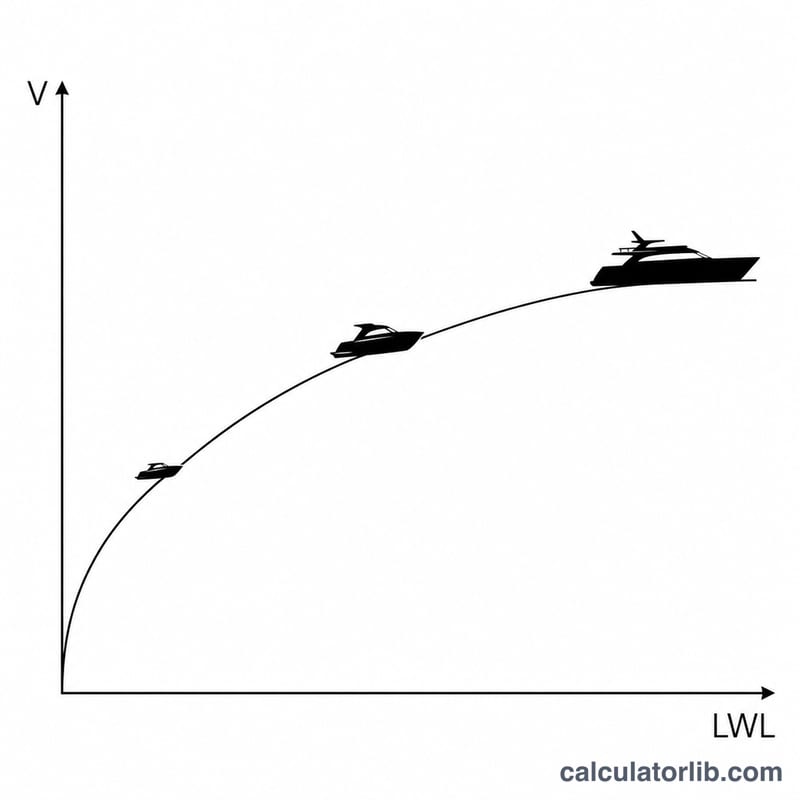
The square root dominates everything. Doubling waterline length does not double hull speed — it multiplies it by \(\sqrt{2} \approx 1.414\), about a 41% gain. The 30 ft boat makes 7.34 kn; the 60 ft boat makes \(1.34\sqrt{60} = 10.38\) kn, which is 7.34 × 1.414. Over a 24-hour run that is 176 nm versus 249 nm. It is also why overhangs matter: a traditional hull that immerses its counter when heeled gains effective LWL and a little speed with it, while loading a boat down by the bow or stern changes LWL far less than owners usually hope. For planning, treat the \(C = 1.34\) column as a ceiling and budget a real average of perhaps 70–85% of it, since current, sea state, fouling and the steep power demand near hull speed all eat into the theoretical figure.
FAQ
Why waterline length instead of overall length? The wave the hull makes is set by the part actually in the water. Long overhangs add nothing until the boat heels and immerses them, which is why a heeled sailboat can momentarily exceed its upright hull speed.
Can a boat go faster than hull speed? Yes, but not economically. Power demand rises steeply near the limit, so a displacement hull needs enormous thrust for a fraction of a knot. Semi-displacement and planing hulls escape by rising over their bow wave; this calculator does not apply to them.
Is hull speed relevant for a dinghy or powerboat? Only below planing speed. Light dinghies and fast powerboats plane and are limited by power and hull form, not by wave-making.