What this calculator does
Bagged compound fertilizer rarely matches the ratio your soil test asks for, and buying a custom blend is expensive in small quantities. This calculator turns a target analysis - for example a 10-10-10 - into a weighing list: how many kilograms of a nitrogen source, a phosphate source, a potash source and inert filler to combine for a batch of any size. It works in whatever mass unit you type, so kilograms and pounds both behave correctly, and nutrient percentages follow the international N-P2O5-K2O label convention used worldwide.
How to use it
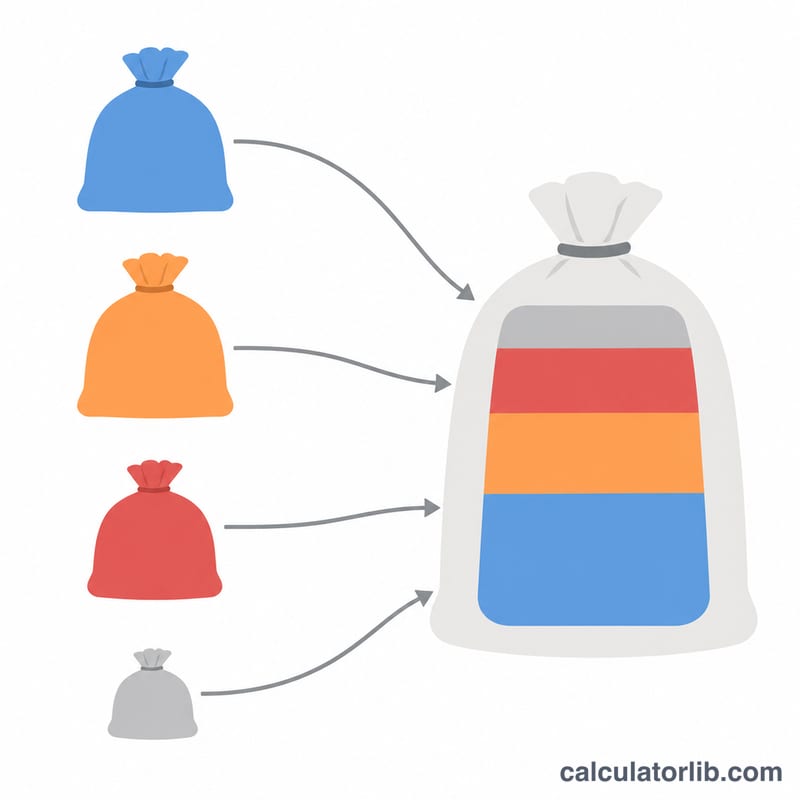
Enter the finished batch weight, then the three target percentages. Next copy the analysis numbers straight off your bags: urea is typically 46-0-0, diammonium phosphate (DAP) 18-46-0 and muriate of potash 0-0-60. Because DAP carries nitrogen as well as phosphate, the calculator sizes the potash and phosphate first, counts the nitrogen that arrives with the phosphate, and only then adds enough of the nitrogen source to close the gap.
The formula
For each nutrient the required source mass is the nutrient mass divided by the source concentration, with \(B\) = batch weight, \(T\) = target percentage and \(A\) = label percentage:
$$m_{\text{source}} = \frac{B \times T/100}{A/100}$$then nitrogen is corrected for what the phosphate already supplied, and the remainder of the batch is filler:
$$m_N = \frac{B T_N/100 - m_P A_{PN}/100}{A_{NN}/100}, \qquad F = B - (m_N + m_P + m_K)$$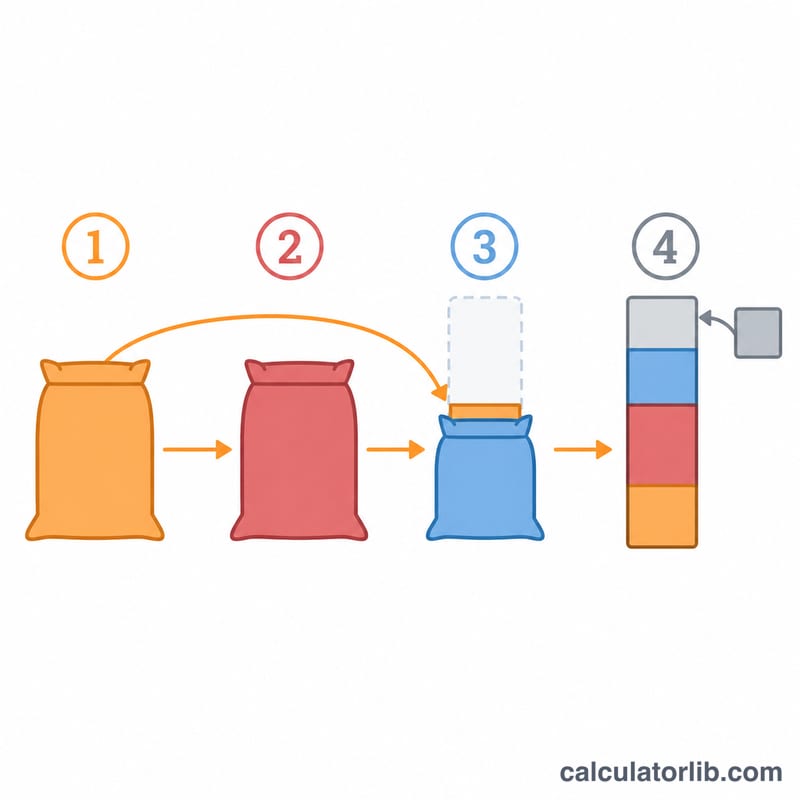
Worked example
Make 100 kg of 10-10-10 from urea, DAP and MOP. Each nutrient target is 10 kg. Potash first:
$$m_K = \frac{10}{0.60} = 16.67\,\text{kg}$$Phosphate next, which also brings nitrogen:
$$m_P = \frac{10}{0.46} = 21.74\,\text{kg}, \quad N_{\text{from P}} = 21.74 \times 0.18 = 3.91\,\text{kg}$$$$m_N = \frac{10 - 3.91}{0.46} = 13.23\,\text{kg}$$Total nutrient sources are 51.64 kg, so 48.36 kg of sand, dry soil or composted bark finishes the 100 kg batch.
Common Fertilizer Source Analyses (N-P₂O₅-K₂O)
Dry blending works by drawing each nutrient from a straight (single-nutrient or two-nutrient) fertilizer of known analysis. The grade printed on the bag is written in the order N – P₂O₅ – K₂O, which is the labelling convention used in the United States, Canada, the United Kingdom, India and most international fertilizer trade. A few countries and some technical datasheets instead quote elemental N – P – K, which gives smaller P and K numbers for the same product, so check which convention a label or recommendation uses before entering numbers into the calculator.
| Product | Abbreviation | N (%) | P₂O₅ (%) | K₂O (%) | Secondary nutrients |
|---|---|---|---|---|---|
| Urea | — | 46 | 0 | 0 | None |
| Ammonium nitrate | AN | 34 | 0 | 0 | None |
| Ammonium sulfate | AS / SOA | 21 | 0 | 0 | ~24% S |
| Calcium ammonium nitrate | CAN | 27 | 0 | 0 | ~6–8% Ca (as CaO) |
| Diammonium phosphate | DAP | 18 | 46 | 0 | Trace S in some grades |
| Monoammonium phosphate | MAP | 11 | 52 | 0 | Trace S in some grades |
| Triple superphosphate | TSP | 0 | 46 | 0 | ~13–15% Ca, ~1% S |
| Single superphosphate | SSP | 0 | 16 | 0 | ~19–20% Ca, ~11–12% S |
| Muriate of potash (potassium chloride) | MOP / KCl | 0 | 0 | 60 | ~46% Cl |
| Sulfate of potash (potassium sulfate) | SOP / K₂SO₄ | 0 | 0 | 50 | ~18% S |
| Potassium nitrate | NOP / KNO₃ | 13 | 0 | 46 | None |
These are the standard commercial grades, but the exact analysis varies by supplier, ore source and region — MOP is sold as 0-0-60 in some markets and 0-0-61 or 0-0-62 in others, and SSP ranges from about 0-16-0 to 0-20-0 depending on the rock phosphate used. Always enter the figures from the bag label or the supplier's certificate of analysis rather than the table values; the label wins, because that is what you are actually weighing out.
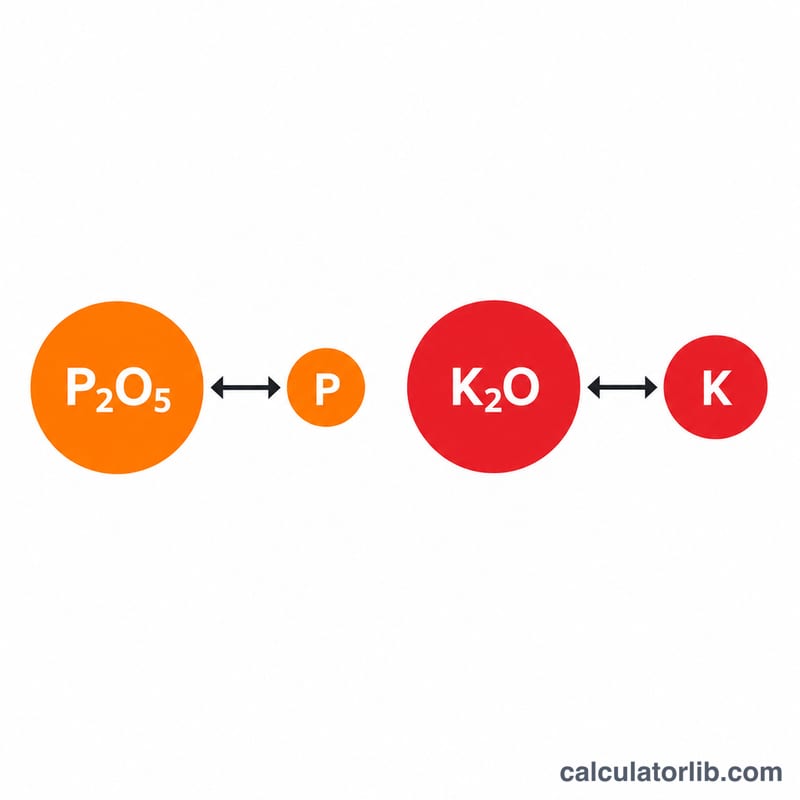
P₂O₅ ↔ P and K₂O ↔ K Conversions
Fertilizer labels state phosphorus and potassium as oxides (P₂O₅ and K₂O), while soil test reports, plant tissue analyses and many scientific papers use the elements (P and K). Converting is a single multiplication by the mass fraction of the element in the oxide.
| Convert from | To | Multiply by | Example |
|---|---|---|---|
| P₂O₅ | P | 0.4364 | \(50 \times 0.4364 = 21.82\) kg P |
| P | P₂O₅ | 2.291 | \(20 \times 2.291 = 45.82\) kg P₂O₅ |
| K₂O | K | 0.8301 | \(60 \times 0.8301 = 49.81\) kg K |
| K | K₂O | 1.205 | \(40 \times 1.205 = 48.20\) kg K₂O |
| SO₄ (sulfate) | S | 0.3338 | \(30 \times 0.3338 = 10.01\) kg S |
| CaO | Ca | 0.7147 | \(25 \times 0.7147 = 17.87\) kg Ca |
| MgO | Mg | 0.6032 | \(15 \times 0.6032 = 9.05\) kg Mg |
Reading a grade. A 10-10-10 bag contains 10% N, 10% P₂O₅ and 10% K₂O by mass — so 100 kg of it carries 10 kg N, 10 kg P₂O₅ and 10 kg K₂O. In elemental terms that is
$$10 \times 0.4364 = 4.36\ \text{kg P} \qquad 10 \times 0.8301 = 8.30\ \text{kg K}$$i.e. roughly a 10-4.4-8.3 analysis on an N-P-K basis. The oxide numbers are always the larger ones, which is why a "balanced" 10-10-10 is not actually balanced between the three elements.
Mass and rate units. For converting a mixing sheet or an application rate between metric and US/imperial units:
- \(1\ \text{kg} = 2.2046\ \text{lb}\); \(1\ \text{lb} = 0.4536\ \text{kg}\)
- \(1\ \text{kg/ha} = 0.892\ \text{lb/acre}\); \(1\ \text{lb/acre} = 1.121\ \text{kg/ha}\)
- \(1\ \text{hectare} = 2.471\ \text{acres}\)
So a 150 kg/ha rate of a blend is \(150 \times 0.892 = 133.8\) lb/acre, and a 100 lb/acre rate is \(100 \times 1.121 = 112.1\) kg/ha.
FAQ
Why do I need filler at all? Concentrated sources supply the nutrients in far less than 100 kg of material. Filler spreads them evenly so a handful or a spreader setting delivers the intended rate.
Can I skip the filler? Yes - mix only the three sources and treat the result as a stronger blend, then apply proportionally less. The ratio between N, P and K is unchanged.
What if the phosphate source supplies too much nitrogen? The calculator flags it and drops the nitrogen source to zero. Use a low-nitrogen phosphate such as triple superphosphate (0-46-0) to hit a low-N ratio exactly.