What This Calculator Does
Stoichiometry is the arithmetic of chemical reactions: it links how much of one substance you have to how much of another substance reacts or forms. This calculator performs the classic three-step mass-to-mass conversion for any balanced equation, in any unit system — it is pure chemistry, so it applies worldwide with no country-specific assumptions.
How to Use It
First balance your equation by hand. Then choose whether your known quantity is a mass in grams or an amount in moles, and enter the stoichiometric coefficient \(a\) and molar mass \(M_{known}\) of the species you know, together with the coefficient \(b\) and molar mass \(M_{target}\) of the species you want. The calculator reports the target amount in both moles and grams.
The Formula Explained
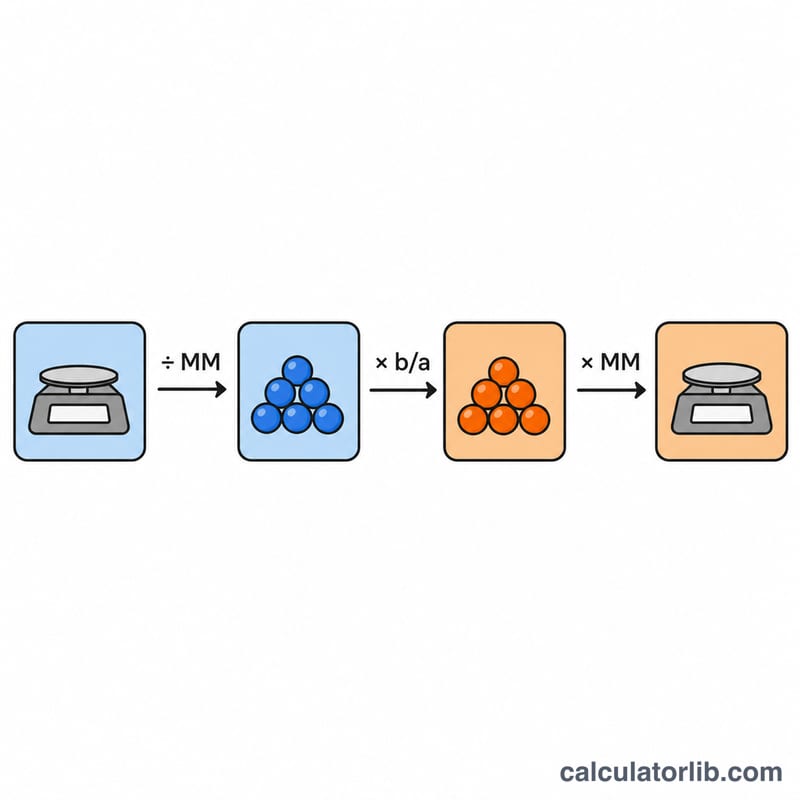
The full chain, where \(m\) = mass in grams, \(n\) = amount in moles and \(M\) = molar mass in g/mol, is:
$$m_{target} = \frac{m_{known}}{M_{known}} \times \frac{b}{a} \times M_{target}$$The first factor converts grams to moles, the middle factor \(\frac{b}{a}\) is the mole ratio read directly off the balanced equation, and the last factor converts moles back to grams. Only the ratio of coefficients matters, so doubling the whole equation changes nothing.
Worked Example
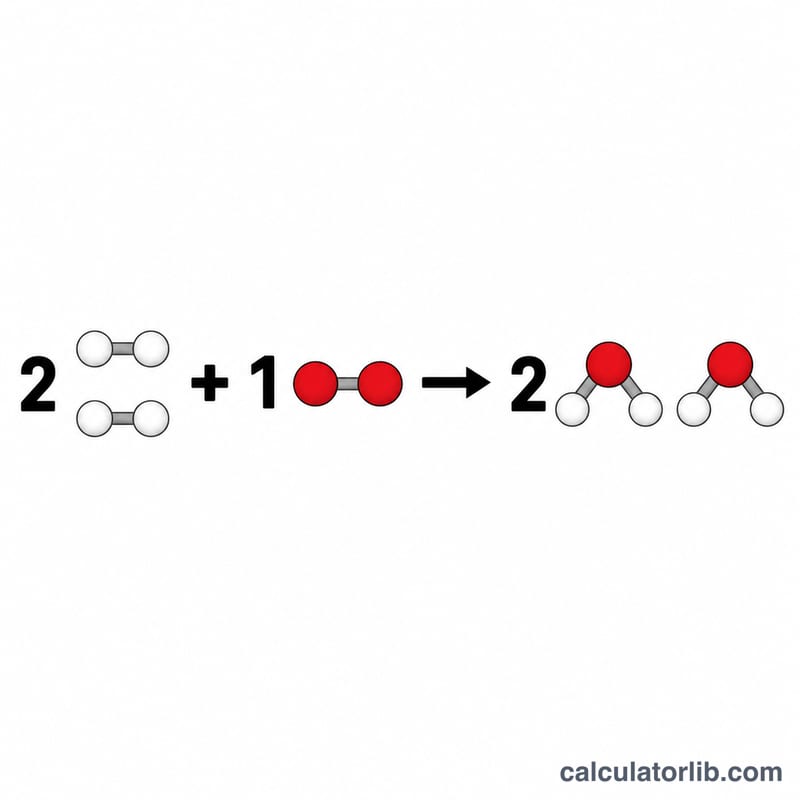
Burn 10 g of hydrogen in the reaction 2 H2 + O2 → 2 H2O. Here \(a = 2\), \(M_{known} = 2.016\), \(b = 2\) and \(M_{target} = 18.015\):
$$n_{H_2} = \frac{10}{2.016} = 4.9603\,\text{mol}$$$$m_{H_2O} = 4.9603 \times \frac{2}{2} \times 18.015 = 89.36\,\text{g}$$So 10 g of hydrogen yields about 89.4 g of water.
Molar Masses of Common Substances
The molar mass \(M\) (in g/mol) is the bridge between the mass you weigh out and the moles the balanced equation actually counts. The values below are computed from the IUPAC 2021 table of standard atomic weights (an international standard, not a national one) and rounded to 4 significant figures — ample precision for ordinary stoichiometry work.
| Substance | Formula | Molar mass (g/mol) |
|---|---|---|
| Hydrogen gas | H2 | 2.016 |
| Oxygen gas | O2 | 32.00 |
| Nitrogen gas | N2 | 28.01 |
| Chlorine gas | Cl2 | 70.90 |
| Water | H2O | 18.02 |
| Carbon dioxide | CO2 | 44.01 |
| Carbon monoxide | CO | 28.01 |
| Ammonia | NH3 | 17.03 |
| Methane | CH4 | 16.04 |
| Ethanol | C2H6O | 46.07 |
| Glucose | C6H12O6 | 180.16 |
| Sodium chloride | NaCl | 58.44 |
| Sodium hydroxide | NaOH | 40.00 |
| Hydrogen chloride | HCl | 36.46 |
| Sulfuric acid | H2SO4 | 98.08 |
| Calcium carbonate | CaCO3 | 100.09 |
| Calcium oxide (lime) | CaO | 56.08 |
| Iron(III) oxide | Fe2O3 | 159.69 |
| Aluminium oxide | Al2O3 | 101.96 |
| Potassium permanganate | KMnO4 | 158.03 |
Building M for any formula
For a species not listed, sum each element's atomic weight multiplied by its subscript in the formula:
$$M = \sum_i n_i \, A_i$$where \(n_i\) is the number of atoms of element \(i\) and \(A_i\) its standard atomic weight. Useful atomic weights (IUPAC 2021): H 1.008, C 12.011, N 14.007, O 15.999, Na 22.990, S 32.06, Cl 35.45, K 39.098, Ca 40.078, Fe 55.845, Al 26.982.
Example — sulfuric acid, H2SO4:
$$M = 2(1.008) + 1(32.06) + 4(15.999) = 2.016 + 32.06 + 63.996 = 98.07\ \text{g/mol}$$Small differences in the last digit (98.07 versus the tabulated 98.08) come only from rounding the intermediate sums; they do not affect a 3-significant-figure answer. Multiply the whole bracketed group when a formula contains parentheses — for Ca(OH)2, \(M = 40.078 + 2(15.999 + 1.008) = 74.09\) g/mol. For hydrates such as CuSO4·5H2O, add 5 × 18.02 g/mol for the water of crystallisation.
FAQ
Does the equation have to be balanced? Yes. The mole ratio is meaningless otherwise, and the calculator cannot detect an unbalanced equation for you.
What about the limiting reactant? This tool assumes the species you enter as known is the limiting one. Run the calculation for each reactant separately; the one giving the smallest product amount is limiting.
Why is my lab yield lower? The result is the theoretical yield. Actual yield is lower because of side reactions and losses: multiply by percent yield / 100.