What is a buffer solution calculator?
A buffer solution resists changes in pH when small amounts of acid or base are added. This calculator uses the Henderson-Hasselbalch equation to tell you exactly how much weak acid and conjugate base you need to hit a target pH. Enter the target pH, the acid dissociation constant \(\text{p}K_a\), the total buffer concentration \(C\), and the volume \(V\), and it returns the required moles and concentrations of each component.
The formula explained
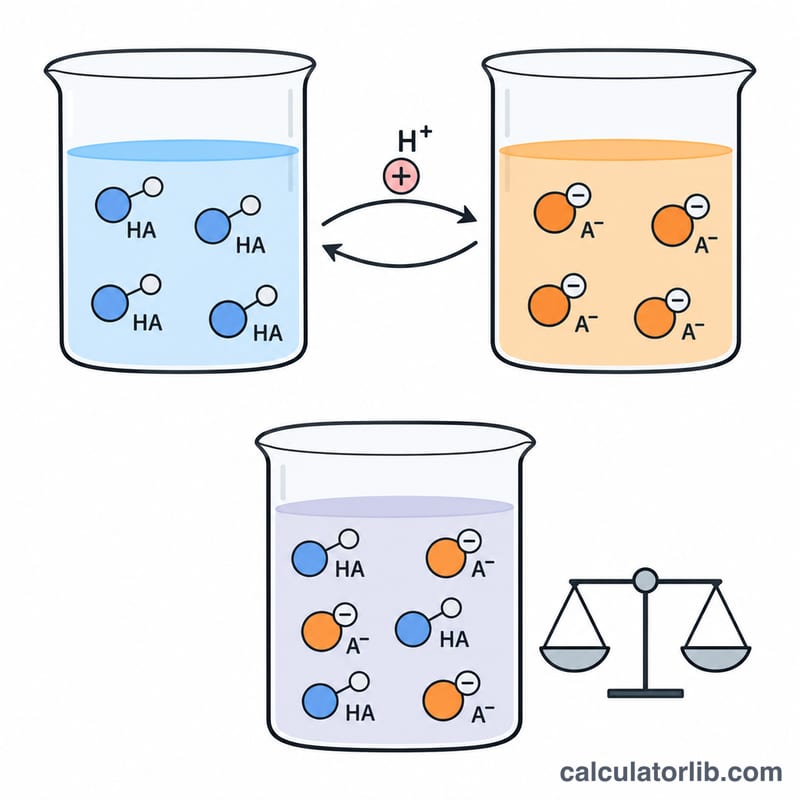
The pH of a buffer is governed by the ratio of conjugate base to weak acid:
$$\text{pH} = \text{p}K_a + \log_{10}\frac{[\text{A}^-]}{[\text{HA}]}$$Rearranging gives the mole ratio \(R = 10^{\,\text{pH} - \text{p}K_a}\). With a fixed total concentration \(C\) and volume \(V\), the amounts of each species are:
$$n_{\text{HA}} = \frac{C\,V}{1 + R}, \qquad n_{\text{A}^-} = \frac{C\,V\,R}{1 + R}$$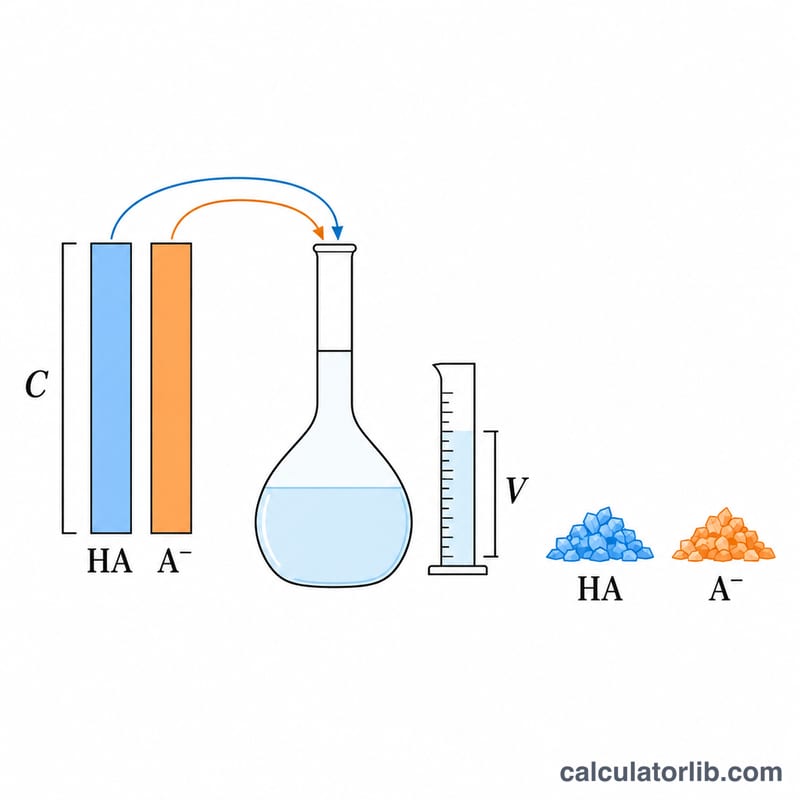
How to use it
Look up the \(\text{p}K_a\) of your weak acid; for acetic acid it is \(4.76\). Choose the pH you want and the total molarity of the buffer. The tool computes the ratio \(R\) and splits the total concentration between acid and base, then multiplies by the volume to give the moles you can weigh out or pipette.
Worked example
Prepare 1 L of a 0.1 mol/L acetate buffer at pH 5.00 with \(\text{p}K_a = 4.76\):
$$R = 10^{5.00 - 4.76} = 10^{0.24} = 1.738$$$$n_{\text{HA}} = \frac{0.1 \times 1}{1 + 1.738} = 0.0365\ \text{mol}$$$$n_{\text{A}^-} = 0.1 - 0.0365 = 0.0635\ \text{mol}$$So you combine about 0.0365 mol of acetic acid with 0.0635 mol of sodium acetate and dilute to 1 L.
pKa Values of Common Buffer Systems
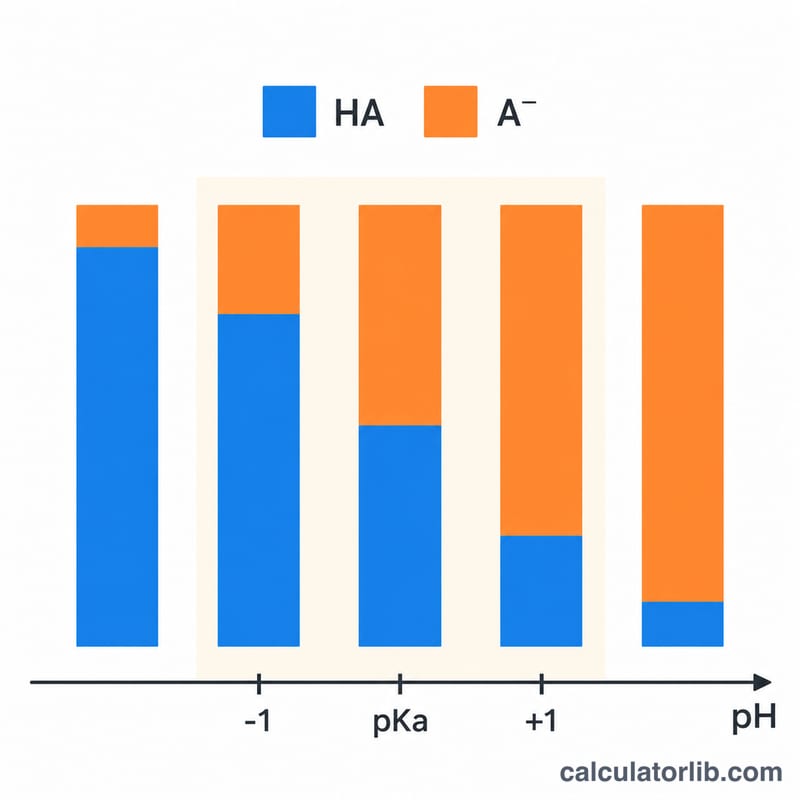
A buffer works best when the target pH is within about one unit of the weak acid's pKa. In that range the ratio \(R = [\text{A}^-]/[\text{HA}]\) stays between 0.1 and 10. Choose the acid/conjugate-base pair whose pKa is closest to your target pH, then enter that pKa in the calculator. Values in the table are typical literature values at 25 °C.
| Buffer system (acid / conjugate base) | pKa at 25 °C | Effective pH range (pKa ± 1) |
|---|---|---|
| Acetic acid / acetate | 4.76 | 3.76 – 5.76 |
| Citric acid / dihydrogen citrate (pKa1) | 3.13 | 2.13 – 4.13 |
| Dihydrogen citrate / hydrogen citrate (pKa2) | 4.76 | 3.76 – 5.76 |
| Hydrogen citrate / citrate (pKa3) | 6.40 | 5.40 – 7.40 |
| Formic acid / formate | 3.75 | 2.75 – 4.75 |
| Phosphoric acid / H2PO4− (pKa1) | 2.15 | 1.15 – 3.15 |
| H2PO4− / HPO42− (pKa2) | 7.20 | 6.20 – 8.20 |
| HPO42− / PO43− (pKa3) | 12.35 | 11.35 – 13.35 |
| Carbonic acid / bicarbonate | 6.35 | 5.35 – 7.35 |
| Bicarbonate / carbonate | 10.33 | 9.33 – 11.33 |
| Tris-H+ / Tris | 8.07 | 7.07 – 9.07 |
| HEPES | 7.5 | 6.5 – 8.5 |
| MES | 6.15 | 5.15 – 7.15 |
| Ammonium / ammonia | 9.25 | 8.25 – 10.25 |
| Boric acid / borate | 9.24 | 8.24 – 10.24 |
For polyprotic acids such as citric and phosphoric acid, use the pKa of the step that brackets your target pH. For example, use 7.20 for a phosphate buffer near neutral pH. The 6.35 value for carbonic acid is the apparent pKa, which counts dissolved CO2 as part of the acid.
All values apply at 25 °C and low ionic strength. pKa changes with temperature and salt concentration. Tris is especially sensitive: its pKa falls by about 0.028 units per °C. A Tris buffer made to pH 8.07 at 25 °C will therefore be noticeably more alkaline at 4 °C and less alkaline at 37 °C. If your buffer will be used at another temperature or ionic strength, use a pKa corrected for those conditions.
How Target pH Changes the Acid/Base Split
This table uses an acetate buffer with a total concentration of 0.1 mol/L, a volume of 1 L and pKa = 4.76. Total buffer is fixed at 0.100 mol. Changing the target pH only changes how that total is split between acetic acid (HA) and acetate (A−):
$$R = 10^{\,\text{pH} - 4.76}, \qquad n_{\text{HA}} = \frac{0.1 \times 1}{1+R}, \qquad n_{\text{A}^-} = \frac{0.1 \times 1 \cdot R}{1+R}$$| Target pH | pH − pKa | R = 10(pH−pKa) | nHA (mol) | nA− (mol) |
|---|---|---|---|---|
| 3.76 | −1.00 | 0.100 | 0.0909 | 0.0091 |
| 4.26 | −0.50 | 0.316 | 0.0760 | 0.0240 |
| 4.76 | 0.00 | 1.000 | 0.0500 | 0.0500 |
| 5.00 | 0.24 | 1.738 | 0.0365 | 0.0635 |
| 5.26 | 0.50 | 3.162 | 0.0240 | 0.0760 |
| 5.76 | 1.00 | 10.000 | 0.0091 | 0.0909 |
Here is the calculation for the pH 5.76 row: \(R = 10^{5.76-4.76} = 10^{1} = 10\). That gives \(n_{\text{HA}} = 0.1/(1+10) = 0.0091\) mol and \(n_{\text{A}^-} = 0.1 \times 10/(1+10) = 0.0909\) mol.
The table is symmetric about the pKa. Moving the pH 0.5 units above the pKa gives the same split as moving it 0.5 units below, with the acid and base amounts swapped. Buffer capacity is highest at R = 1, where pH = pKa and acid and base are present in equal amounts. Near the edges of the range (R = 0.1 or R = 10), one component makes up only about 9% of the total. Once that small reserve is used up, the pH changes quickly.
Interpreting Your Result and Limitations
The calculator uses the Henderson–Hasselbalch equation, \(\text{pH} = \text{p}K_a + \log_{10}([\text{A}^-]/[\text{HA}])\). The equation uses concentrations in place of activities, so the result is an approximation. Activity coefficients and ionic strength are ignored. As a result, the pH you actually measure is often off by about 0.05–0.1 units, and sometimes more in concentrated or high-salt buffers. Use the calculated amounts as a starting recipe:
- Dissolve the components in less than the final volume of water.
- Measure the pH with a calibrated pH meter at the temperature where the buffer will be used.
- Adjust the pH with small additions of strong acid or base, such as HCl or NaOH.
- Make up to the final volume.
The equation becomes unreliable in two situations:
- Very dilute buffers (below about 1 mM): water autoionization and the acid's own dissociation shift the concentrations of HA and A− away from the amounts you added. A full equilibrium calculation is then needed.
- pKa below about 3 or above about 11: strong acids dissociate noticeably, and at high pKa the conjugate base hydrolyses noticeably. The assumption that [HA] and [A−] equal the amounts added breaks down. This applies, for example, to phosphate pKa1 (2.15) and pKa3 (12.35).
Turning moles into grams. The calculator gives amounts in moles. To find the mass to weigh, multiply each amount by the molar mass of the compound you actually have, including any water of hydration:
$$m = n \times M$$For the 0.1 M, 1 L acetate buffer at pH 5.76, you need 0.0909 mol of acetate. With anhydrous sodium acetate (82.03 g/mol), that is \(0.0909 \times 82.03 \approx 7.46\) g. With sodium acetate trihydrate (136.08 g/mol), it is \(0.0909 \times 136.08 \approx 12.37\) g. The 0.0091 mol of acetic acid (60.05 g/mol) is \(0.0091 \times 60.05 \approx 0.55\) g. Because acetic acid is a liquid, it is usually measured by volume using its density.
Choosing the total concentration. The pH depends only on the ratio R, not on the total concentration. Buffer capacity, however, scales with the total concentration. A 0.1 M buffer can absorb roughly ten times as much added acid or base as a 0.01 M buffer at the same pH before the pH shifts by the same amount. Choose a concentration high enough for the acid or base load you expect, but stay within what your experiment can tolerate in ionic strength and solubility.
FAQ
Does temperature matter? Yes. The \(\text{p}K_a\) shifts slightly with temperature, so prepare and measure the buffer at your working temperature.
What is the best buffering range? Buffers work best within one pH unit of the \(\text{p}K_a\), where \(R\) stays between \(0.1\) and \(10\).
Can I use it for a weak base? Yes, use the \(\text{p}K_a\) of the conjugate acid of the base.