What Is the Battery Charger Sizing Calculator?
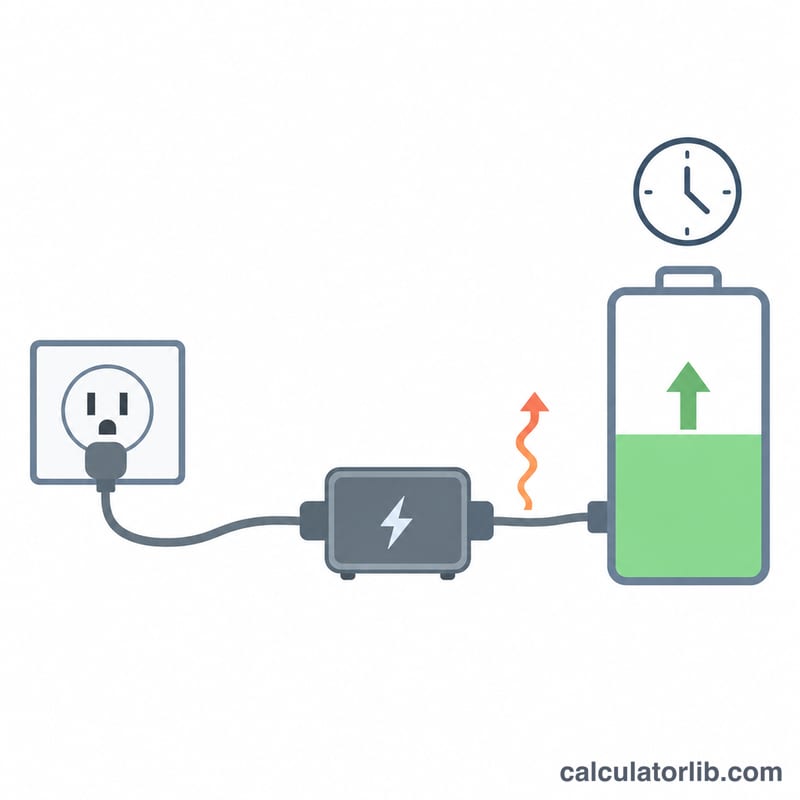
This calculator tells you the charger current (in amps) and power (in watts) you need to recharge a battery within a chosen time window. Picking the right charger size avoids painfully slow charges from an undersized unit, as well as the heat, gassing, or reduced cycle life that an oversized charger can cause.
The Formula Explained
The required charger current depends on how much charge you must replace, how long you have, and how efficiently the battery accepts charge:
$$I = \frac{C \times \text{DoD}}{t \times \eta}$$where \(C\) = battery capacity in amp-hours (Ah), \(\text{DoD}\) = depth of discharge as a fraction, \(t\) = target charge time in hours, and \(\eta\) = charging efficiency as a fraction. The charger power is then \(P = I \times V\), with \(V\) the battery voltage.
How to Use It
Enter your battery capacity and nominal voltage, how deeply it was discharged, the time you want the recharge to take, and the charging efficiency (around 85% for lead-acid, 95% or more for lithium). The calculator returns the recommended charger current and wattage so you can match a real charger to the job.
Worked Example
Suppose a 100 Ah, 12 V battery is fully discharged (\(\text{DoD} = 1.0\)), you want it charged in 10 hours, and charging efficiency is 85%:
$$I = \frac{100 \times 1.0}{10 \times 0.85} = 11.8\,\text{A}$$ $$P = 11.8 \times 12 \approx 141\,\text{W}$$So a charger rated around 12 A / 140 W meets the goal with a little headroom.
Typical Charging Efficiency and Max Charge Rate by Battery Chemistry
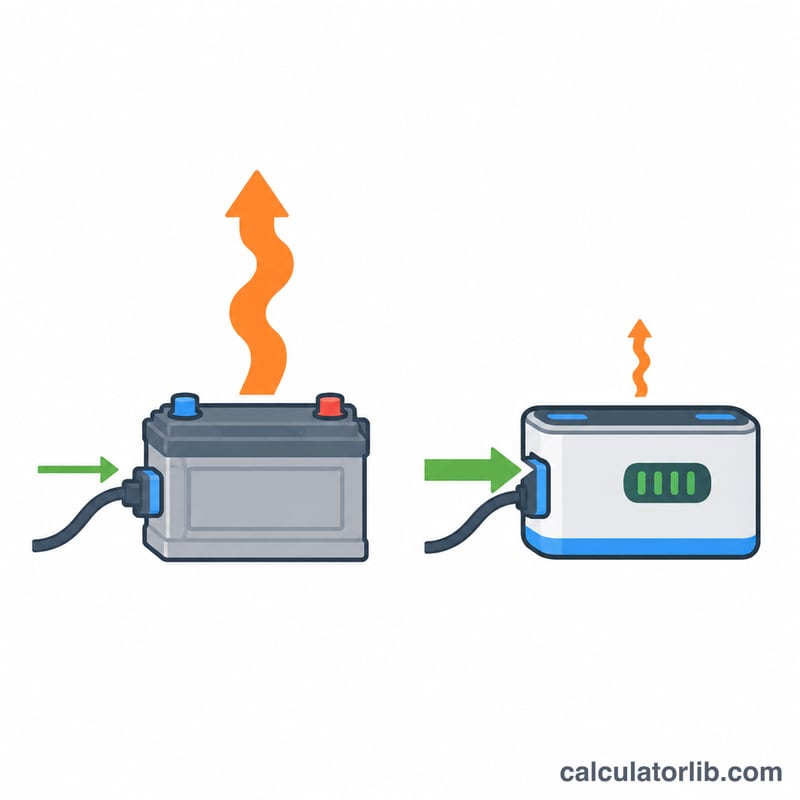
Charging efficiency (\(\eta\)) is the share of energy from the charger that ends up stored in the battery. The charge rate is given as a C-rate, which is charge current divided by rated capacity. For example, 0.2C on a 100 Ah battery is 20 A. The figures below are typical ranges, not fixed values. They change with temperature, battery age, state of charge and the charger's charging profile.
| Chemistry | Typical charging efficiency | Typical recommended charge rate | Notes |
|---|---|---|---|
| Flooded lead-acid | 0.80–0.85 (80–85%) | ~0.1–0.2C | Gassing near full charge lowers efficiency. Needs a long absorption stage. |
| AGM (absorbed glass mat) | 0.85–0.90 (85–90%) | Up to ~0.2–0.3C | Can take higher current than flooded batteries. Some premium AGMs allow more. |
| Gel | 0.85–0.90 (85–90%) | ~0.2C | Sensitive to overvoltage, so use a gel-specific charging profile. |
| LiFePO4 (lithium iron phosphate) | 0.95–0.99 (95–99%) | 0.5C standard, up to ~1C max | The BMS sets the real limit. Do not charge below 0 °C unless the battery is heated. |
| Li-ion (NMC) | 0.95–0.99 (95–99%) | ~0.5–1C | Charged CC/CV (constant current, then constant voltage). Many cells specify 0.5C as standard. |
| NiMH | ~0.66–0.80 (66–80%) | Varies widely (slow ~0.1C; fast chargers higher with −ΔV/temperature cutoff) | Low efficiency because of heat losses. Fast charging needs a charger that detects end of charge. |
Always check the manufacturer's datasheet for your specific battery. The maximum charge current, recommended charge current and voltage settings in the datasheet replace any typical value shown here.
Charger Size Across Common Battery Scenarios
Each row uses the same two formulas:
$$I = \frac{C \cdot D}{\eta \cdot t} \qquad P = I \cdot V \qquad \text{C-rate} = \frac{I}{C}$$For the first row, a 100 Ah, 12 V flooded lead-acid battery at 50% DoD, charged in 8 h at 85% efficiency:
$$I = \frac{100 \times 0.50}{0.85 \times 8} = \frac{50}{6.8} \approx 7.35\ \text{A}, \qquad P = 7.35 \times 12 \approx 88.2\ \text{W}$$| Scenario | Inputs (C, V, DoD, t, η) | Current I | Power P | C-rate (I ÷ C) | Within typical limit? |
|---|---|---|---|---|---|
| Flooded lead-acid, overnight | 100 Ah, 12 V, 50%, 8 h, 0.85 | 7.35 A | ≈ 88.2 W | ≈ 0.07C | Yes. It is below the ~0.1–0.2C range, so this is a gentle charge. |
| LiFePO4 house bank | 200 Ah, 12 V, 80%, 5 h, 0.95 | ≈ 33.7 A | ≈ 404 W | ≈ 0.17C | Yes. It is well under the 0.5C standard rate. |
| AGM, full discharge | 100 Ah, 24 V, 100%, 10 h, 0.88 | ≈ 11.4 A | ≈ 273 W | ≈ 0.11C | Yes. It is within ~0.2–0.3C. |
| LiFePO4 48 V solar/ESS bank | 280 Ah, 48 V, 90%, 4 h, 0.96 | 65.63 A | ≈ 3,150 W | ≈ 0.23C | Yes. It is under 0.5C. |
| Flooded lead-acid, rushed | 100 Ah, 12 V, 80%, 3 h, 0.85 | ≈ 31.4 A | ≈ 376 W | ≈ 0.31C | No. It is above ~0.1–0.2C, so allow a longer charge time. |
The last row shows the most common mistake: setting a short target time for a lead-acid battery. The formula gives a current, but the battery cannot safely accept it. A 3 h recharge of a deep-discharged flooded battery is not realistic.
Interpreting Your Result
The result is an average current. The calculator works out the steady current that would replace the used amp-hours, plus losses, within your target time \(t\). Real chargers do not hold one current for the whole charge.
- Lead-acid (flooded, AGM, gel): charging runs in bulk, absorption and float stages. In the absorption stage the voltage is held constant and the current tapers off. Expect the real charge time to be longer than \(t\), and expect the last 10–20% of charge to be much slower than the rest.
- Lithium (LiFePO4, NMC): charging is CC/CV. Most of the charge is delivered at constant current, followed by a short constant-voltage tail. The average current is therefore closer to the charger's rated current.
Check the C-rate. Divide the current by the battery capacity:
$$\text{C-rate} = \frac{I}{C}$$For example, 33.7 A into a 200 Ah battery gives \(33.7 \div 200 \approx 0.17\text{C}\). Compare your C-rate with the limit for your chemistry, using the table above and your battery's datasheet. If the required current is above the battery's maximum charge current, you cannot safely reach the target time. Lengthen the charge time or reduce the depth of discharge. Do not exceed the limit.
Output watts vs. wall watts. Charger power ratings are given at the DC output: \(P = I \times V\) at the battery. The charger loses some energy as heat, so it draws more power from the AC outlet or generator than it delivers. Account for that loss when sizing a generator, inverter or circuit.
Choosing a real charger. Chargers come in standard sizes, such as 10, 15, 20, 30 and 40 A. Round your result up to the next standard size, as long as that size stays within the battery's maximum charge current. If 7.35 A is required, a 10 A charger suits a 100 Ah lead-acid battery (0.1C). If rounding up would push past the battery's limit, choose the smaller size and accept a slightly longer charge time.
FAQ
Why include efficiency? Batteries waste some energy as heat and gassing, so you must push in more amp-hours than you took out. Dividing by \(\eta\) accounts for this loss.
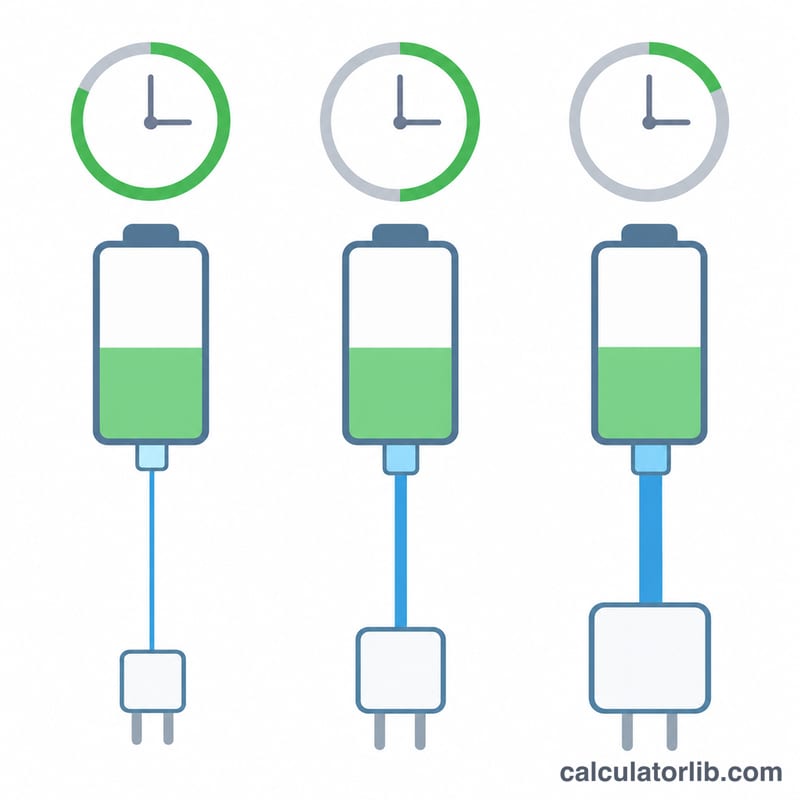
Can I charge faster with a bigger charger? Yes, but never exceed the battery manufacturer maximum charge current, often expressed as a C-rate.
Does this apply to lithium batteries? Yes. Use a higher efficiency (around 0.95) and respect the battery recommended charge current limits.