What Is the Welding Gas Consumption Calculator?
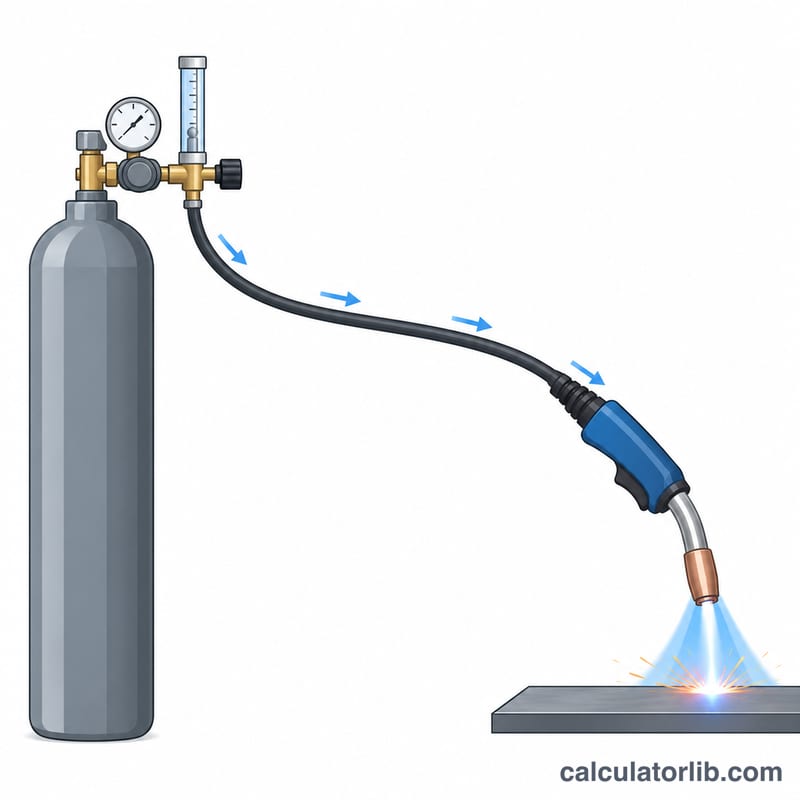
This tool estimates how much shielding gas a welding job consumes and how long a single cylinder will last. Shielding gas such as argon, CO2, or an argon mix protects the molten weld pool from the atmosphere during MIG and TIG welding. Knowing your consumption helps you budget gas, plan long jobs, and avoid running dry in the middle of a weld.
How to Use It
Enter three values: the gas flow rate in litres per minute (read from your flowmeter), the total welding time (arc-on time) in minutes, and the free-gas volume contained in a full cylinder. The calculator instantly returns the total gas used plus the run-time of a full cylinder in both minutes and hours.
The Formula Explained
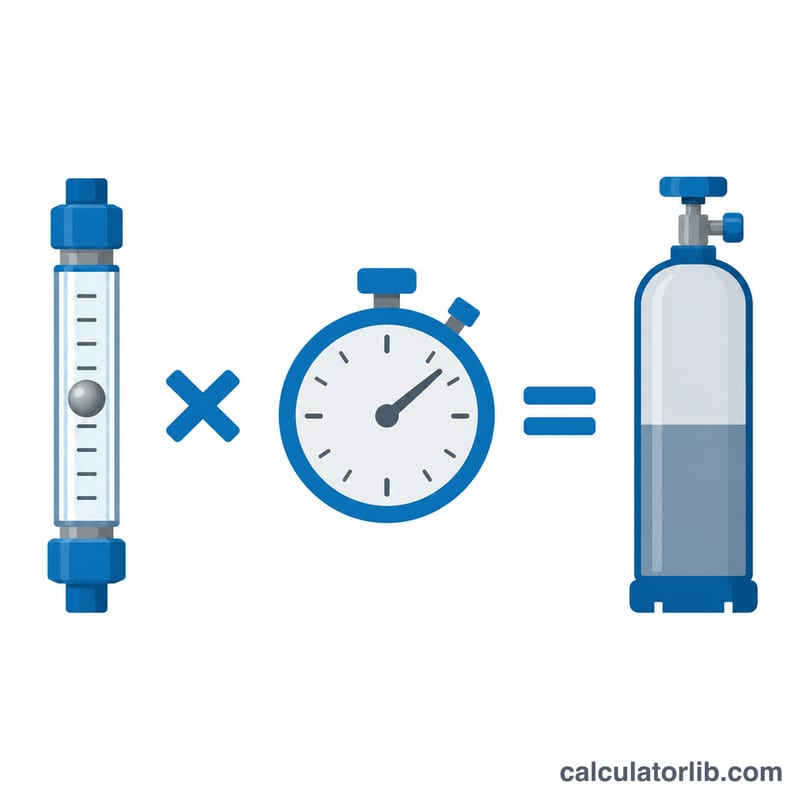
Gas consumption is simply flow rate multiplied by time, while cylinder life is the cylinder volume divided by the flow rate:
$$V_{gas} = Q \times t \qquad t_{run} = \frac{V_{cyl}}{Q}$$Here \(Q\) = flow rate in L/min, \(t\) = total arc time in minutes, \(V_{cyl}\) = free gas volume in the cylinder in litres, \(V_{gas}\) = gas consumed, and \(t_{run}\) = minutes of welding a full cylinder provides.
Worked Example
Suppose you weld for 20 minutes at a flow rate of 15 L/min using a cylinder holding 6000 L of gas. The gas used and the cylinder run-time are:
$$V_{gas} = 15 \times 20 = 300\,\text{L}$$ $$t_{run} = \frac{6000}{15} = 400\,\text{min} = 6.67\,\text{h}$$So the job uses 300 litres and a full cylinder supports about 6.7 hours of continuous arc time.
Common Cylinder Sizes and Free-Gas Volumes
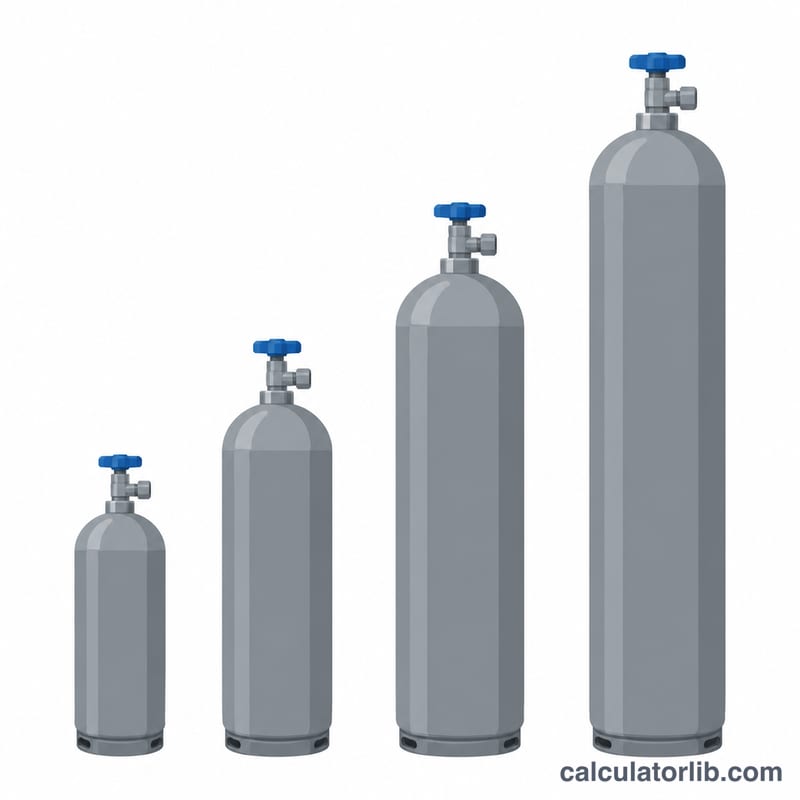
Enter a cylinder's free-gas volume in the calculator. This is how much gas the full cylinder releases at atmospheric pressure, not the size of the cylinder itself. Cylinders are labelled in two main ways. In the United States they are sold by nominal cubic feet of gas. In Europe and many metric countries they are labelled by water capacity (internal volume in litres) and fill pressure (bar).
To convert US cubic-foot sizes to litres, use \(1\ \text{ft}^3 = 28.317\ \text{L}\). For metric cylinders, a good estimate is:
$$\text{Free gas volume (L)} \approx \text{Water capacity (L)} \times \text{Fill pressure (bar)}$$| Cylinder (labelling system) | Size / fill | Approx. free-gas volume |
|---|---|---|
| US cubic-foot size | 40 ft³ | ≈ 1,130 L (40 × 28.317) |
| US cubic-foot size | 80 ft³ | ≈ 2,265 L (80 × 28.317) |
| US cubic-foot size | 125 ft³ | ≈ 3,540 L (125 × 28.317) |
| US cubic-foot size | 300 ft³ | ≈ 8,500 L (300 × 28.317) |
| European / metric | 10 L water capacity @ 200 bar | ≈ 2,000 L (10 × 200) |
| European / metric | 20 L water capacity @ 200 bar | ≈ 4,000 L (20 × 200) |
| European / metric | 50 L water capacity @ 200 bar | ≈ 10,000 L (50 × 200) |
| European / metric | 50 L water capacity @ 300 bar | ≈ 14,000–15,000 L |
Note: These are approximate figures. Real contents depend on the gas (argon, CO₂ or a mix), the supplier and the actual fill pressure. Gases also do not behave perfectly at high pressure, which is why a 300 bar cylinder holds somewhat less than the simple water capacity × pressure estimate. For an exact figure, check the cylinder label or the supplier's data sheet.
CO₂ cylinders: CO₂ is stored as a liquid and sold by weight, so the formula above does not apply. As a guide, 1 kg of CO₂ gives about 509 L of gas at 15 °C and 1 atm. For example, a 6 kg CO₂ cylinder holds roughly 6 × 509 ≈ 3,050 L of gas.
Flow Rate and Volume Unit Conversions
The calculator works in litres and litres per minute (L/min). Many flowmeters, especially in the US, are marked in cubic feet per hour (CFH). Use these factors to convert to the calculator's units:
- \(1\ \text{CFH} = 0.4719\ \text{L/min}\)
- \(1\ \text{L/min} = 2.119\ \text{CFH}\)
- \(1\ \text{ft}^3 = 28.317\ \text{L}\)
- \(1\ \text{m}^3 = 1{,}000\ \text{L}\)
For example, a 20 CFH setting is \(20 \times 0.4719 = 9.44\ \text{L/min}\).
| Flowmeter setting (CFH) | Equivalent (L/min) |
|---|---|
| 10 | ≈ 4.7 |
| 15 | ≈ 7.1 |
| 20 | ≈ 9.4 |
| 25 | ≈ 11.8 |
| 30 | ≈ 14.2 |
| 35 | ≈ 16.5 |
| 40 | ≈ 18.9 |
To convert in the other direction, multiply L/min by 2.119. For example, 15 L/min ≈ 31.8 CFH.
Practical Tips for Planning Gas Supply
The calculator assumes gas flows only while the arc is lit. Real use is always higher, so treat the result as a minimum.
- Add a margin of about 10–20%. Pre-flow and post-flow, purging lines and torches, drafts and small leaks all use gas that arc time does not include. For example, take 150 minutes of arc time at 10 L/min. The gas used is \(10 \times 150 =\) 1500 L. With a 20% margin, plan for about \(1{,}500 \times 1.2 = 1{,}800\) L.
- Don't plan to empty the cylinder. Leave some residual pressure in it. This stops air and moisture getting in, and suppliers often expect cylinders to be returned with some pressure left. So the gas you can actually use is a little less than the full free-gas volume.
- Compare the job's gas use with the cylinder's run time. A 2,000 L cylinder at 10 L/min lasts \(2{,}000 \div 10 =\) 200 minutes of arc time (about 3.3 h). The 1,800 L job above would use about 90% of that cylinder. When a job needs most of a cylinder, have a spare ready, or use a larger cylinder, so you don't run out partway through a weld.
- Check fittings for leaks. Test regulator, hose and torch connections with a leak-detection solution, especially after changing a cylinder. A cylinder that loses pressure overnight with the valve open and no welding points to a leak.
- Don't set the flow higher than you need. Use the flow rate given in your welding procedure or the consumable manufacturer's guidance. Too much flow wastes gas. It can also cause turbulence that pulls air into the shielding gas, so it does not give better coverage. If you're welding in a draft, use screens rather than turning up the flow.
FAQ
Does this count idle time? No. Use arc-on (welding) time only, since gas flows mainly while the trigger is pulled, plus small pre-flow and post-flow amounts.
What flow rate should I use? Typical MIG welding uses 10-20 L/min and TIG 5-15 L/min, but always follow your welding procedure and raise the flow in drafty conditions.
Why does my cylinder empty faster than predicted? High flow, drafts, leaks, and long pre/post-flow settings all push real-world consumption above this ideal estimate.