What this calculator does
The Brake Pad Wear Calculator estimates how much life is left in your brake pads and how fast they are wearing. It uses four simple measurements: the thickness of the pad when new, its current thickness, the minimum safe thickness recommended for replacement, and the distance you have driven on the pads. From these it projects the remaining driving distance and the wear rate, so you can plan a replacement before the pad becomes unsafe.
The formula explained
Assuming the pad wears at a roughly constant rate, the remaining life is:
$$L = \frac{(T_c - T_m) \times M}{T_i - T_c}$$where \(T_i\) = new pad thickness, \(T_c\) = current thickness, \(T_m\) = minimum safe thickness, and \(M\) = mileage driven on the pads. The wear rate per 1000 km is:
$$R = \frac{T_i - T_c}{M} \times 1000$$The pad life used is the worn material divided by the total usable range \(T_i - T_m\).
How to use it
Measure the friction material with a caliper or gauge, not the metal backing plate. Enter the new thickness (often 10-12 mm), the current thickness, and your minimum safe limit (commonly 2-3 mm). Add the mileage driven since the pads were fitted, then read the projected remaining distance.
Worked example
A pad started at \(12\,\text{mm}\), now reads \(8\,\text{mm}\), with a \(3\,\text{mm}\) safe limit after \(40000\,\text{km}\):
$$L = \frac{(8 - 3) \times 40000}{12 - 8} = \frac{5 \times 40000}{4} = 50000\,\text{km}$$and the wear rate is
$$R = \frac{12 - 8}{40000} \times 1000 = 0.1\,\text{mm/1000 km}.$$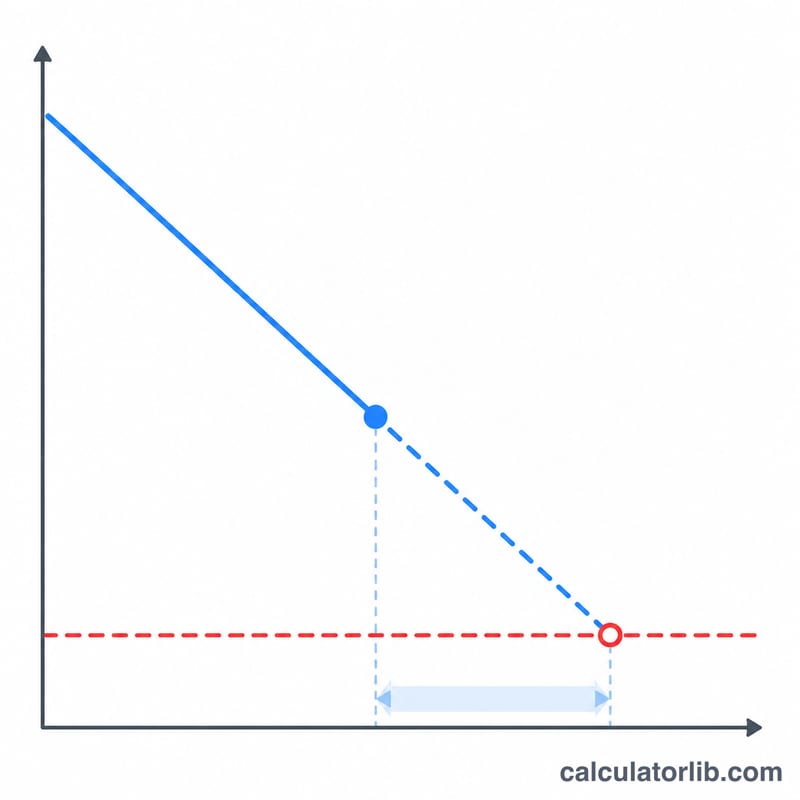
How Driving Conditions Change Remaining Pad Life
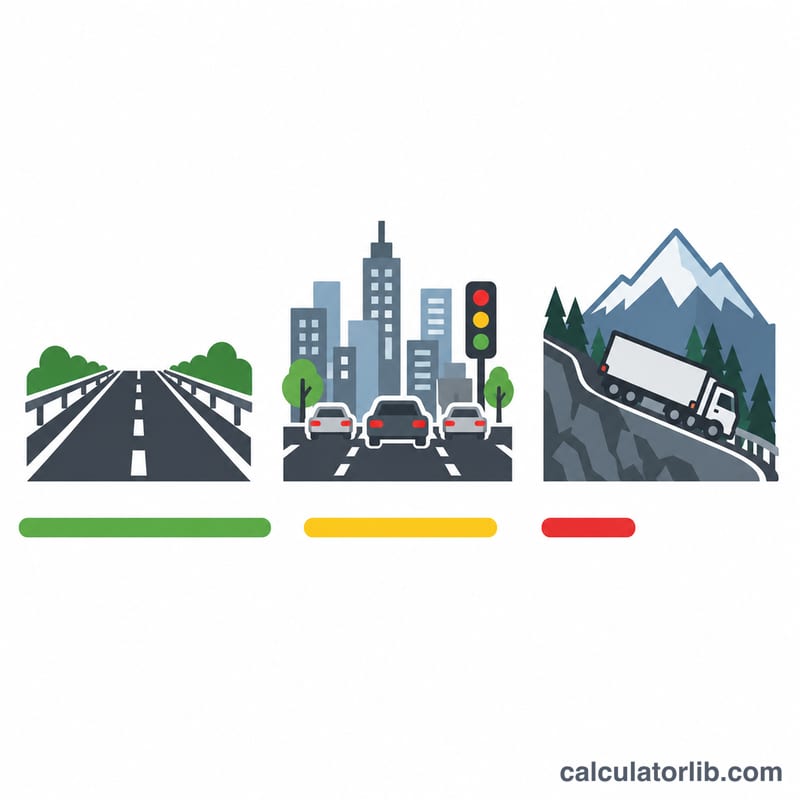
The way you drive has a big effect on how fast pads wear. The table below holds most inputs fixed so you can compare scenarios fairly: a new pad thickness of 12 mm, a minimum safe limit of 3 mm and 20,000 km driven since the pads were fitted. Only the measured current thickness changes. These are made-up example inputs chosen to show how the formulas work. They are not measured data or typical results for any vehicle.
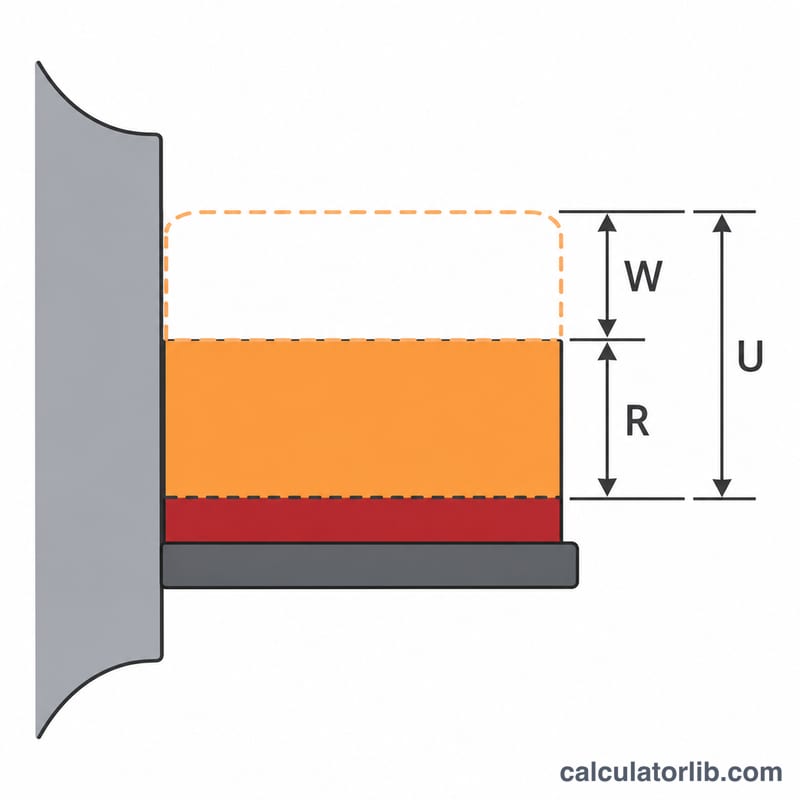
Every row uses the article's formulas, with \(U = 12 - 3 = 9\) mm of usable pad:
$$W = \text{New} - \text{Current}, \quad R = \text{Current} - \text{Minimum}, \quad \text{Wear Rate} = \frac{W}{D} \times 1000, \quad L_{\text{remaining}} = \frac{R \cdot D}{W}$$| Scenario (illustrative) | Measured thickness | Worn W | Remaining R | Wear rate (mm/1000 km) | Worn (%) | Remaining distance L |
|---|---|---|---|---|---|---|
| Mostly highway driving | 10 mm | 2 mm | 7 mm | \(\frac{2}{20000} \times 1000 = 0.10\) | 22.2% | \(\frac{7 \times 20000}{2} =\) 70,000 km |
| Mixed driving | 9 mm | 3 mm | 6 mm | \(\frac{3}{20000} \times 1000 = 0.15\) | 33.3% | \(\frac{6 \times 20000}{3} = 40{,}000\) km |
| Heavy city stop-and-go | 7 mm | 5 mm | 4 mm | \(\frac{5}{20000} \times 1000 = 0.25\) | 55.6% | \(\frac{4 \times 20000}{5} =\) 16,000 km |
| Towing or mountain driving | 6 mm | 6 mm | 3 mm | \(\frac{6}{20000} \times 1000 = 0.30\) | 66.7% | \(\frac{3 \times 20000}{6} = 10{,}000\) km |
The wear rate triples from 0.10 to 0.30 mm per 1000 km between the gentlest and hardest scenario. Over the same distance, that cuts the remaining distance from 70,000 km to 10,000 km. The remaining distance falls much faster than the wear rate rises, because a faster-wearing pad also has less material left. The estimate assumes your future driving will be like your past driving. If you start towing, move to a hilly area or switch to mostly city driving, measure the pads again and recalculate.
Typical Brake Pad Thickness Reference Values
The figures below are commonly cited general industry figures for disc brake pads. They are not a legal standard of any particular country. They refer to the thickness of the friction material only, not the steel backing plate. Pad designs vary by vehicle and brand. Your vehicle manufacturer's service specification always takes priority over these general values. Some local roadworthiness or inspection rules also set their own minimums.
| Item | Typical value | Notes |
|---|---|---|
| New pad friction material (passenger car) | About 10–12 mm | A common starting value for the "New (mm)" input if you don't have the exact specification |
| New pad friction material (trucks, SUVs, heavier vehicles) | Often thicker than passenger-car pads | Check the specification for your vehicle |
| Rear pads compared with front pads | Often thinner | The front brakes usually do most of the braking, so front and rear pads can differ in size and thickness |
| Typical recommended replacement point | About 3 mm | A common, cautious value for the "Minimum (mm)" input |
| Common hard minimum | About 2 mm | Below this, replace the pads straight away; braking performance and the brake discs are at risk |
| Mechanical wear indicator (squealer) | Usually sounds at about 2–3 mm | A high-pitched squeal when braking means the pads should be inspected and probably replaced soon |
Using 3 mm rather than 2 mm as the minimum gives a more conservative estimate. For example, a 12 mm pad then has \(U = 12 - 3 = 9\) mm of usable material instead of \(12 - 2 = 10\) mm. The calculator's remaining-life figure is an estimate only. It does not replace a physical inspection of both the inner and outer pads on each axle. Inner pads can wear faster than outer pads.
FAQ
Is the estimate exact? No. It assumes steady wear, but city driving, towing, and aggressive braking wear pads faster, so treat it as a planning guide.
When should I replace pads? Replace at or before the manufacturer minimum, typically 2-3 mm of friction material, or sooner if you hear wear indicators.
Can I use miles? Yes. Enter mileage in miles and the remaining life and rate will be in the same unit.