What Is the Wine Dilution Calculator?
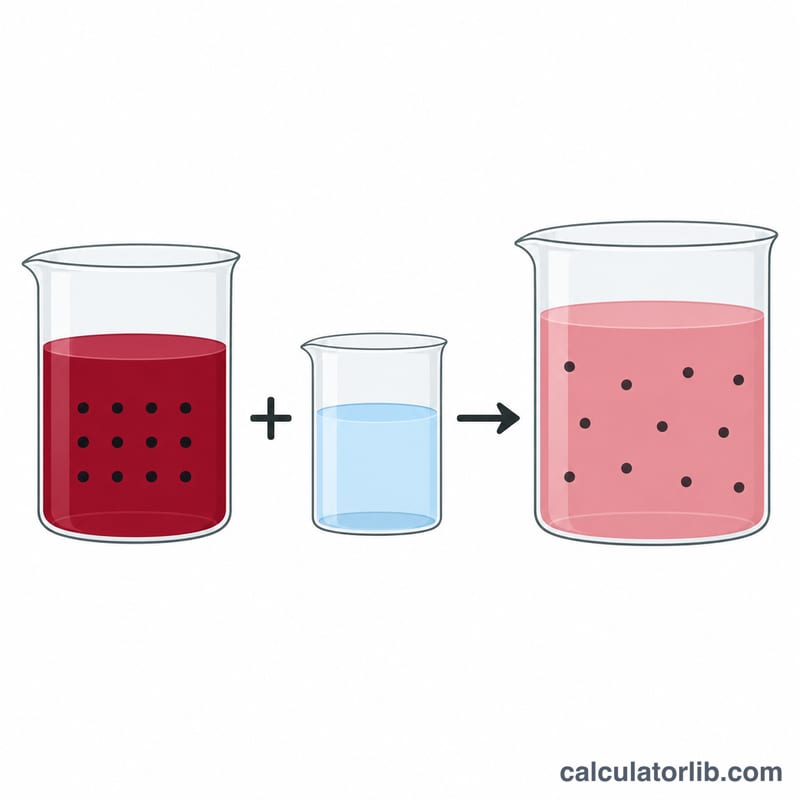
The Wine Dilution Calculator tells you exactly how much water to add to lower the alcohol strength (ABV) of a wine, cider, or any alcoholic liquid. It is handy for cutting back a high-proof homebrew, softening a fortified wine, or adjusting a batch to a milder, more drinkable strength while keeping the math honest.
How to Use It
Enter three values: the current alcohol percentage \(C_1\), the current volume \(V_1\) in milliliters, and the target alcohol percentage \(C_2\) you want to reach. The calculator returns the volume of water to add and the final total volume. Because you can only make a drink weaker by adding water, \(C_2\) should be lower than \(C_1\).
The Formula Explained
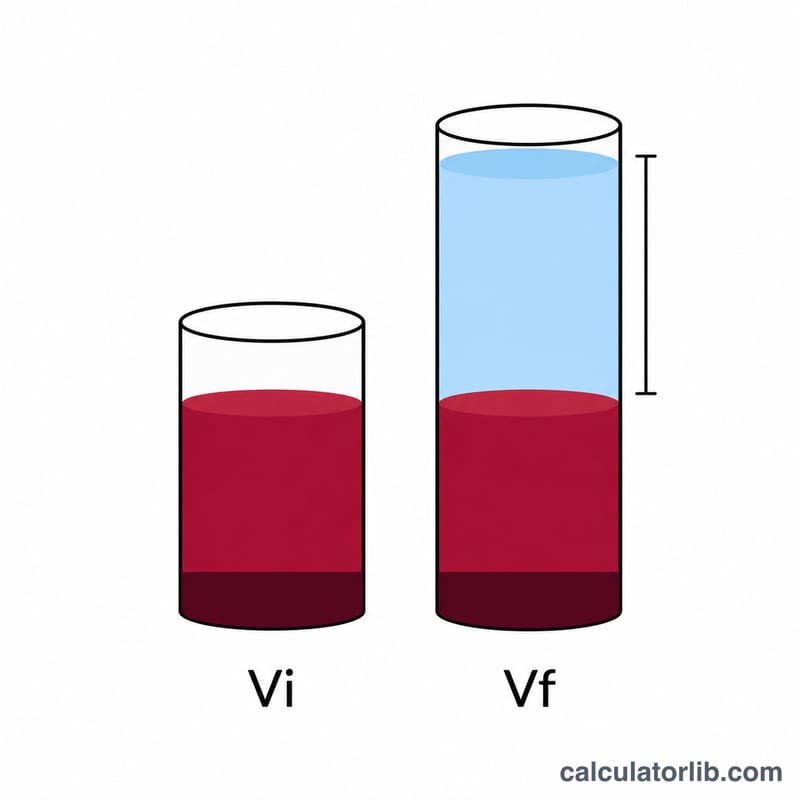
Adding water does not change the amount of pure alcohol in the glass, only the total liquid. That conservation principle gives the final volume, and subtracting the starting volume leaves the water needed:
$$W = \frac{C_1 \times V_1}{C_2} - V_1$$
Here \(C_1\) is the starting ABV, \(V_1\) is the starting volume, \(C_2\) is the target ABV, and \(W\) is the water to add. The intermediate term \(\frac{C_1 \times V_1}{C_2}\) is the final volume \(V_f\).
Worked Example
Suppose you have a 750 ml bottle of wine at 14% ABV and want to bring it down to 12%. The pure alcohol is \(0.14 \times 750 = 105\,\text{ml}\), which must now represent 12% of the total:
$$W = \frac{14 \times 750}{12} - 750 = 875 - 750 = 125\,\text{ml}$$
So you add \(125\,\text{ml}\) of water for a final volume of \(875\,\text{ml}\) at 12% ABV.
More Dilution Examples
Every example below uses the same dilution relationship. Water adds volume but no alcohol, so the amount of pure alcohol stays the same. Only the total volume changes:
$$W = \frac{C_1 \times V_1}{C_2} - V_1$$Here \(C_1\) is the current ABV, \(V_1\) the current volume, \(C_2\) the target ABV and \(W\) the water to add. Each example works through three steps: the pure alcohol, the final volume, and the water needed.
Example 1: 5-gallon homebrew batch, 16% down to 12%
A 5 US gallon batch is about 18,927 ml.
- Pure alcohol: \(0.16 \times 18927 = 3028.32\) ml
- Final volume: \(\frac{16 \times 18927}{12} = \frac{302832}{12} = 25236\) ml
- Water to add: \(25236 - 18927 = 6309\) ml
Result: add about 6309 ml of water (roughly 1.67 US gallons). The batch grows to about 25,236 ml, and it still holds 3,028 ml of pure alcohol: \(0.12 \times 25236 \approx 3028\).
Example 2: 500 ml fortified wine, 20% down to 15%
- Pure alcohol: \(0.20 \times 500 = 100\) ml
- Final volume: \(\frac{20 \times 500}{15} = \frac{10000}{15} \approx 666.7\) ml
- Water to add: \(666.7 - 500 = 166.7\) ml
Result: add about 166.7 ml of water, for a final volume of about 666.7 ml at 15% ABV.
Example 3: 700 ml spirit, 40% down to 30%
- Pure alcohol: \(0.40 \times 700 = 280\) ml
- Final volume: \(\frac{40 \times 700}{30} = \frac{28000}{30} \approx 933.3\) ml
- Water to add: \(933.3 - 700 = 233.3\) ml
Result: add about 233.3 ml of water, for a final volume of about 933.3 ml at 30% ABV.
Notice that cutting from 40% to 30% takes proportionally less water than you might expect. The final volume is always the starting volume multiplied by the ratio \(C_1 / C_2\). In this case that ratio is \(40/30 \approx 1.333\).
Typical ABV of Common Wines and Ciders
The ranges below are commonly cited for each style. They are only a rough guide. Actual strength depends on the producer, vintage, ripeness and winemaking method. Use the ABV printed on the label whenever you have it. For homebrew, use a hydrometer reading.
| Style | Typical ABV range |
|---|---|
| Cider | ~4–8% |
| Low-alcohol wines (e.g. Moscato d'Asti) | ~5–7% |
| German Riesling (especially off-dry styles) | ~8–11% |
| Most light-to-medium table wines | ~11–13.5% |
| Fruit / country homebrew wines | ~10–16% |
| Full-bodied reds (e.g. Zinfandel, Shiraz) | ~14–16% |
| Fortified wines (e.g. sherry, port) | ~15–22% |
These ranges are approximate and overlap. Two bottles of the same style can differ by a percentage point or more. Since the calculator's result depends directly on the starting ABV, a wrong starting value leads to the wrong amount of water.
Practical Tips for Diluting Wine
- Add water in stages. Start with about half to two-thirds of the calculated amount. Mix gently, then taste. Add the rest a little at a time until you like the balance. Water can't be taken back out, so it is safer to stop short.
- Use clean water. Use filtered, non-chlorinated water. Bottled still water or boiled-and-cooled water also works. Chlorine and chloramine in tap water can cause off-flavours, and water with a strong mineral taste will show in the finished drink.
- Expect slight volume shrinkage. Ethanol and water contract a little when mixed. The measured final volume may come out slightly below the calculated figure. The formula treats volumes as simply adding together, so treat its result as a very close estimate rather than an exact one. If the exact strength matters, measure the final ABV yourself. A hydrometer works when you have before-and-after gravity readings. A refractometer works with the correction needed when alcohol is present.
- Remember that dilution changes more than alcohol. Water also lowers acidity, residual sugar, body and preservative (sulfite) levels by the same proportion. Diluted homebrew may taste flat or thin. You might need to adjust acid or sweetness afterwards. Because protection against spoilage and oxidation is lower, plan to drink it sooner or re-check the sulfite level before storing it.
- Mix thoroughly and record what you did. Stir or gently swirl so the batch is even before you take any reading. Note the volumes and readings so you can repeat or refine the result next time.
- Check legal rules if you sell it. If the wine or cider is sold or labelled commercially, the stated ABV must follow the labelling and alcohol-duty rules where you sell it. Those rules, and the tolerance allowed between labelled and actual ABV, differ by country. A calculated estimate is not a substitute for a proper measurement in that case.
FAQ
Does adding water change the flavor? Yes. Dilution lowers alcohol but also thins aroma, body, and sweetness, so add water gradually and taste as you go.
Can I use this for spirits or cider? Absolutely. The formula works for any liquid where you know the ABV and volume.
Why must the target ABV be lower? Water only dilutes. To raise ABV you would need to add alcohol, which this tool does not model.