What is the Wine Must Sugar Calculator?
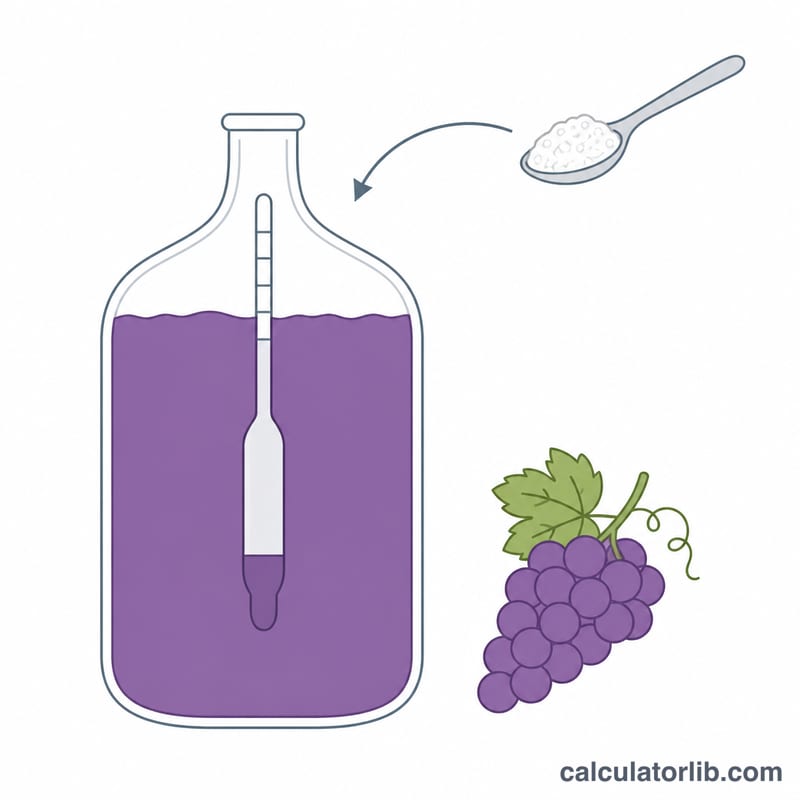
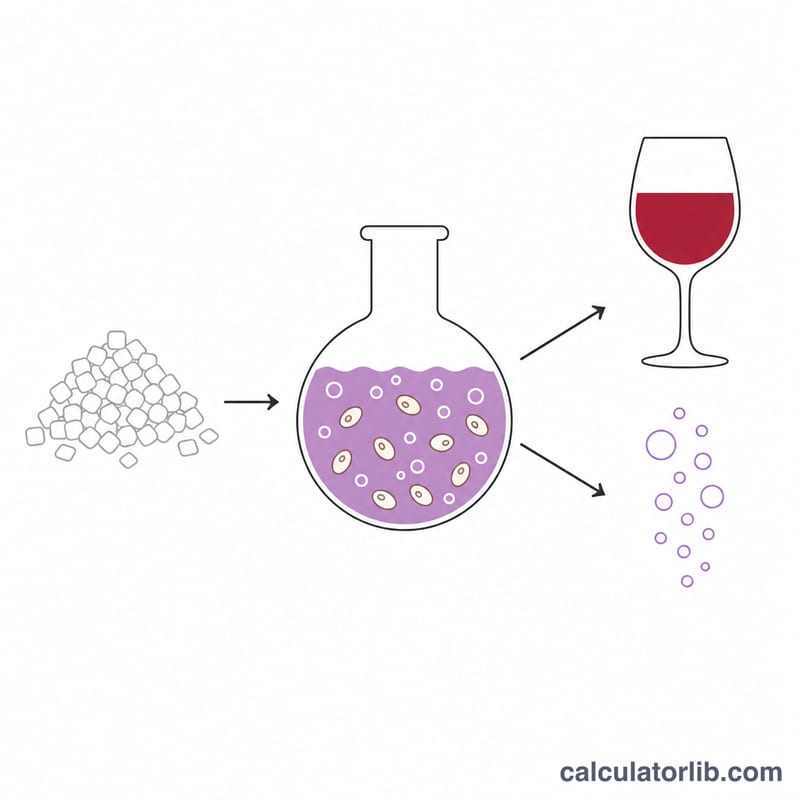
The Wine Must Sugar Calculator helps home and small-scale winemakers work out how much sugar to add to grape must (a process called chaptalization) so the finished wine reaches a desired alcohol level. During fermentation yeast converts sugar into alcohol and carbon dioxide, so the starting sugar concentration of the must sets the ceiling for potential alcohol. If your grapes ripened in a cool season and fell short on sugar, a measured addition brings the batch up to target.
The formula explained
The calculation rests on a simple conversion factor: roughly \(k = 17\) grams of sugar per liter yields about 1% ABV. The total sugar to add is:
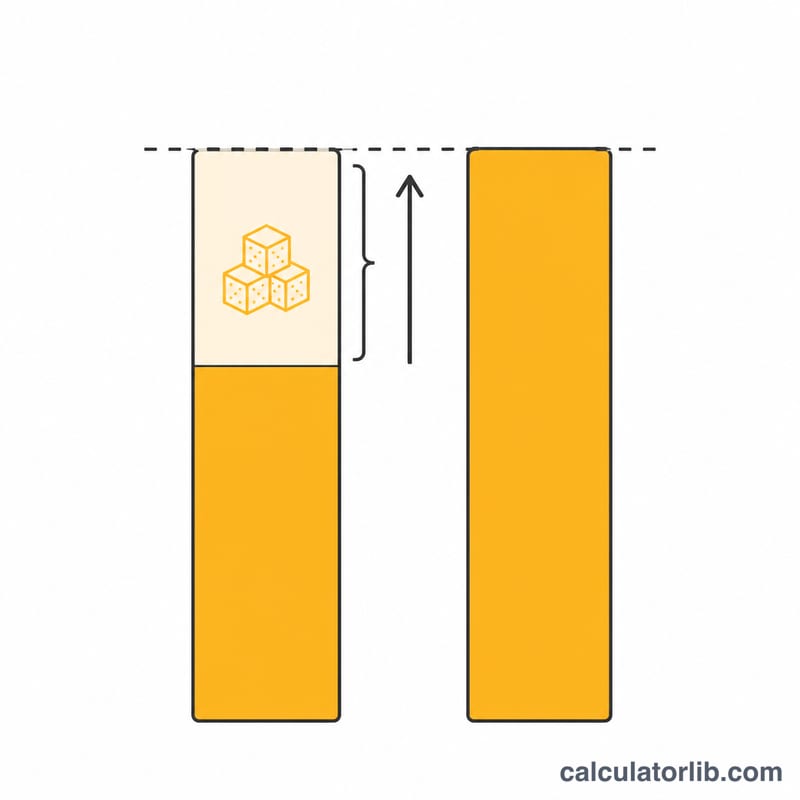
$$\text{Sugar} = (\text{ABV}_{t} \times k - S_0) \times V$$where \(\text{ABV}_{t}\) = target alcohol in percent, \(k\) = grams of sugar per 1% ABV, \(S_0\) = current sugar in grams per liter, and \(V\) = must volume in liters. The current potential alcohol is \(\text{ABV}_0 = \tfrac{S_0}{k}\).
How to use it
Measure your must volume, test the current sugar in g/L with a hydrometer or refractometer, enter your target ABV, and keep the default factor of 17 (or adjust it for your region and yeast). The calculator returns the total grams of sugar to dissolve and stir into the must.
Worked example
Suppose you have \(20\) liters of must at \(180\) g/L sugar and want \(13\%\) ABV with \(k = 17\):
$$\text{Sugar} = (13 \times 17 - 180) \times 20 = (221 - 180) \times 20 = 820\,\text{g}$$So you would add about 820 grams of sugar.
FAQ
Which sugar per ABV factor should I use? Common values range from 16.5 to 18 g/L per 1% ABV; 17 is a reliable default.
Can the result be negative? Yes. A negative value means the must already exceeds your target sugar, so no addition is needed.
Should I add sugar all at once? Dissolve it fully and stir gently; for large boosts, split the addition to avoid stressing the yeast.