What this calculator does
Sulfur dioxide (SO2) protects wine from oxidation and spoilage microbes. Most home and small commercial winemakers add it as potassium metabisulfite (KMBS, K2S2O5). This calculator works out how many grams of KMBS will raise your free SO2 from its measured level to a target level. It also tells you how much of that free SO2 is in the active molecular form at your pH.
How to use it
Enter the wine volume in liters or US gallons, the pH, your measured free SO2 (from an aeration-oxidation or Ripper test) and the free SO2 level you want. If you are not sure what target to use, look at the row showing the free SO2 needed for 0.8 mg/L molecular SO2. That is the usual protective level for dry wines.
The formula
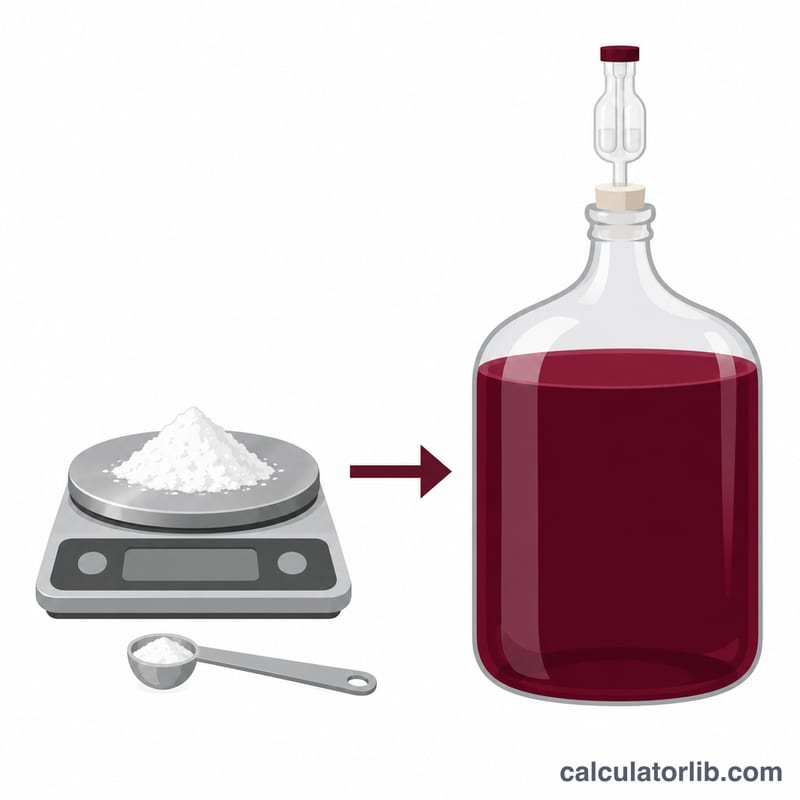
KMBS supplies 57.6% of its mass as SO2, so the addition is:
$$m = \frac{(F_t - F_c) \times V}{1000 \times 0.576}$$where \(F_t\) is the target free SO2 in mg/L, \(F_c\) is the current free SO2, \(V\) is the volume in liters and \(m\) is the result in grams. At wine pH, free SO2 is mostly bisulfite. The molecular share follows from the pKa of 1.81:
$$M = \frac{F}{1 + 10^{\text{pH} - 1.81}}$$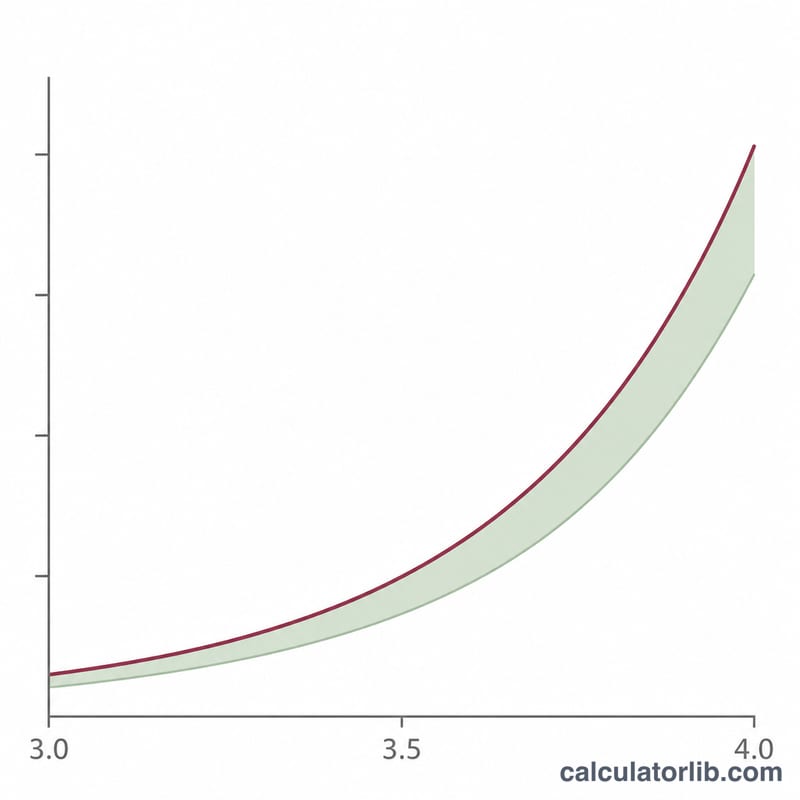
Worked example
Take 20 L of wine at pH 3.5 with 10 mg/L free SO2 and a target of 40 mg/L:
$$m = \frac{30 \times 20}{1000 \times 0.576} = 1.04\,\text{g}$$At pH 3.5, 40 mg/L of free SO2 gives
$$M = \frac{40}{1 + 10^{1.69}} = 0.80\,\text{mg/L}$$so it hits the 0.8 mg/L goal almost exactly.
Free SO2 Needed by pH
Only a small share of free SO2 is in the molecular form (SO2), which is the form that protects wine from microbes. That share falls quickly as pH rises. To find the free SO2 needed for a given molecular target, rearrange the molecular SO2 equation, using a pKa of 1.81:
$$F = M \times \left(1 + 10^{\,\text{pH} - 1.81}\right)$$Here \(F\) is free SO2 in mg/L and \(M\) is the molecular SO2 target in mg/L. For example, at pH 3.5: \(F = 0.8 \times (1 + 10^{1.69}) = 0.8 \times 49.98 \approx 40\) mg/L.
| Wine pH | Free SO2 for 0.5 mg/L molecular (mg/L) | Free SO2 for 0.8 mg/L molecular (mg/L) |
|---|---|---|
| 3.0 | 8 | 13 |
| 3.1 | 10 | 16 |
| 3.2 | 13 | 20 |
| 3.3 | 16 | 26 |
| 3.4 | 20 | 32 |
| 3.5 | 25 | 40 |
| 3.6 | 31 | 50 |
| 3.7 | 39 | 63 |
| 3.8 | 49 | 79 |
| 3.9 | 62 | 99 |
| 4.0 | 78 | 125 |
Values are rounded to the nearest mg/L. The model assumes a typical pKa. Real wine also depends on alcohol and temperature, so treat the table as a guide.
Example: a 20 L batch of white wine at pH 3.5 has 10 mg/L free SO2 and needs 40 mg/L (0.8 mg/L molecular). The increase is \(\Delta = 40 - 10 = 30\) mg/L. Potassium metabisulfite (KMBS) supplies about 57.6% of its weight as SO2:
$$\text{KMBS} = \frac{30 \times 20}{1000 \times 0.576} = \frac{600}{576} \approx 1.04\ \text{g}$$So add about 1.04 g of KMBS.
Note: many people can smell free SO2 above about 50–60 mg/L. Above about pH 3.7, a full 0.8 mg/L molecular target needs more free SO2 than that. This is why winemakers often lower the pH of high-pH wines (for example with tartaric acid) instead of simply adding more sulfite.
Typical Molecular and Total SO2 Targets
These are common winemaking rules of thumb, not fixed standards. Choose a target based on the wine's style, how long you plan to keep it, and how clean your cellar practices are.
| Wine style | Typical molecular SO2 target (mg/L) | Notes |
|---|---|---|
| Red wines | about 0.5–0.6 | Tannins and other phenolics give extra protection against oxidation. |
| Dry white and rosé wines | about 0.8 | Fewer phenolics, so more protection is needed against oxidation and browning. |
| Sweet or off-dry wines | about 0.8–1.0 or more | Leftover sugar can restart fermentation. Often used together with potassium sorbate. |
Free SO2 at key stages: additions at crush, or right after malolactic fermentation is finished, often aim for about 30–50 mg/L free SO2. Hold off on SO2 until malolactic fermentation is done if you want it to happen, because SO2 inhibits malolactic bacteria.
Legal total SO2 limits (these vary by country):
| Jurisdiction | Wine type | Maximum total SO2 |
|---|---|---|
| United States (TTB) | Wine generally | 350 mg/L |
| European Union | Red wines (low residual sugar) | 150 mg/L |
| European Union | White and rosé wines (low residual sugar) | 200 mg/L |
| European Union | Sweet wines and certain special wines | Higher limits, set by category |
Other countries set their own limits, and organic or other certification schemes are often stricter. Check the rules where the wine will be sold.
Note: each sulfite addition raises total SO2. Some of the free SO2 binds to compounds in the wine and stops protecting it, but it still counts toward total SO2. Repeated small top-ups over months of aging can push total SO2 close to the legal limit. Measure free SO2 before each addition, and test total SO2 now and then on wines that are aged for a long time.
FAQ
Why does pH matter so much?
Each 0.1 rise in pH cuts the molecular fraction by about 20%. High-pH wines therefore need much more free SO2 for the same protection.
Will all of the added SO2 stay free?
No. Some of it binds to acetaldehyde, sugars and other compounds. Measure free SO2 again a day or so after adding and top up if needed.
What is the 10% solution figure?
Dissolving 10 g of KMBS in water to make 100 mL gives a 10% solution. You can measure it more accurately than a small amount of powder.