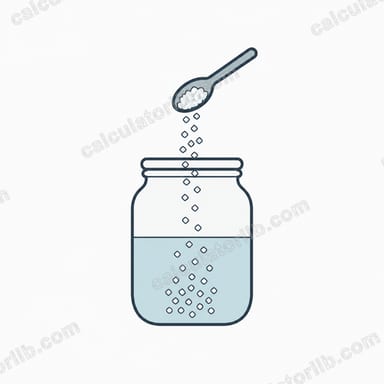
What is a poultry brine calculator?
A brine is salt dissolved in water. It helps chicken, turkey and other poultry stay juicy and well seasoned. This calculator turns a target salt percentage and a volume of water into exact amounts of salt and optional sugar, in grams, tablespoons and cups. It is a general cooking tool, so no country or jurisdiction applies.
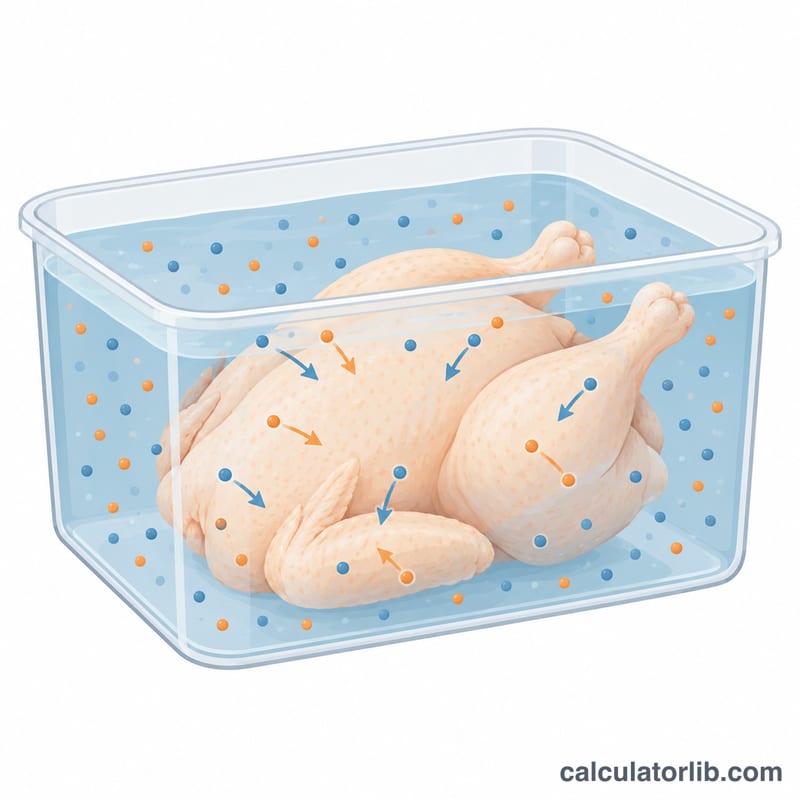
How to use it
Enter the volume of water and pick liters, US quarts or US gallons. Set the salt concentration as a percentage of the water weight; 4 to 6 percent is common for poultry. Add an optional sugar percentage and the planned brining time. Choose your salt type, because kosher salts are much less dense than table salt and the same spoonful holds far less salt.
The formula explained
Water weighs about 1000 g per liter, so the salt mass is:
$$m_{\text{salt}} = V \times 1000 \times \frac{p}{100}$$
Here \(V\) is the water volume in liters and \(p\) is the salt percentage by weight. Sugar uses the same formula with its own percentage. Spoon measures divide the grams by the grams per tablespoon of your salt: about 18 g for table salt, 14.4 g for Morton kosher and 8.5 g for Diamond Crystal. The strength index \(I = p \times t\) is a rough guide: values above about 60 suggest the bird may turn salty.
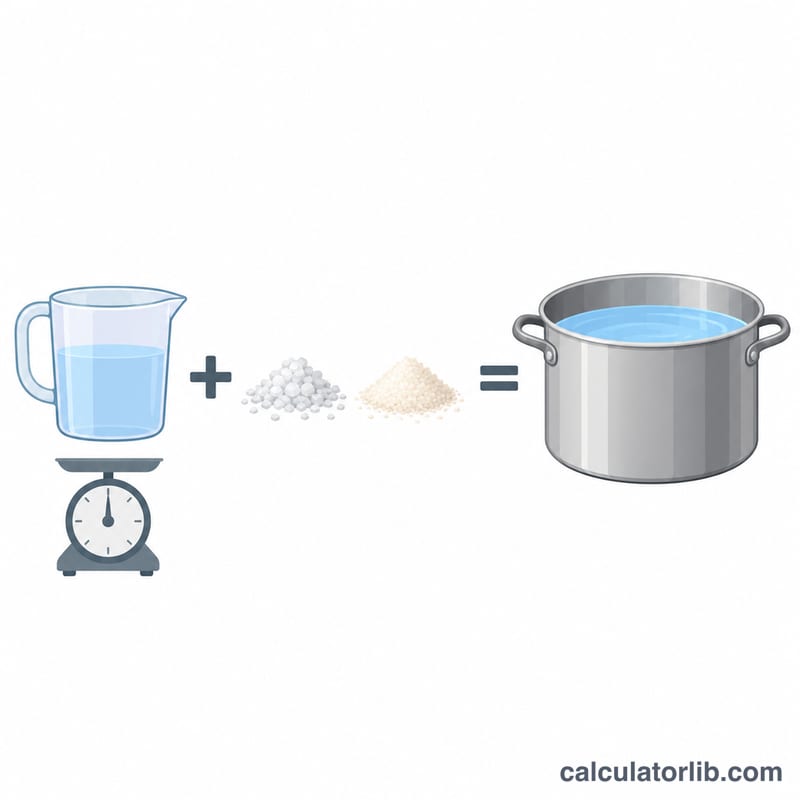
Worked example
Brine a chicken in 4 L of water at 5 percent salt and 2 percent sugar, using table salt:
$$m_{\text{salt}} = 4 \times 1000 \times \frac{5}{100} = 200\,\text{g}$$
$$m_{\text{sugar}} = 4 \times 1000 \times \frac{2}{100} = 80\,\text{g}$$
The salt is \(200 / 18 \approx 11.1\) tablespoons of table salt. With an 8 hour brine, \(I = 5 \times 8 = 40\), which is within the normal range.
Salt Types: Grams per Tablespoon and Cup
Salt crystals differ in size and shape, so the same volume of different salts weighs very different amounts. The calculator uses the values below. Morton and Diamond Crystal are US brands of kosher salt, so check which one you actually have. These figures are approximate and rounded.
| Salt type | g per teaspoon | g per tablespoon | g per US cup (16 tbsp) |
|---|---|---|---|
| Table salt (fine) | 6 | 18 | 288 |
| Morton kosher salt | 4.8 | 14.4 | 230 |
| Diamond Crystal kosher salt | about 2.8 | 8.5 | 136 |
Note: Sea salt varies widely by grain size, from fine to flaky, so it has no single value. Weighing the salt in grams on a kitchen scale is the most accurate method and avoids over-salting when you swap one salt for another.
Typical Brine Strengths and Times for Poultry
The figures below are common culinary practice ranges, not strict standards. Salt percentage is salt weight as a percentage of the water weight (1 L of water is about 1000 g).
| Poultry | Typical salt (% of water weight) | Typical brining time | Index S × t |
|---|---|---|---|
| Whole chicken | 4–6% | 4–8 hours | about 16–48 |
| Chicken pieces (bone-in) | 4–5% | 1–2 hours | about 4–10 |
| Boneless breasts | 3–5% | 0.5–1.5 hours | about 1.5–7.5 |
| Whole turkey | 3–5% | 8–12 hours | about 24–60 |
Strength index guide
The calculator's Brine Index is \(S \times t\), where \(S\) is the salt percentage and \(t\) is the time in hours. It is a rough guide to how much salt exposure the meat gets. As a rule of thumb, values above about 60 risk a noticeably salty result, and smaller or boneless cuts absorb salt faster, so they need lower values.
Food safety
Always brine in the refrigerator at or below 4 °C (40 °F), and keep the container covered. Discard used brine and never reuse it. Sugar, often 0–2% of the water weight, is optional and mainly adds browning and a slight sweetness.
FAQ
Can I swap kosher salt for table salt by volume?
No. Weigh the salt, or use the tablespoon figure for your specific salt type, because the same volume of Diamond Crystal holds roughly half the salt of table salt.
How long should I brine chicken?
Whole chickens are commonly brined for 4 to 12 hours in the refrigerator. Pieces need less time. Stronger brines need shorter times.
Do I need sugar?
No. Sugar adds mild sweetness and helps browning, but a salt-only brine works well.