What Is a Brine Percentage Calculator?
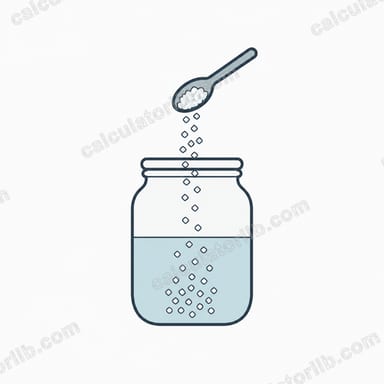
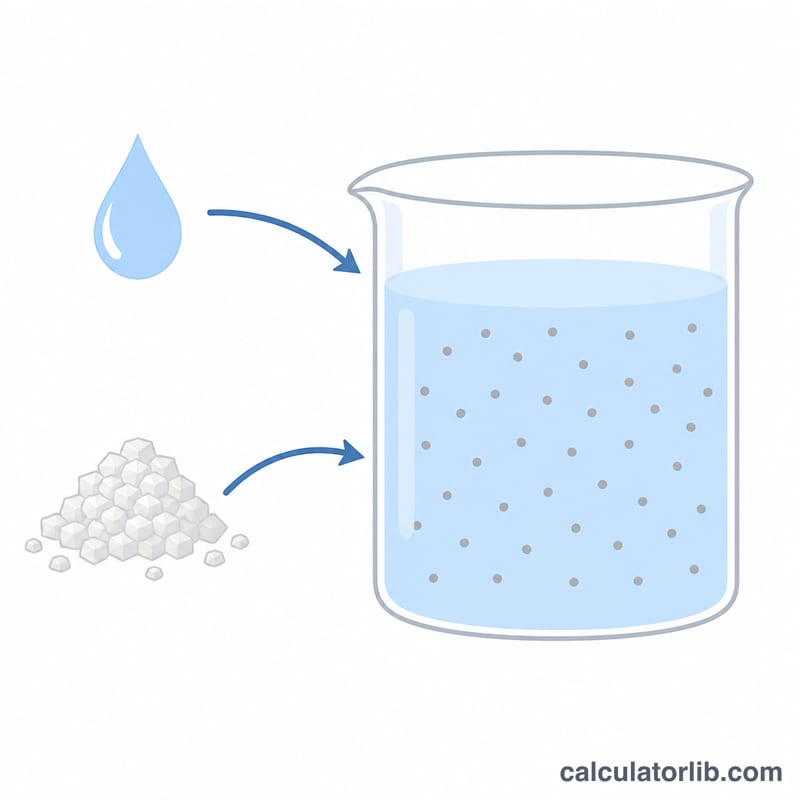
A brine is a solution of salt dissolved in water, used in cooking, pickling, fermentation, and food preservation. The brine percentage tells you how strong that solution is. This calculator converts the weight of salt and the weight of water you use into a clear salt concentration figure, so you can hit a target strength every time and keep results repeatable.
How to Use It
Enter the weight of salt and the weight of water in grams, then read the result. The main figure is the brine percentage by total solution weight, and the table also shows the salt-to-water ratio and the total weight. Weigh ingredients on a scale rather than using volume, because salt crystals vary in density and volume measures are unreliable.
The Formula Explained
The concentration is the salt weight divided by the combined weight of salt and water, multiplied by 100. With \(S\) = salt weight and \(W\) = water weight:
$$\text{Brine \%} = \frac{S}{S + W} \times 100$$Some fermentation recipes instead express strength as salt divided by water only, \(\tfrac{S}{W} \times 100\); this calculator reports both so you can match any recipe convention.

Worked Example
Suppose you dissolve 50 g of salt in 950 g of water. The total weight is 1000 g, so:
$$\text{Brine \%} = \frac{50}{50 + 950} \times 100 = 5\%$$The salt-to-water ratio would be \(\tfrac{50}{950} \times 100 \approx 5.26\%\), slightly higher because water alone is a smaller denominator.
Typical Brine Strengths by Use
The table below lists brine salt concentrations that are widely documented as culinary and food-preservation norms. They are general guidelines drawn from common recipes and preserving references, not legal or safety standards, and exact figures vary between recipes, regions, and traditions. This is general culinary information, not professional food-safety advice; when preserving for shelf stability, follow a tested recipe from a trusted authority.
| Application | Typical brine (total-weight %) | Notes |
|---|---|---|
| Vegetable lacto-fermentation (general) | ~2–3% | Enough salt to favor lactic-acid bacteria while fermenting crisp vegetables. |
| Sauerkraut / dry-salted cabbage | ~2% | Often salted by weight of the vegetable rather than a separate brine. |
| Pickle & olive brines | ~5–8% | Higher salt for firmer texture and longer keeping; olives are often cured in this range. |
| Feta / brined cheese storage | ~5–7% | Storage brine that keeps the cheese preserved and seasoned. |
| Meat / poultry wet brine | ~5–8% | Short-term brining for seasoning and moisture, usually refrigerated, then rinsed and cooked. |
Convention matters: the percentages above are total-weight brine strengths, computed as
$$\text{Brine \%} = \frac{\text{Salt (g)}}{\text{Salt (g)} + \text{Water (g)}} \times 100$$
Some recipes instead state a salt-to-water ratio (salt as a percentage of the water only), which gives a slightly higher salt weight for the "same" number. For example, a 3% total-weight brine is 30 g salt in 970 g water, giving 3%, whereas "3% of the water" would be 30 g salt in 1000 g water. Before mixing a batch, confirm whether your recipe means the ratio or the total-weight percentage, since the two are not identical.
FAQ
Which percentage should I use for fermentation? Most vegetable ferments call for a salt-to-water ratio, typically 2 to 5 percent. Check whether your recipe means ratio or total-weight concentration.
Can I use ounces or pounds? Yes, as long as salt and water use the same unit the percentage is identical, since the units cancel.
Does salt type matter? The math is the same for any salt, but always weigh by mass rather than volume for accuracy.