What It Is
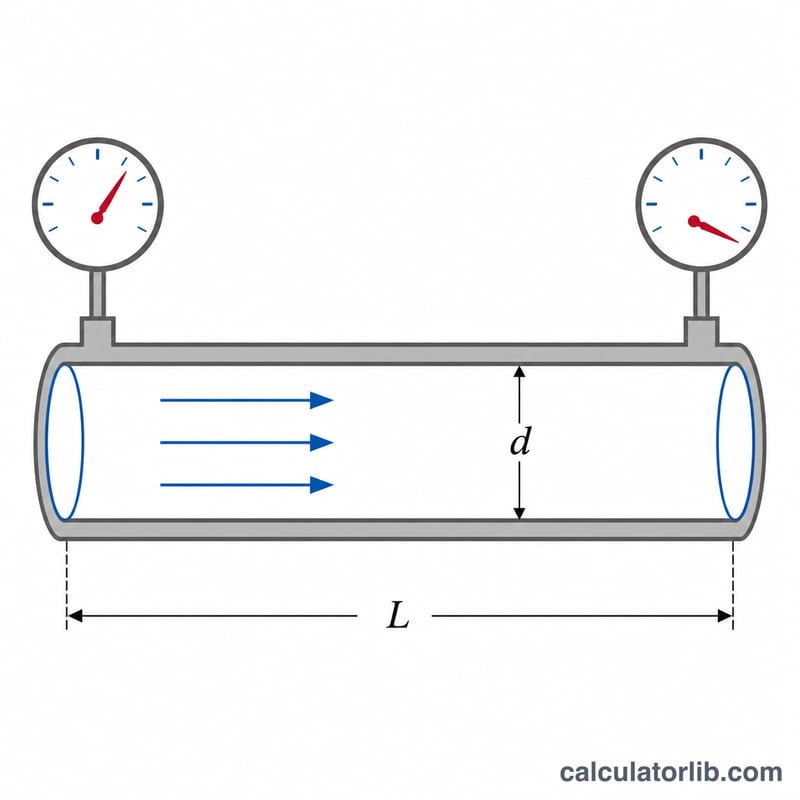
The Water Pressure Drop Calculator estimates the pressure lost by water as it flows through a straight pipe. Friction between the moving water and the pipe wall converts useful pressure into heat, and this loss grows with flow rate and pipe length while falling rapidly as the pipe gets wider.
The Formula
The tool uses the Darcy-Weisbach equation, the most widely accepted model for pipe friction losses:
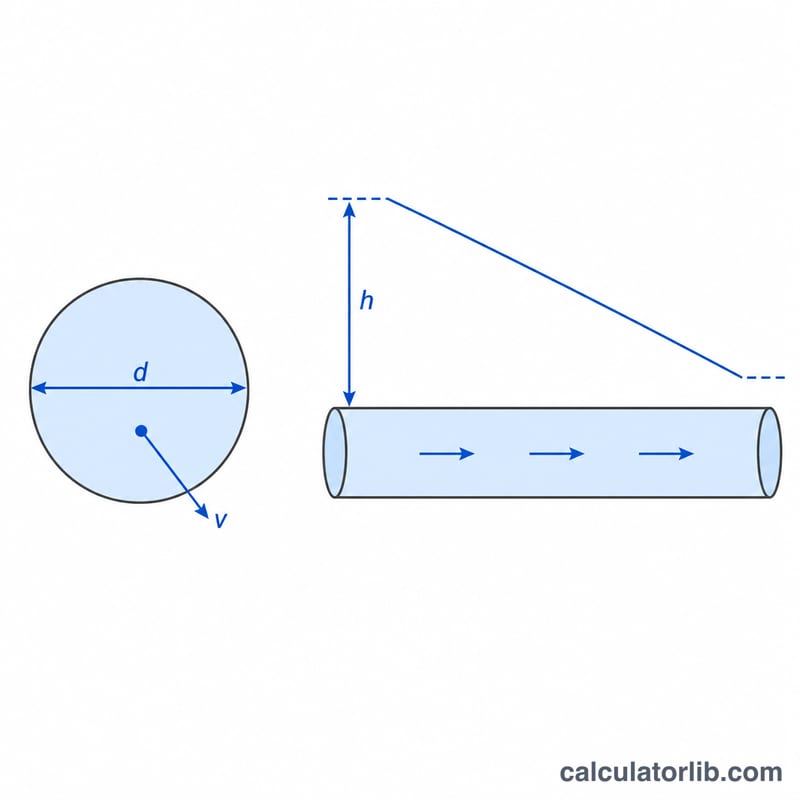
$$\Delta P = f \, \frac{L}{d} \, \frac{\rho v^{2}}{2}$$where \(f\) is the Darcy friction factor, \(L\) the pipe length, \(d\) the inside diameter, \(\rho \approx 1000\ \text{kg/m}^{3}\) the density of water, and \(v\) the mean velocity. Velocity comes from the flow rate \(Q\) and cross-sectional area: \(v = \dfrac{Q}{A}\), with \(A = \dfrac{\pi d^{2}}{4}\).
How To Use It
Enter the volumetric flow rate in litres per minute, the pipe length in metres, and the inside diameter in millimetres. A friction factor near \(0.02\) is typical for smooth pipes in turbulent flow; increase it for rough or older pipes. The calculator returns the flow velocity, the head loss in metres of water, and the pressure drop in kilopascals.
Worked Example
For \(Q = 60\ \text{L/min}\), \(L = 100\ \text{m}\), \(d = 50\ \text{mm}\), and \(f = 0.02\):
$$v = \frac{0.001}{\pi (0.05)^{2}/4} = 0.509\ \text{m/s}$$$$\Delta P = 0.02 \times \frac{100}{0.05} \times \frac{1000 \times 0.509^{2}}{2} \approx 5.19\ \text{kPa}$$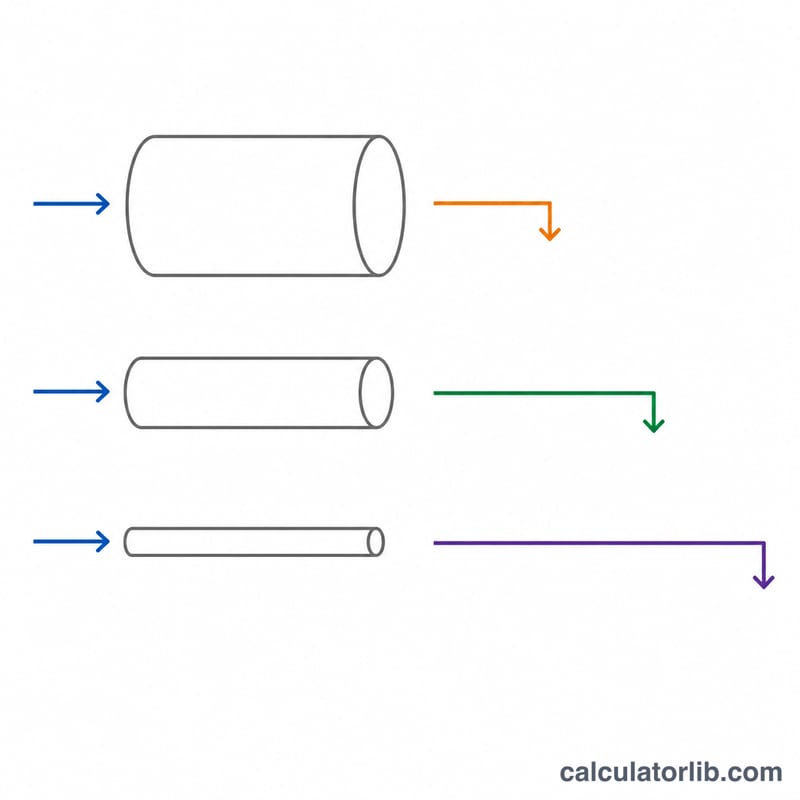
FAQ
Why does diameter matter so much? Pressure drop scales with roughly \(1/d^{5}\) once velocity is expressed through flow rate, so doubling the diameter can cut losses more than thirtyfold.
What friction factor should I use? Use about \(0.02\) for clean commercial pipe; for precise work compute \(f\) from the Reynolds number and relative roughness.
Does this include fittings? No, it covers straight pipe only; add equivalent lengths for valves and bends.