What is the Brine Ratio Calculator?
Brining is soaking food in salted water so it holds moisture and seasons evenly. This calculator turns the food weight, the amount of water you want to use, and a target salt concentration into exact gram amounts of salt and water, so you can mix a consistent brine every time instead of guessing.
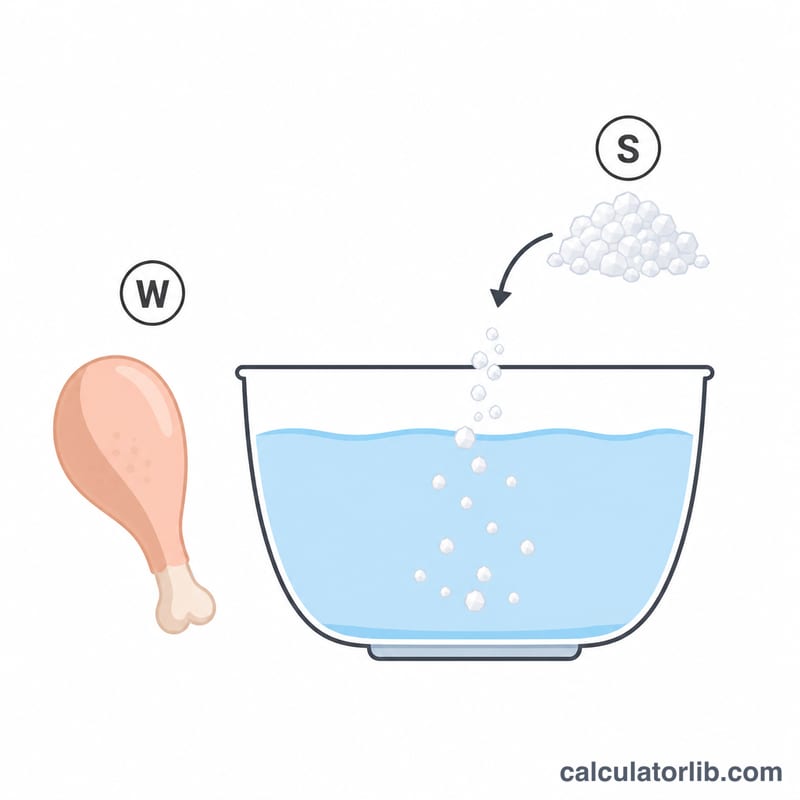
How to use it
Enter the food weight in grams, choose a water ratio (how much water to use as a multiple of the food weight), and set the salt concentration as a percentage of the water. A ratio of 1 covers most cuts; a concentration of 5% to 6% suits meat and poultry, while 3% to 4% is common for quick vegetable brines. Assume 1 mL of water weighs 1 g.
The formula explained
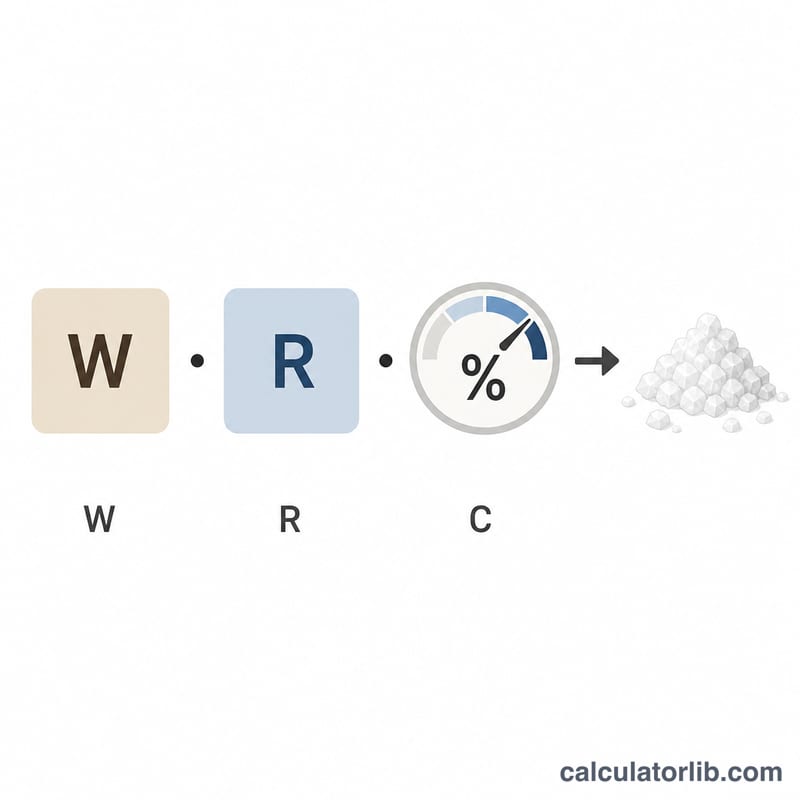
The water is scaled from the food weight, then the salt is a fixed share of that water. With \(W\) = food weight, \(R\) = water ratio, and \(C\) = salt concentration in percent:
$$\text{Water} = W \times R \qquad \text{Salt} = (W \times R) \times \frac{C}{100}$$The total brine weight is simply \(\text{Water} + \text{Salt}\).
Worked example
For 1000 g of chicken, a water ratio of 1, and a 5% brine:
$$\text{Water} = 1000 \times 1 = 1000\,\text{g}$$$$\text{Salt} = 1000 \times \frac{5}{100} = 50\,\text{g}$$Dissolve 50 g of salt in 1000 g (1 L) of water for a total brine of 1050 g, then submerge the food fully.
Typical Brine Concentrations by Food
The table shows common wet-brine strengths. Each value is grams of salt as a percentage of the water's weight, which is how this calculator works. For example, a 5% brine is 50 g of salt for every 1,000 g (1 litre) of water.
| Food | Typical salt (% of water weight) | Approximate soak time |
|---|---|---|
| Whole poultry / turkey | about 5–6% | Overnight to 24 h for whole birds |
| Chicken pieces | 5–6% | 1–4 h |
| Pork chops / pork loin | 5–6% | 2–12 h |
| Shrimp / seafood | 3–5% | 15–60 min |
| Fish fillets | 5–10% | 10–60 min |
| Vegetables / quick pickles | 3–5% | Varies by recipe |
| Lacto-fermentation | 2–5% | Days to weeks, depending on the recipe |
Strength and time work against each other. Short soaks use stronger brines so the food takes up enough salt quickly. Long soaks use weaker brines so the food doesn't become too salty or take on a cured, ham-like texture. If you have to brine for longer than planned, lower the concentration. Thin or small pieces brine much faster than thick cuts.
Here is how the numbers work in practice. A 2,000 g chicken in a 5% brine, using a water ratio of 1 (1 g of water per gram of food), needs 2,000 g of water and \(2000 \times \frac{5}{100} =\) 100 g of salt.
These ranges are general cooking conventions, not safety standards. Brine in the refrigerator, at or below about 4 °C (40 °F). Throw away used brine. For fermentation and pickling, follow a trusted, tested recipe, because salt level, temperature and acidity all affect food safety.
Salt Weight to Volume by Salt Type
The same spoonful of salt can weigh very different amounts. It depends on crystal shape and grain size: flaky kosher salt holds more air than fine table salt. That's why a brine measured by volume can come out much saltier or weaker than intended. The values below are approximate and use US measuring spoons and cups (1 cup = 48 tsp). Morton and Diamond Crystal are US brands.
| Salt type | Grams per teaspoon | Grams per tablespoon | Grams per cup (approx.) |
|---|---|---|---|
| Table salt (fine, granulated) | about 6 g | about 18 g | about 280–290 g |
| Morton kosher salt | about 4.8 g | about 15 g | about 230–240 g |
| Diamond Crystal kosher salt | about 2.8 g | about 8–9 g | about 135–140 g |
| Fine sea salt | about 5–6 g | about 15–18 g | about 240–290 g |
For example, 100 g of salt is about \(100 \div 18 \approx 5.6\) tablespoons of table salt. The same 100 g is about \(100 \div 15 \approx 6.7\) tablespoons of Morton kosher, or about \(100 \div 8.5 \approx 11.8\) tablespoons of Diamond Crystal. That is roughly twice the volume of table salt for the same amount of salt.
Treat these conversions as rough guides only. Real values vary by brand, grain size, moisture and how tightly the salt is packed into the spoon. Weighing the salt in grams on a kitchen scale is still the most accurate method, and the gram values from this calculator are meant to be weighed.
FAQ
Is concentration based on water or total weight? Here it is a percentage of the water weight, the most common kitchen convention.
Which salt should I weigh? Weigh by mass, not volume, since table, kosher, and sea salt have different densities. Grams keep the ratio exact.
How long should I brine? Roughly 1 hour per 500 g for a 5% to 6% brine, but always follow a trusted recipe for food safety.