What This Calculator Does
The BSA Chemotherapy Dose Calculator estimates the total dose of a chemotherapy drug based on a patient body surface area (BSA). Most cytotoxic drugs are prescribed in milligrams per square meter (mg/m²) because BSA correlates better with metabolic rate and drug clearance than weight alone. This tool combines the widely used Mosteller BSA formula with the prescribed dose intensity to return a single, ready-to-check total dose in milligrams.
The Formula Explained
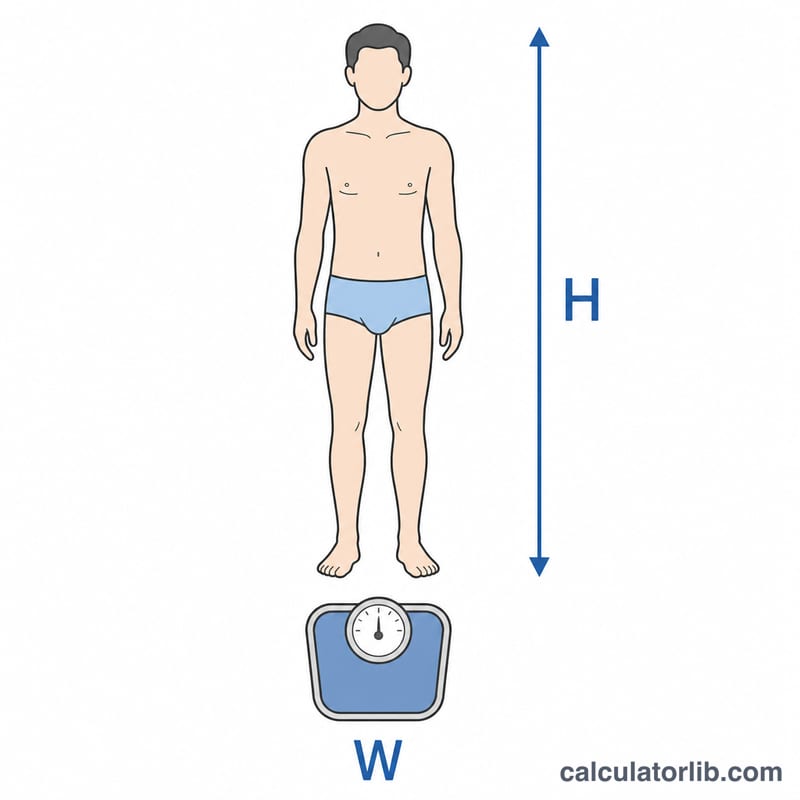
First we compute BSA from height \(H\) (cm) and weight \(W\) (kg):
$$\text{BSA} = \sqrt{\frac{H \times W}{3600}}$$Then the total dose uses the prescribed intensity \(D\) in mg/m²:
$$\text{Dose} = D \times \sqrt{\frac{H \times W}{3600}}$$Here \(H\) = height in centimeters, \(W\) = weight in kilograms, and \(D\) = dose per square meter ordered by the oncology protocol.
How To Use It
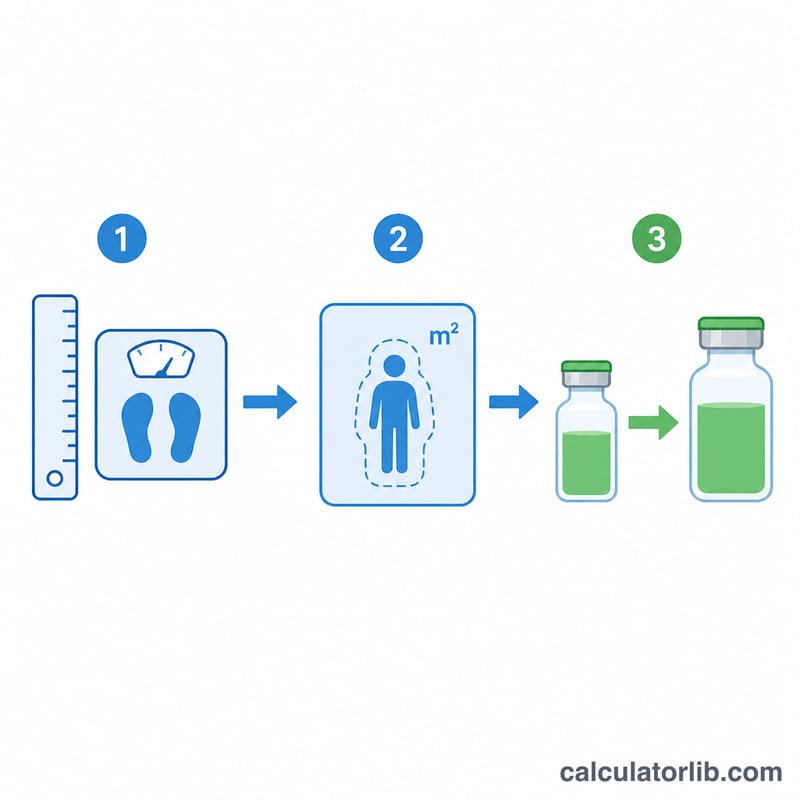
Enter the patient height in centimeters, the weight in kilograms, and the drug dose per square meter from the treatment protocol. The calculator returns the BSA and the total milligram dose. Always confirm against institutional protocols and consider dose capping or rounding rules.
Worked Example
For a patient of 180 cm and 75 kg receiving a drug at 100 mg/m²:
$$\text{BSA} = \sqrt{\frac{180 \times 75}{3600}} = \sqrt{3.75} = 1.936\,\text{m}^2$$$$\text{Dose} = 100 \times 1.936 = 193.65\,\text{mg}$$Interpreting the BSA and Dose Result
The calculator gives you two numbers: body surface area (BSA) in square metres from the Mosteller formula, and the total dose in milligrams. The dose is the prescribed mg/m² multiplied by that BSA:
$$\text{Dose (mg)} = \text{Dose per m}^2 \times \sqrt{\frac{\text{Height (cm)} \times \text{Weight (kg)}}{3600}}$$Typical adult values. Most adults have a BSA of about 1.6–2.0 m². Averages are often quoted at about 1.7 m² for women and 1.9 m² for men. A result well outside this range, such as 0.8 m² or 3.5 m² for an adult, usually means a unit was entered wrongly, for example pounds instead of kilograms or inches instead of centimetres. It can also be a genuinely unusual body size that needs careful clinical review.
BSA capping and obesity. Some institutions have historically capped BSA at 2.0 m² out of concern about toxicity in larger patients. The American Society of Clinical Oncology (ASCO) clinical practice guideline on chemotherapy dosing in obese adults with cancer says something different. It recommends full weight-based doses, using actual body weight, rather than routine capping or empiric dose reduction. Dose changes should instead respond to the toxicities a patient actually has. ASCO is a US-based professional body, and local protocols in other countries or institutions may differ.
Dose banding and rounding. In practice, the calculated dose is often not given exactly as computed. Many oncology services use dose banding, where doses within a set range are standardised to a pre-defined amount. They may also round to practical vial or tablet sizes, commonly within about ±5–10% depending on local policy. The number shown here is a starting calculation, not necessarily the final administered dose.
Results are estimates. BSA formulas are approximations, and different formulas (Mosteller, Du Bois, Haycock and others) give slightly different values for the same person. The prescribing clinician and pharmacist must check every chemotherapy dose against the protocol, current measured height and weight, organ function, prior toxicity and institutional policy.
This is general information, not professional medical advice. Do not use this calculator to choose, start, or change any treatment.
Height and Weight Unit Conversions
The Mosteller formula as used here expects height in centimetres and weight in kilograms. If your measurements are in imperial units (common in the US), convert them before entering. The exact conversion factors are:
- 1 inch = 2.54 cm
- 1 foot = 30.48 cm
- 1 pound = 0.453592 kg
For example, 5'8" is 68 inches, so \(68 \times 2.54 = 172.72\) cm. A weight of 175 lb is \(175 \times 0.453592 = 79.38\) kg.
| Height (ft/in) | Total inches | Height (cm) |
|---|---|---|
| 5'0" | 60 | 152.40 |
| 5'2" | 62 | 157.48 |
| 5'4" | 64 | 162.56 |
| 5'6" | 66 | 167.64 |
| 5'8" | 68 | 172.72 |
| 5'10" | 70 | 177.80 |
| 6'0" | 72 | 182.88 |
| 6'2" | 74 | 187.96 |
| 6'4" | 76 | 193.04 |
| Weight (lb) | Weight (kg) |
|---|---|
| 100 | 45.36 |
| 125 | 56.70 |
| 150 | 68.04 |
| 175 | 79.38 |
| 200 | 90.72 |
| 225 | 102.06 |
| 250 | 113.40 |
Always convert to cm and kg before entering values. If you enter pounds as kilograms, or inches as centimetres, the BSA and dose will be badly wrong.
FAQ
Which BSA formula is used? The Mosteller formula, valued for its simplicity and accuracy across a broad range of body sizes.
Can I use it for pediatric patients? The math holds for any height and weight, but pediatric dosing often uses weight-based or capped protocols, so always follow specialty guidance.
Is the result a prescription? No. This is an educational estimate. A qualified clinician must verify every dose before administration.