
What this BSA calculator does
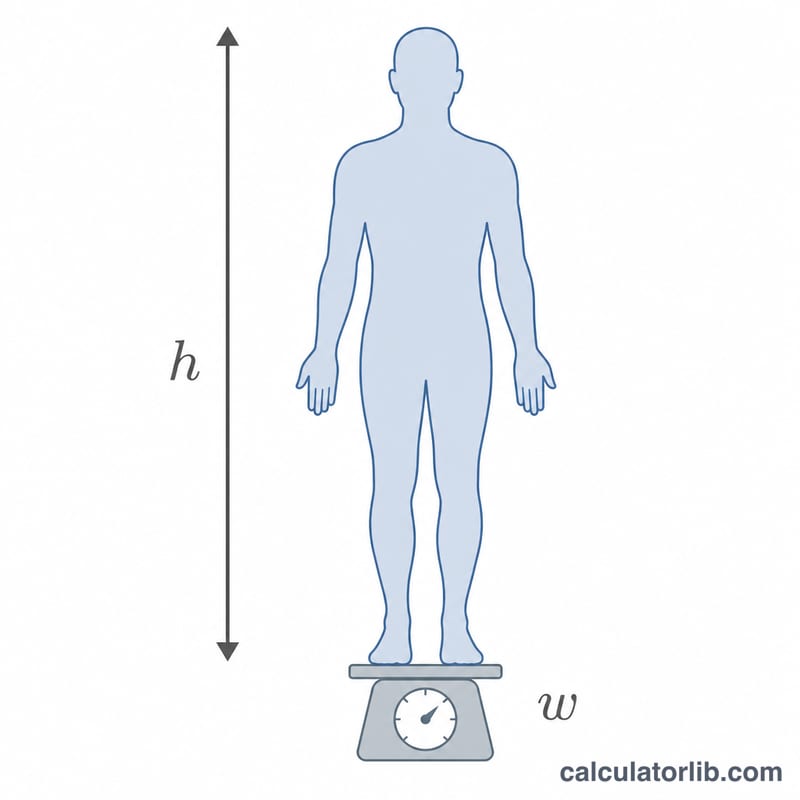
Body surface area (BSA) is the total external area of the human body, expressed in square metres (m²). It is widely used in clinical settings to size chemotherapy and other drug doses, to scale cardiac output (cardiac index), and to estimate metabolic and fluid needs more accurately than weight alone. This calculator computes BSA from just two measurements — your weight in kilograms and height in centimetres — and lets you choose which validated equation to apply.
How to use it
- Weight (kg): enter body weight in kilograms.
- Height (cm): enter height in centimetres.
- Formula: pick one of Du Bois, Mosteller, Haycock, Gehan & George, or Boyd.
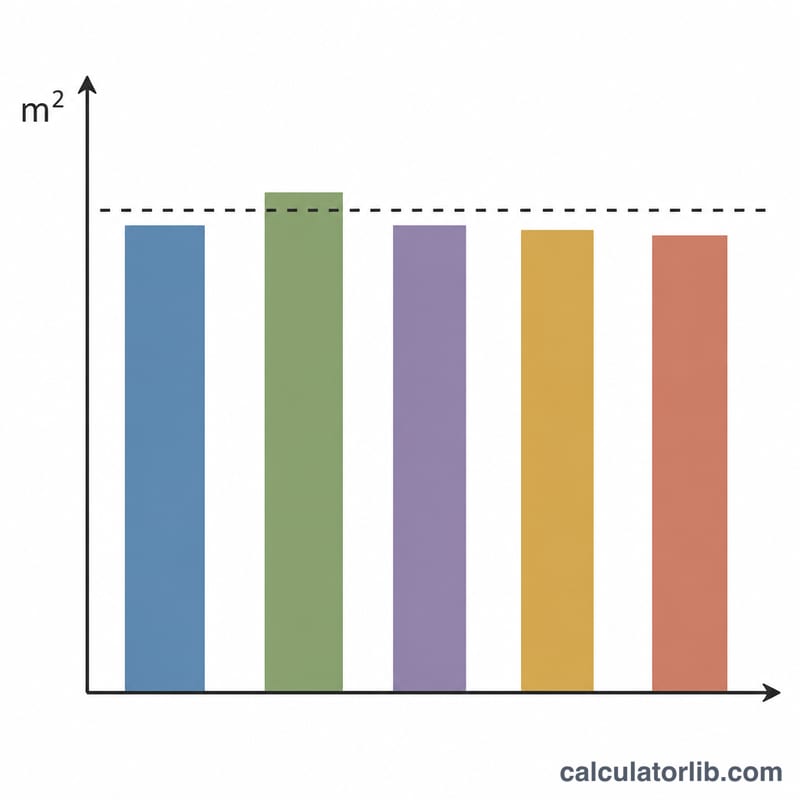
The result is your BSA in m². Different formulas give slightly different values, so use the one your institution or protocol specifies.
The formulas explained
Each method uses height (H, cm) and weight (W, kg):
- Mosteller: \(\text{BSA} = \sqrt{\dfrac{\text{H} \times \text{W}}{3600}}\) — the simplest and most popular.
- Du Bois: \(\text{BSA} = 0.007184 \times \text{W}^{0.425} \times \text{H}^{0.725}\) — the classic 1916 equation.
- Haycock: \(\text{BSA} = 0.024265 \times \text{W}^{0.5378} \times \text{H}^{0.3964}\) — works well across infants to adults.
- Gehan & George: \(\text{BSA} = 0.0235 \times \text{W}^{0.51456} \times \text{H}^{0.42246}\).
- Boyd: \(\text{BSA} = 0.0333 \times \text{W}^{\left(0.6157 - 0.0188 \times \log_{10}\text{W}\right)} \times \text{H}^{0.3}\).
Worked example
For a person who is 170 cm tall and weighs 70 kg, using the Mosteller formula:
$$\text{BSA} = \sqrt{\frac{170 \times 70}{3600}} = \sqrt{\frac{11900}{3600}} = \sqrt{3.306} \approx 1.82 \text{ m}^2$$Running the same height and weight through Du Bois gives \(0.007184 \times 70^{0.425} \times 170^{0.725} \approx 1.81 \text{ m}^2\) — very close, which is typical for healthy adults.
Interpreting Your BSA Result
Body surface area (BSA) is the total external area of the human body, expressed in square metres (m²). For most adults, BSA falls in the range of roughly 1.6–2.0 m², with an often-cited average of about 1.7 m² for adult men and 1.6 m² for adult women. The value rises with both height and weight, so taller and heavier individuals have a larger BSA.
A long-standing clinical convention uses 1.73 m² as a reference ("normalized") BSA. This figure was historically taken as the average BSA of a young adult and is used to index physiological measurements so that they can be compared across people of different sizes. The most familiar example is estimated glomerular filtration rate (eGFR), which is reported per 1.73 m².
BSA is widely used to scale measurements and doses to body size:
- Drug dosing. Many medications — particularly chemotherapy agents — are prescribed in mg per m² of BSA. A patient's dose is the per-m² dose multiplied by their computed BSA, which helps account for differences in metabolism and distribution that correlate better with surface area than with weight alone.
- Cardiac index. Cardiac output (L/min) divided by BSA gives the cardiac index in L/min/m², allowing a person's heart performance to be compared to normal ranges (typically about 2.5–4.0 L/min/m²) independent of body size.
Infants and children have much smaller BSA values — a newborn is often near 0.2–0.25 m² and rises through childhood — which is precisely why pediatric dosing frequently relies on BSA rather than a flat adult dose.
This is general educational information about how BSA is interpreted and is not medical advice. Dosing and clinical decisions should be made by a qualified healthcare professional.
Key Terms & Variables
- Body Surface Area (BSA)
- The total surface area of the body, expressed in square metres (m²). It is estimated from height and weight using empirical formulas and is used to scale physiological values and drug doses to body size.
- Height (H, cm)
- The patient's standing height in centimetres. Height enters every BSA formula with a positive exponent, so a taller person has a larger BSA at the same weight.
- Weight (W, kg)
- The patient's body mass in kilograms. Weight is the other primary input; increasing weight increases BSA.
- Cardiac Index
- Cardiac output (L/min) divided by BSA, giving L/min/m². Indexing to BSA lets heart output be compared across body sizes; a typical resting range is about 2.5–4.0 L/min/m².
- 1.73 m² Reference Standard
- A conventional "normalized" adult BSA used to standardize measurements such as eGFR (reported per 1.73 m²), so results are comparable between patients of different sizes.
- Dosing per m²
- A dosing strategy where the prescribed amount equals a per-m² dose multiplied by the patient's BSA (e.g. a chemotherapy dose of 100 mg/m² for a patient with 1.8 m² BSA gives 180 mg). It is common in oncology and pediatrics.
FAQ
Which BSA formula should I use? Mosteller is the most common default because it is easy to verify by hand. Du Bois is the historical standard, while Haycock is often preferred for children. Always follow your specific clinical protocol.
Why do the results differ between formulas? Each was derived from a different study population and uses different exponents, so values can vary by a few percent. For most adults the spread is small.
Is this a medical device? No. It is an educational and reference tool. Dosing and clinical decisions should be made by a qualified healthcare professional.