
What the Carbohydrate Calculator Does
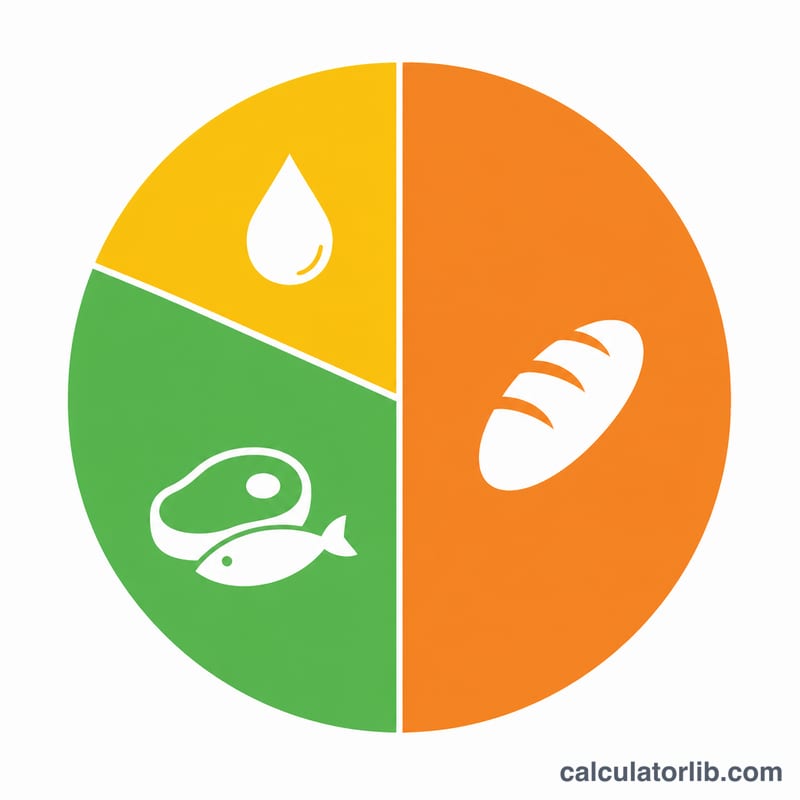
This calculator estimates how many grams of carbohydrates you should eat per day, along with matching protein and fat targets. It works by first estimating your daily calorie needs, then splitting those calories using a balanced 50/30/20 macronutrient ratio (50% carbs, 30% protein, 20% fat). It is a general fitness and nutrition tool and is not tailored to any single country's dietary guidelines.
The Inputs You Provide
- Age – in years, used in the metabolic rate formula.
- Gender – Male or Female, which changes the equation constants.
- Weight (kg) – your body weight in kilograms.
- Height (cm) – your height in centimetres.
- Activity Level – Sedentary, Lightly Active, Moderately Active, Very Active, or Extra Active.
The Formula Explained
The tool uses the Mifflin–St Jeor style Harris-Benedict (revised) equations to find your Basal Metabolic Rate (BMR):
- Male: \(\text{BMR} = 88.362 + (13.397 \times \text{weight}) + (4.799 \times \text{height}) - (5.677 \times \text{age})\)
- Female: \(\text{BMR} = 447.593 + (9.247 \times \text{weight}) + (3.098 \times \text{height}) - (4.330 \times \text{age})\)
Your BMR is then multiplied by an activity factor to get your Total Daily Energy Expenditure (TDEE): Sedentary ×1.2, Lightly Active ×1.375, Moderately Active ×1.55, Very Active ×1.725, Extra Active ×1.9.
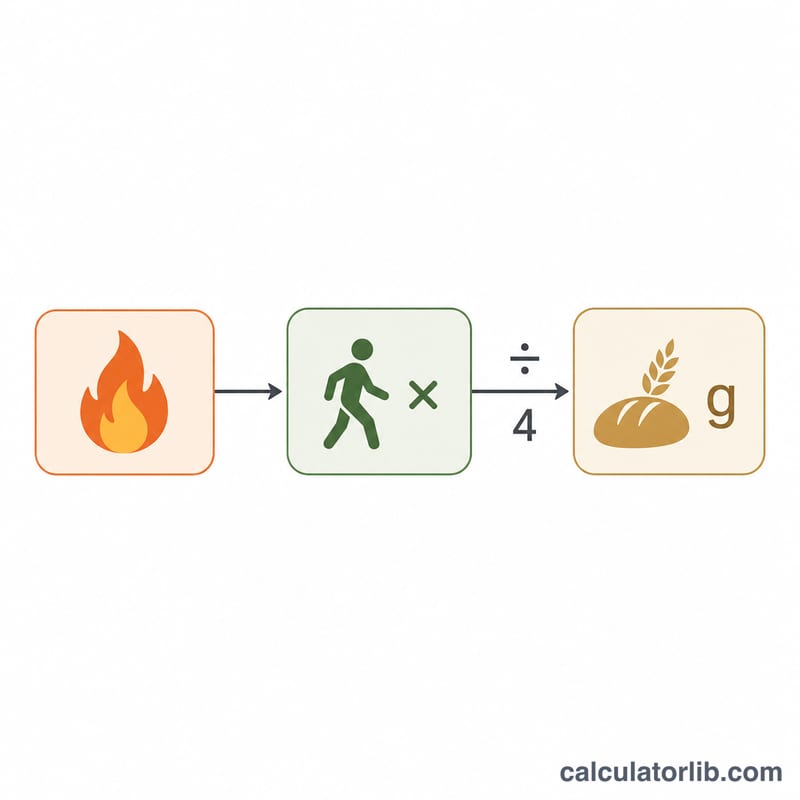
Finally, macros are derived from TDEE. Because carbs and protein supply 4 calories per gram and fat 9 calories per gram:
- Carbs (g) \(= (\text{TDEE} \times 0.50) \div 4\)
- Protein (g) \(= (\text{TDEE} \times 0.30) \div 4\)
- Fat (g) \(= (\text{TDEE} \times 0.20) \div 9\)
Worked Example
Consider a 30-year-old male, 80 kg, 180 cm, Moderately Active:
- $$\text{BMR} = 88.362 + (13.397 \times 80) + (4.799 \times 180) - (5.677 \times 30) \approx 1{,}832 \text{ kcal}$$
- $$\text{TDEE} = 1{,}832 \times 1.55 \approx 2{,}840 \text{ kcal}$$
- $$\text{Carbs} = (2{,}840 \times 0.5) \div 4 \approx \textbf{355 g}$$
- $$\text{Protein} = (2{,}840 \times 0.3) \div 4 \approx \textbf{213 g}$$
- $$\text{Fat} = (2{,}840 \times 0.2) \div 9 \approx \textbf{63 g}$$
Frequently Asked Questions
Is 50% of calories from carbs right for me? The 50/30/20 split is a widely used balanced template, but athletes, low-carb dieters, or people with medical conditions may need different ratios.
Should I use weight in kilograms or pounds? Always enter weight in kilograms and height in centimetres, since the formula constants are calibrated for metric units.
Will eating these carbs help me lose weight? These figures are based on maintenance calories (TDEE). To lose weight, you would need to reduce total calories below your TDEE while keeping protein adequate.