What Is the CrCl Calculator?
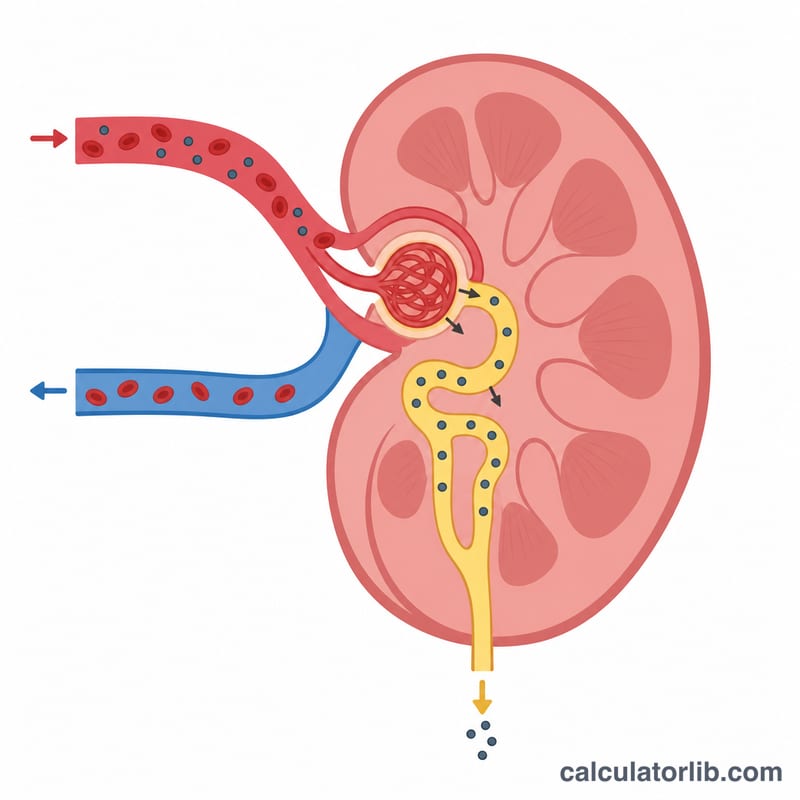
The CrCl Calculator estimates your creatinine clearance — a measure of how efficiently your kidneys filter waste from your blood. It uses the widely accepted Cockcroft–Gault formula, which relies on your age, body weight, serum creatinine level, and sex. Creatinine clearance is reported in milliliters per minute (mL/min) and gives clinicians a practical estimate of kidney function (glomerular filtration). This tool uses US-standard units: weight in kilograms and serum creatinine in mg/dL.
How to Use the Calculator
Enter the following values and let the calculator do the math:
- Age — in years.
- Weight — in kilograms (kg). Ideal or adjusted body weight may be more accurate for very over- or underweight patients.
- Serum creatinine — in mg/dL, taken from a recent blood test.
- Gender — used to apply the female correction factor.
The Cockcroft–Gault Formula Explained
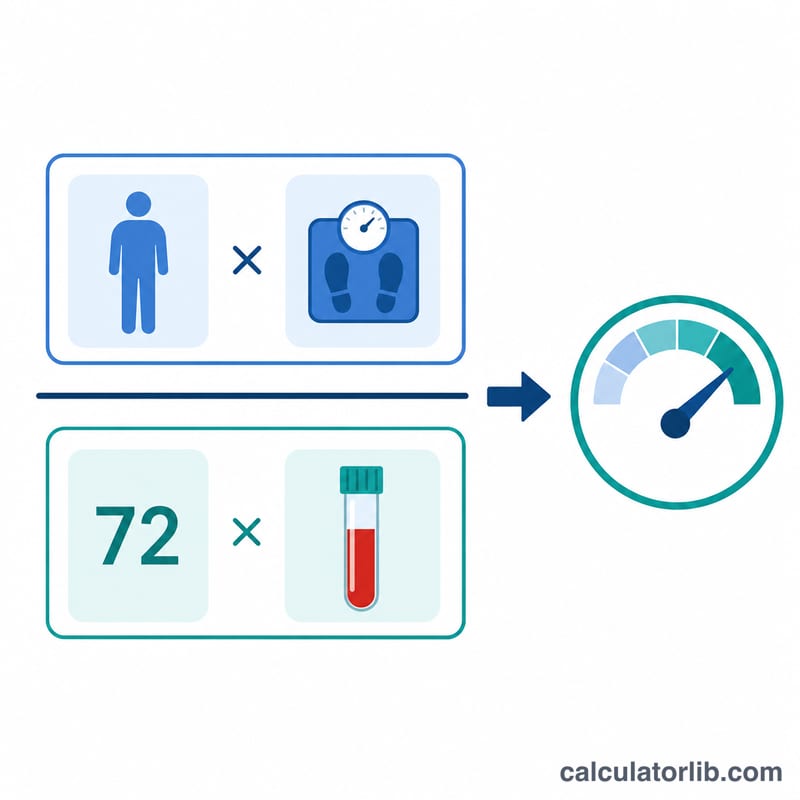
The formula is:
$$\text{CrCl} = \frac{(140 - \text{age}) \times \text{weight}}{72 \times \text{serum creatinine}}$$
For females, the result is multiplied by \(0.85\) to account for typically lower muscle mass. As age rises and creatinine increases, the estimated clearance falls — both signs of declining kidney function. Higher body weight increases the estimate because it reflects greater muscle mass producing creatinine.
Worked Example
Consider a 60-year-old woman weighing 70 kg with a serum creatinine of 1.0 mg/dL:
- \((140 - 60) \times 70 = 5{,}600\)
- \(72 \times 1.0 = 72\)
- \(5{,}600 \div 72 = 77.8 \text{ mL/min}\)
- Female factor: \(77.8 \times 0.85 =\) 66.1 mL/min
A CrCl of about 66 mL/min suggests mildly reduced kidney function.
Creatinine Clearance Reference Ranges
The ranges below align CrCl values with the standard stages used to describe chronic kidney disease (CKD). Because CrCl approximates GFR, these boundaries mirror the widely used CKD staging thresholds.
| CrCl (mL/min) | Kidney Function Category | CKD Stage |
|---|---|---|
| ≥ 90 | Normal or high filtration | Stage 1 (with kidney damage) / Normal |
| 60 – 89 | Mildly reduced | Stage 2 |
| 45 – 59 | Mild to moderately reduced | Stage 3a |
| 30 – 44 | Moderate to severely reduced | Stage 3b |
| 15 – 29 | Severely reduced | Stage 4 |
| < 15 | Kidney failure | Stage 5 (end-stage) |
Note: In formal CKD staging, Stages 1 and 2 require evidence of kidney damage (such as protein in the urine) in addition to the filtration value. A CrCl above 90 with no other abnormalities is generally considered normal.
Key Terms Explained
- Creatinine clearance (CrCl)
- An estimate of the volume of blood plasma cleared of creatinine per minute (mL/min). It is used as a practical marker of kidney filtration and to adjust doses of drugs eliminated by the kidneys. The Cockcroft–Gault equation estimates it from age, weight, serum creatinine, and sex.
- Serum creatinine
- The concentration of creatinine — a waste product of muscle metabolism — in the blood, measured in mg/dL. Because healthy kidneys clear creatinine steadily, a rising serum creatinine usually reflects falling kidney function. It is the key input in the CrCl formula (appearing in the denominator, so higher values lower the result).
- Glomerular filtration rate (GFR)
- The rate at which the kidneys' filtering units (glomeruli) filter blood, expressed in mL/min (or mL/min/1.73 m² when normalized for body surface area). GFR is the gold-standard measure of kidney function; CrCl is a convenient bedside approximation of it.
- Ideal body weight (IBW) and adjusted body weight (AdjBW)
- Ideal body weight is a height-based estimate of a healthy weight, often used in Cockcroft–Gault instead of actual weight to avoid overestimating clearance in overweight patients. For obese individuals, an adjusted body weight — IBW plus a fraction of the excess over IBW — is sometimes used. This calculator uses the weight value you enter, so choosing an appropriate weight matters for accuracy.
- Female correction factor
- Women generally have lower muscle mass and therefore lower creatinine production than men of the same size. The Cockcroft–Gault equation accounts for this by multiplying the male-based result by 0.85 for female patients, reducing the estimated CrCl accordingly.
Frequently Asked Questions
What is a normal creatinine clearance? Healthy adults usually have a CrCl of roughly 90–120 mL/min. Values decline naturally with age.
Why is CrCl used for drug dosing? Many medications are cleared by the kidneys. Doctors use CrCl to safely adjust doses for drugs such as certain antibiotics and anticoagulants.
Is this the same as eGFR? No. eGFR is a different estimate that adjusts for body surface area. Cockcroft–Gault CrCl remains the standard for many medication dosing guidelines.
This calculator is for educational use only and does not replace professional medical advice.