
What the GCS Calculator Does
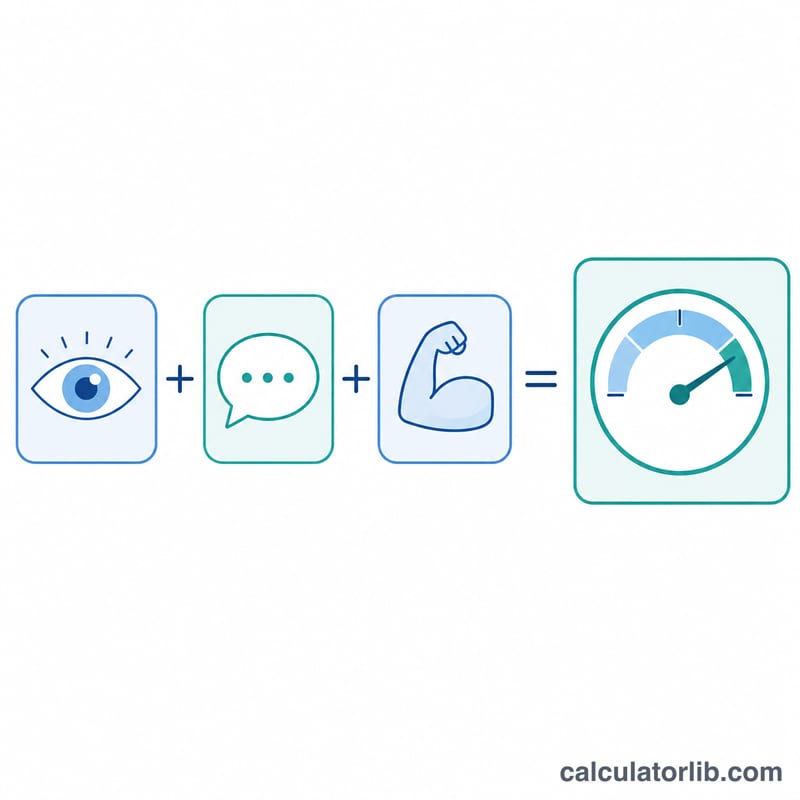
The Glasgow Coma Scale (GCS) Calculator is a clinical scoring tool used worldwide to assess a patient's level of consciousness, most commonly after a head injury, stroke, or other neurological event. It converts three bedside observations — eye opening, verbal response, and motor response — into a single number between 3 and 15 and instantly classifies the brain injury severity. It is widely used by paramedics, nurses, emergency physicians, and medical students.
How to Use It
Select one option from each of the three response categories. Each category has a fixed range of scores:
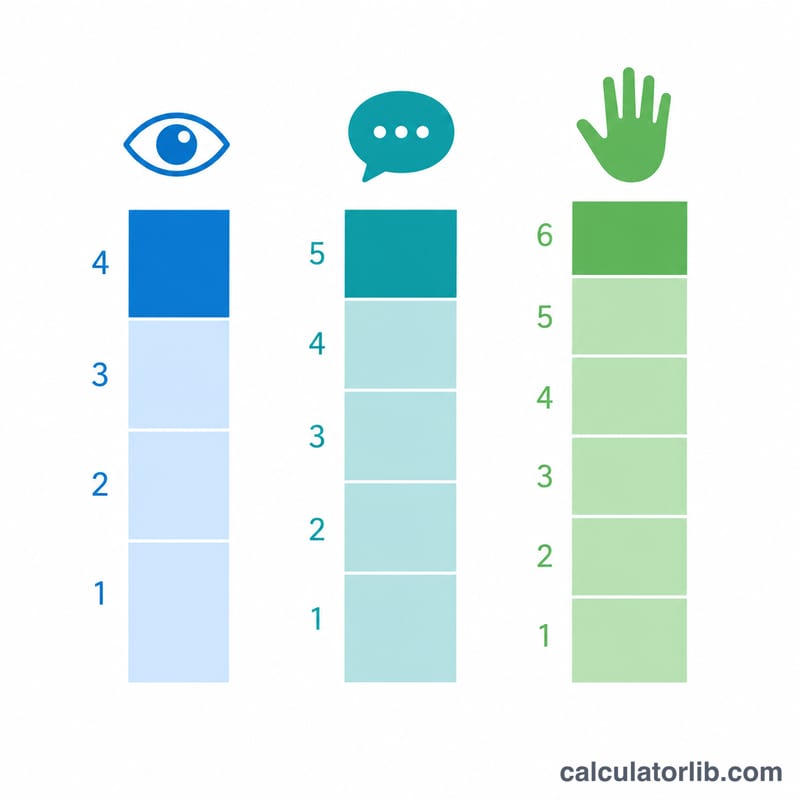
- Eye Response (1–4): 4 = opens eyes spontaneously, 3 = opens to voice, 2 = opens to pain, 1 = no eye opening.
- Verbal Response (1–5): 5 = oriented and conversing normally, 4 = confused, 3 = inappropriate words, 2 = incomprehensible sounds, 1 = no verbal response.
- Motor Response (1–6): 6 = obeys commands, 5 = localizes to pain, 4 = withdraws from pain, 3 = flexion to pain, 2 = extension to pain, 1 = no motor response.
The calculator adds the three selections together to produce a total and an interpretation.
The Formula
The total GCS score is simply the sum of the three components:
$$\text{GCS} = \text{Eye} + \text{Verbal} + \text{Motor}$$
The minimum possible score is 3 (\(1 + 1 + 1\)) and the maximum is 15 (\(4 + 5 + 6\)). The calculator then classifies severity using these standard thresholds:
- Mild: total of 13 or higher
- Moderate: total of 9 to 12
- Severe: total of 8 or below
Worked Example
Suppose a patient opens their eyes only in response to voice (Eye = 3), speaks in confused, disoriented sentences (Verbal = 4), and withdraws from a painful stimulus (Motor = 4). The total is:
$$3 + 4 + 4 = \mathbf{11}$$
A score of 11 falls in the 9–12 range, so the calculator reports a severity of Moderate brain injury.
Frequently Asked Questions
What is the lowest possible GCS score? The lowest is 3 — a patient who scores 1 on all three components. A score of 3 cannot mean "no patient"; it reflects deep unresponsiveness.
Is GCS the only thing that determines treatment? No. GCS is a quick triage and monitoring tool. Clinical decisions also depend on imaging, vital signs, pupil response, and the overall clinical picture. Always document the individual eye, verbal, and motor scores, not just the total.
Why record the components separately? Two patients can have the same total of 9 with very different presentations. Reporting it as "E3 V4 M2," for example, gives clinicians far more useful detail than the sum alone.