
What Is Lean Body Mass?
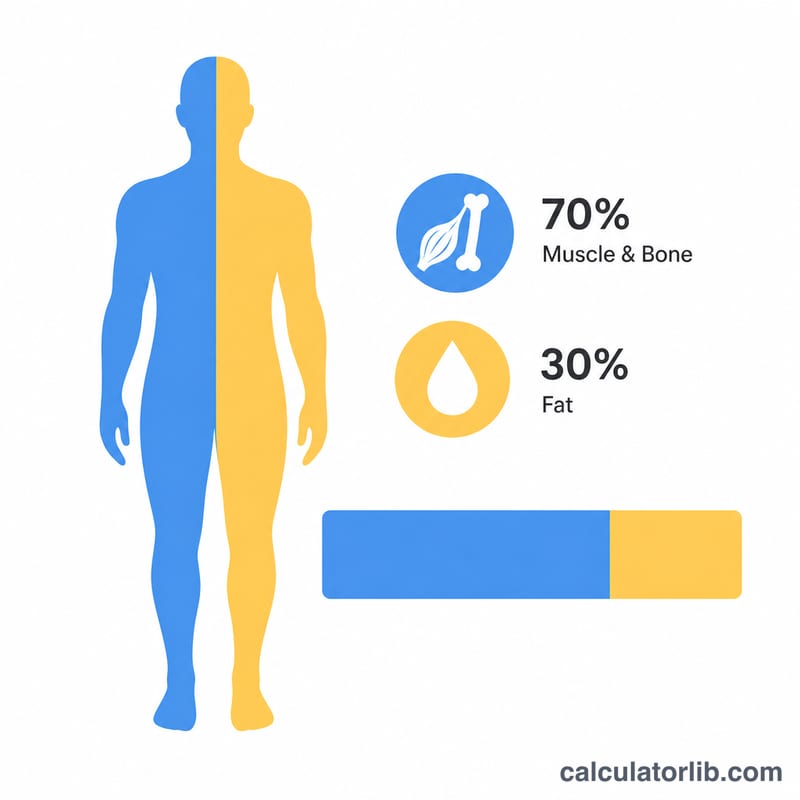
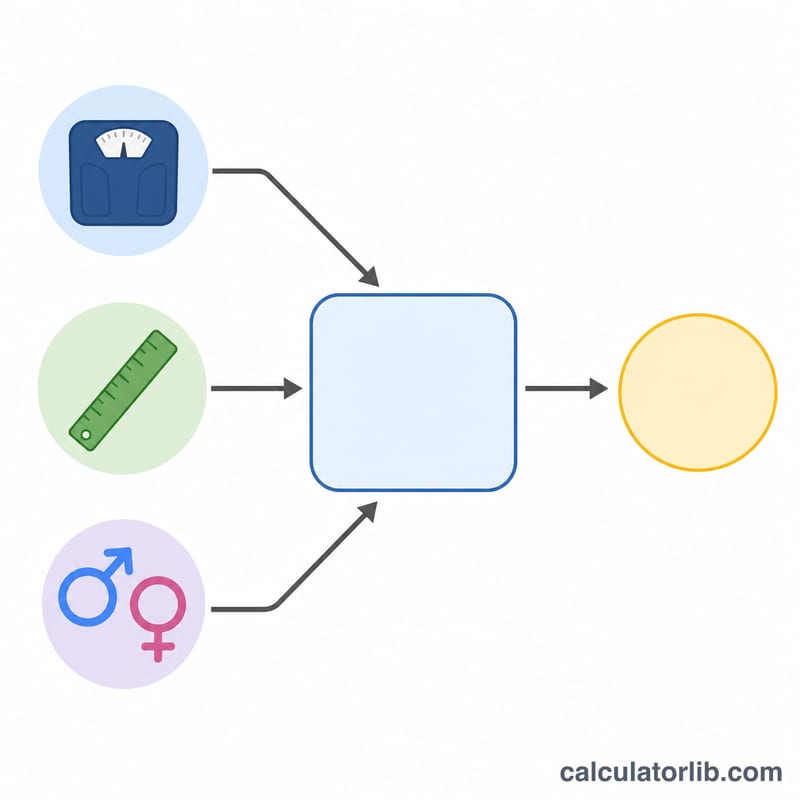
Lean body mass (LBM) is everything in your body that isn't fat — muscle, bone, organs, water and connective tissue. This calculator estimates your LBM from just three inputs: weight (in kilograms), height (in centimetres) and gender (male or female). Instead of relying on a single equation, it runs four established formulas at once and averages them, giving you a more balanced estimate than any one method alone.
How to Use the Calculator
- Weight (kg): Enter your current body weight in kilograms.
- Height (cm): Enter your height in centimetres.
- Gender: Select Male or Female — each formula uses different coefficients by sex.
The tool returns your LBM, your estimated fat mass (weight minus LBM) and body fat percentage for each formula, plus an averaged result.
The Formulas Used
The calculator applies four equations. For a male, for example:
- Boer: \((0.407 \times \text{weight}) + (0.267 \times \text{height}) - 19.2\)
- James: \((1.1 \times \text{weight}) - 128 \times (\text{weight} \div \text{height})^{2}\)
- Hume: \((0.32810 \times \text{weight}) + (0.33929 \times \text{height}) - 29.5336\)
- BMI-based: \((1.10 \times \text{weight}) - 128 \times (\text{weight}^{2} \div \text{height}^{2})\)
Female versions use different constants (e.g. Boer: \(0.252 \times \text{weight} + 0.473 \times \text{height} - 48.3\)). The final averaged LBM is the mean of all four results, and fat percentage is calculated as $$(\text{weight} - \text{LBM}) \div \text{weight} \times 100.$$
Worked Example
Take a male weighing 80 kg at 180 cm:
- Boer: $$0.407 \times 80 + 0.267 \times 180 - 19.2 = \textbf{61.4 kg}$$
- Hume: $$0.32810 \times 80 + 0.33929 \times 180 - 29.5336 = \textbf{57.8 kg}$$
- Boer fat: \(80 - 61.4 = 18.6\) kg, or about 23% body fat.
The averaged LBM across all four formulas lands near 60 kg for this profile.
Frequently Asked Questions
Why does it show four different numbers? Each formula was developed from different population studies, so they vary slightly. Averaging them reduces the bias of any single method.
Which formula is most accurate? The Boer formula is widely regarded as reliable for general use, but for tracking, what matters most is consistency — use the same method over time.
Is this a measurement of fat? No. It's an estimate based on weight, height and sex only. It can't account for individual muscularity, so very athletic or very lean individuals may see less accurate results compared to a DEXA scan or bioelectrical impedance test.