
What the Cardiac Frequency Calculator Does
The Cardiac Frequency Calculator estimates your maximum heart rate and personalized target heart rate training zones based on two simple inputs: your age and your resting heart rate. Instead of using a one-size-fits-all percentage of maximum heart rate, it applies the Karvonen method (heart rate reserve), which factors in your individual fitness baseline for more accurate exercise zones — useful whether you are walking, jogging, cycling, or doing interval training.
The Inputs You Provide
- Age — your age in years (defaults to 30 if left blank). Used to estimate maximum heart rate.
- Resting Heart Rate — your beats per minute at rest, ideally measured first thing in the morning (defaults to 70). A lower resting rate generally indicates better cardiovascular fitness.
The Formula Explained
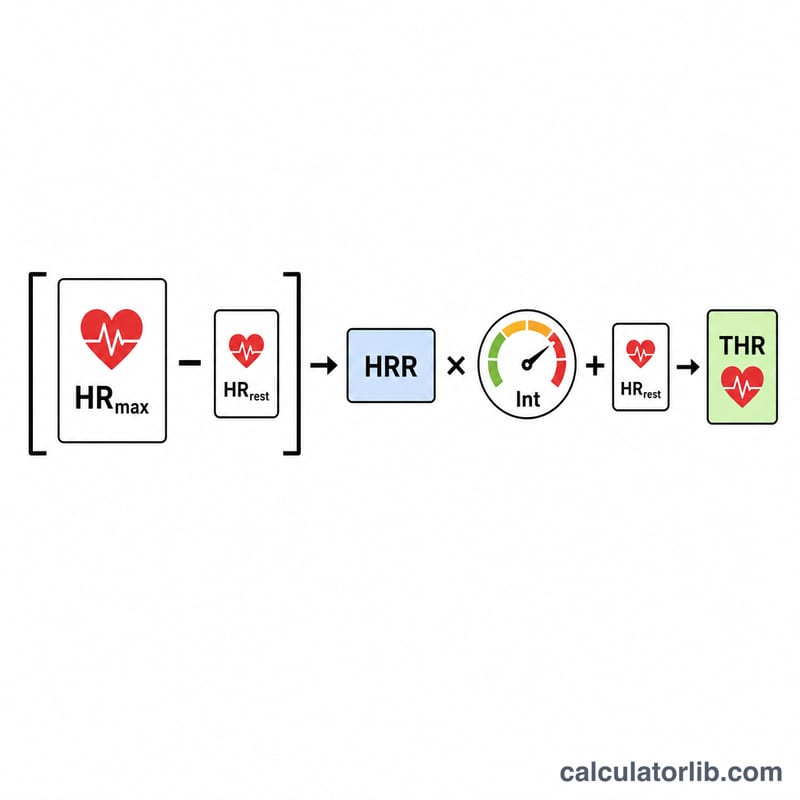
The calculator works in three steps:
- Maximum Heart Rate (MHR): \(220 - \text{Age}\)
- Heart Rate Reserve (HRR): \(\text{MHR} - \text{Resting Heart Rate}\)
- Target Heart Rate at a given intensity: \((\text{HRR} \times \text{intensity}) + \text{Resting Heart Rate}\)
$$\begin{gathered} \text{THR} = \left(\text{HRR} \times I\right) + \text{Resting HR} \\[1.5em] \text{where}\quad \left\{ \begin{aligned} \text{HRR} &= \left(220 - \text{Age}\right) - \text{Resting HR} \\ I &= \text{Intensity}\ (0.5 - 0.9) \end{aligned} \right. \end{gathered}$$
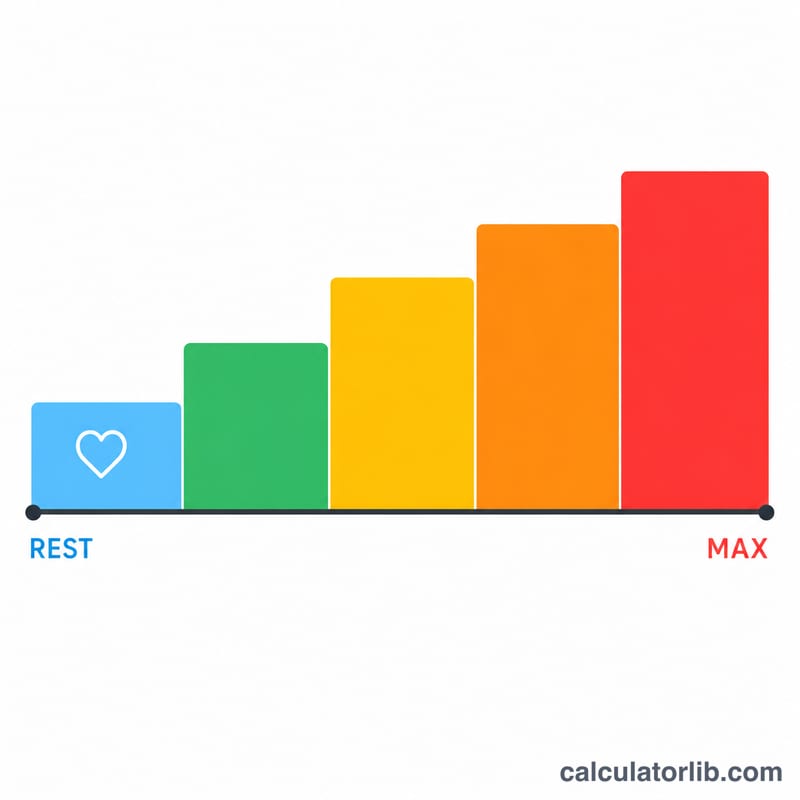
It computes target rates at five intensity levels — 50%, 60%, 70%, 80% and 90% — so you can match your effort to your goal, from gentle warm-ups to high-intensity work.
Worked Example
Suppose you are 40 years old with a resting heart rate of 60 bpm:
- Maximum Heart Rate = \(220 - 40 = \mathbf{180}\) bpm
- Heart Rate Reserve = \(180 - 60 = \mathbf{120}\) bpm
- 50% target = \((120 \times 0.50) + 60 = \mathbf{120}\) bpm
- 60% target = \((120 \times 0.60) + 60 = \mathbf{132}\) bpm
- 70% target = \((120 \times 0.70) + 60 = \mathbf{144}\) bpm
- 80% target = \((120 \times 0.80) + 60 = \mathbf{156}\) bpm
- 90% target = \((120 \times 0.90) + 60 = \mathbf{174}\) bpm
For moderate aerobic exercise, you would aim for roughly 132–156 bpm in this example.
Frequently Asked Questions
Why use heart rate reserve instead of a flat percentage of max? The Karvonen method includes your resting heart rate, personalizing the zones to your fitness level. Two people the same age can have very different target zones if their resting rates differ.
How do I measure my resting heart rate accurately? Count your pulse for 60 seconds while still in bed before getting up, or use a fitness tracker over several mornings and take the average.
Is the 220 − age formula exact? No — it is a widely used estimate and can vary by ±10–12 bpm between individuals. Use the results as a guide, and consult a doctor before starting intense exercise, especially if you have a heart condition.