What is a derivative calculator?
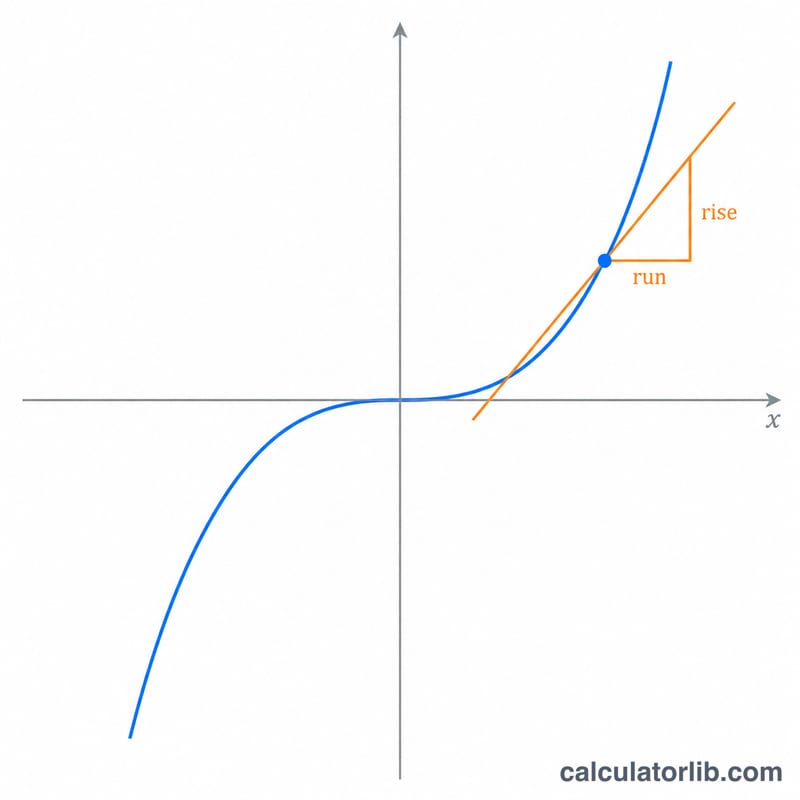
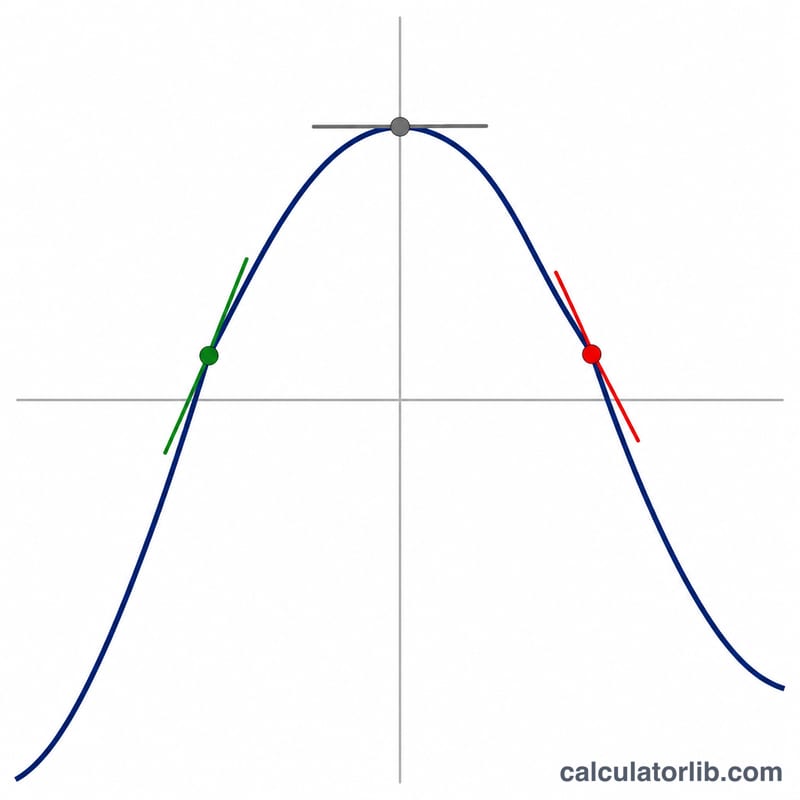
A derivative calculator finds the rate at which a function changes. This tool works with polynomials up to degree four, \(f(x)=a_4x^4+a_3x^3+a_2x^2+a_1x+a_0\). It returns the symbolic derivative, the derivative value at a chosen point, the second derivative and the equation of the tangent line.
How to use it
Enter the coefficients \(a_4\) through \(a_0\). Use 0 for any missing term. Then enter the point \(x\) where you want the slope. The calculator shows \(f(x)\), \(f^{\prime}(x)\), \(f^{\prime\prime}(x)\) and the tangent line \(y=mx+b\).
The formula explained
Each term is differentiated with the power rule:
$$\frac{d}{dx}\left(a x^{n}\right)=n\,a\,x^{n-1}$$so the derivative of the polynomial is
$$f^{\prime}(x)=4a_4x^3+3a_3x^2+2a_2x+a_1$$and the second derivative is \(f^{\prime\prime}(x)=12a_4x^2+6a_3x+2a_2\). The tangent line at \(x_0\) has slope \(m=f^{\prime}(x_0)\) and intercept \(b=f(x_0)-m\,x_0\).
Worked example
Take \(f(x)=x^3-2x^2+3x+5\) at \(x=2\).
$$f(2)=8-8+6+5=11$$$$f^{\prime}(x)=3x^2-4x+3\Rightarrow f^{\prime}(2)=12-8+3=7$$$$f^{\prime\prime}(2)=6(2)-4=8$$$$b=11-7\times 2=-3\Rightarrow y=7x-3$$Power Rule Derivatives of Common Polynomial Terms
The power rule states that for a term \(a x^n\), the derivative is \(n a x^{n-1}\). Applying it twice gives the second derivative. Because a polynomial is a sum of terms, you can differentiate it term by term. In the table below, \(a\) is any real constant coefficient.
| Term | First derivative | Second derivative |
|---|---|---|
| \(a\) (constant) | \(0\) | \(0\) |
| \(a x\) | \(a\) | \(0\) |
| \(a x^{2}\) | \(2 a x\) | \(2 a\) |
| \(a x^{3}\) | \(3 a x^{2}\) | \(6 a x\) |
| \(a x^{4}\) | \(4 a x^{3}\) | \(12 a x^{2}\) |
Note: the derivative of a constant is 0, because a constant does not change as \(x\) changes. This is why the coefficient \(a_0\) does not appear in \(f'(x)\), although it does affect the value \(f(x_0)\) and the tangent line's intercept.
FAQ
Can it handle sin, cos or ln? No. This version is for polynomials, which cover many algebra and calculus exercises.
What does a derivative of zero mean? The tangent line is horizontal there, which often marks a maximum, minimum or inflection point. The sign of the second derivative helps tell them apart.
What does the second derivative tell me? A positive value means the curve bends upward (concave up). A negative value means it bends downward.