
What this calculator does
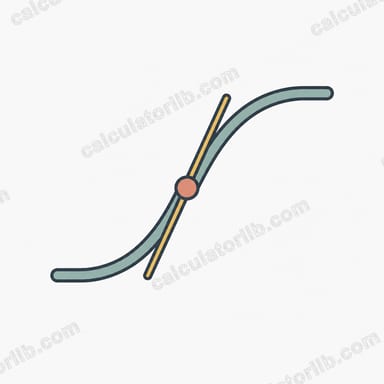
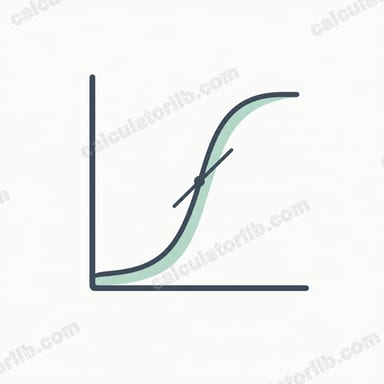
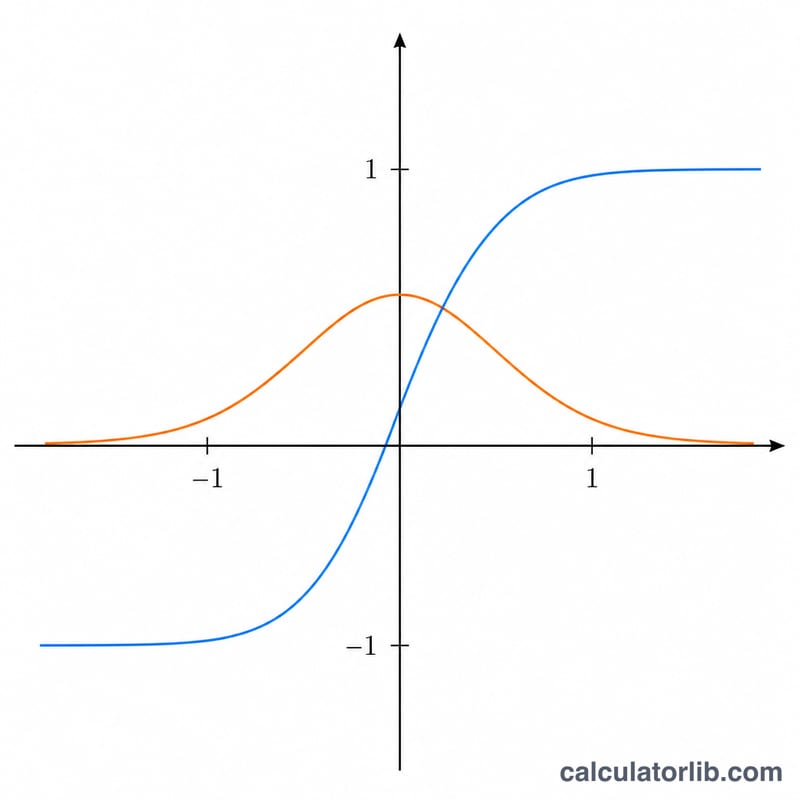
This tool evaluates the hyperbolic tangent function \(\tanh(x)\) and, more importantly, its first derivative \(\tanh'(x)\) at any real input \(x\). It also reports the second derivative \(\tanh''(x)\). The hyperbolic tangent is a smooth, S-shaped (sigmoidal) function whose output is bounded between -1 and 1, which is why it appears so often as a neural-network activation function and in physics and engineering models.
How to use it
Enter any real number for \(x\) and submit. The calculator computes \(\tanh(x)\) once, then derives both the first and second derivatives from that single value. There are no units to convert: \(x\) is a dimensionless real number, and all outputs are dimensionless as well.
The formula explained
The hyperbolic tangent is $$\tanh(x) = \frac{e^x - e^{-x}}{e^x + e^{-x}}.$$ Its first derivative has the elegant closed form $$f'(x) = 1 - \tanh^{2}(x),$$ equivalently \(\operatorname{sech}^2(x) = \frac{1}{\cosh^2(x)}\). Because \(\tanh(x)\) lies in \((-1, 1)\), the first derivative always lies in \((0, 1]\), peaking at \(x = 0\) where the slope is exactly 1. The second derivative is $$f''(x) = -2\tanh(x)\left(1 - \tanh^{2}(x)\right),$$ an odd function that crosses zero at \(x = 0\).
Worked example (x = 0.5)
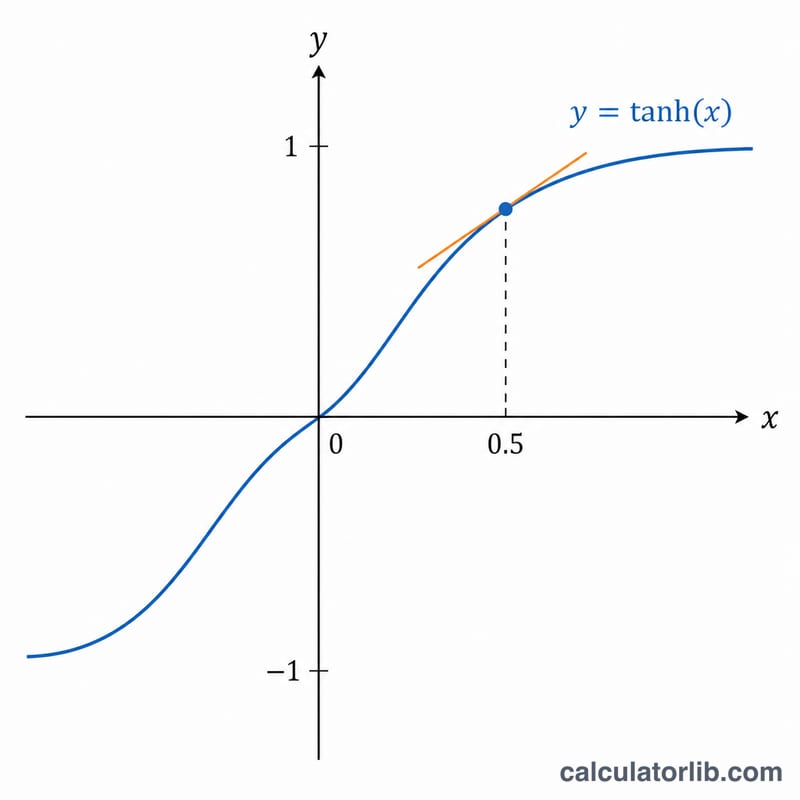
$$\tanh(0.5) = \frac{1.6487212707 - 0.6065306597}{1.6487212707 + 0.6065306597} = 0.4621171573.$$ Then $$f'(0.5) = 1 - 0.4621171573^{2} = 0.7864477541,$$ and $$f''(0.5) = -2 \times 0.4621171573 \times 0.7864477541 = -0.7269278407.$$
FAQ
Why does the gradient vanish for large x? As \(x\) grows, tanh saturates toward \(\pm 1\), so \(1 - \tanh^2\) approaches 0. This "vanishing gradient" can slow training in deep networks.
Is the derivative ever negative? No. \(f'(x) = \operatorname{sech}^2(x)\) is strictly positive for all real \(x\), so tanh is always increasing.
Is there any divide-by-zero risk? No. \(\cosh(x)\) is at least 1 for every real \(x\), so \(\operatorname{sech}^2(x)\) is always well defined.