
What Is the Inductors in Parallel Calculator?
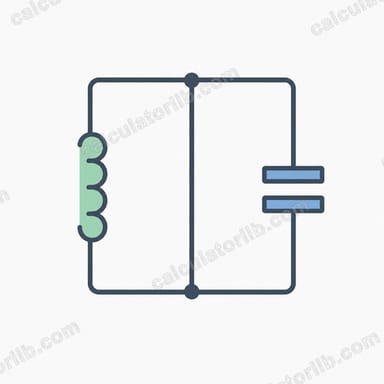
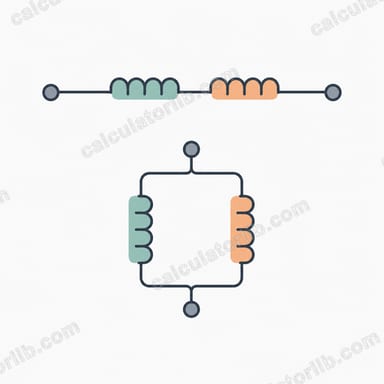
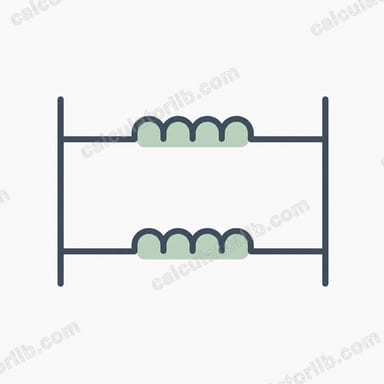
When inductors are connected in parallel, the total (equivalent) inductance is always smaller than the smallest individual inductor — much like resistors in parallel. This calculator instantly computes the combined inductance of up to four inductors wired in parallel, assuming there is no mutual coupling between them.
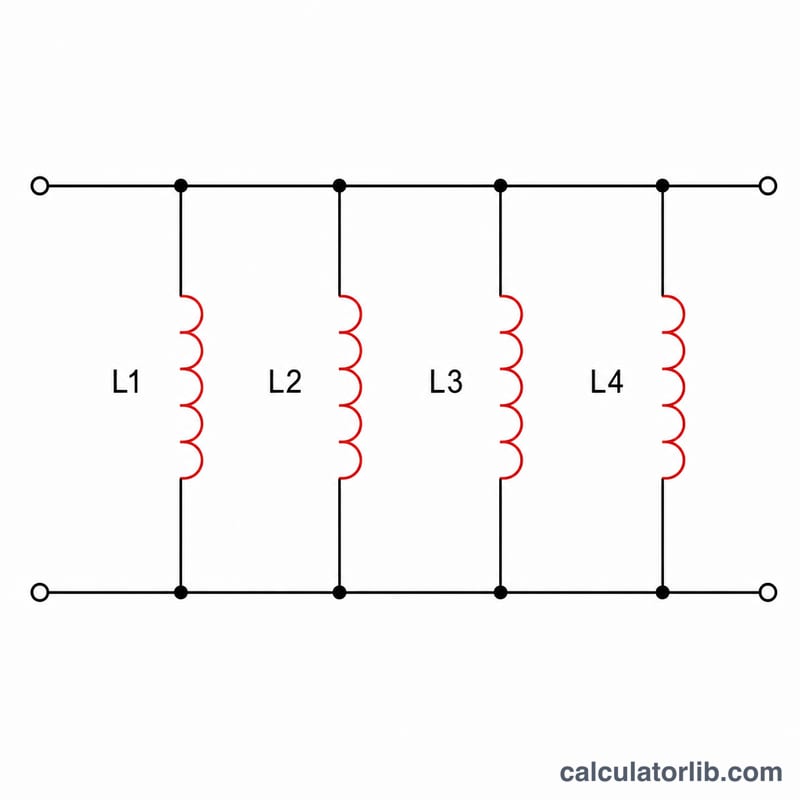
How to Use It
Enter the value of each inductor in henries (H). Fill in L1 and L2 at minimum; L3 and L4 are optional — leave them blank or zero if you only have two inductors. Click calculate and the tool returns the equivalent inductance. To work in millihenries (mH) or microhenries (µH), keep your units consistent: the answer comes out in whatever unit you entered.
The Formula Explained
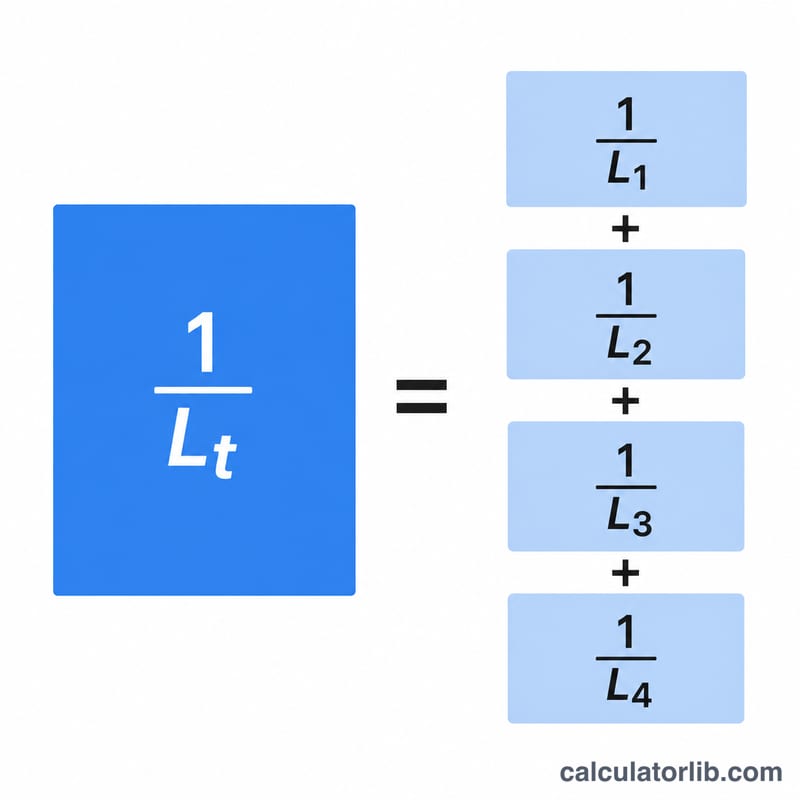
The governing equation is:
$$\frac{1}{\text{L}_{\text{total}}} = \frac{1}{\text{L}_1} + \frac{1}{\text{L}_2} + \dots + \frac{1}{\text{L}_n}$$
You add the reciprocals of every inductance, then take the reciprocal of that sum to get the total. For just two inductors this simplifies to the product-over-sum form \(\text{L}_{\text{total}} = \frac{\text{L}_1 \times \text{L}_2}{\text{L}_1 + \text{L}_2}\).
Worked Example
Suppose you have a 2 H and a 3 H inductor in parallel. Then $$\frac{1}{\text{L}_{\text{total}}} = \frac{1}{2} + \frac{1}{3} = 0.5 + 0.3333 = 0.8333.$$ Taking the reciprocal gives \(\text{L}_{\text{total}} = 1.2\ \text{H}\). Notice the result (1.2 H) is smaller than the smallest inductor (2 H), as expected.
FAQ
Why is parallel inductance smaller than each inductor? Adding parallel current paths provides more ways for current to flow, lowering the opposition to changing current and thus the effective inductance.
Does this account for mutual inductance? No. This calculator assumes the inductors are magnetically isolated (no coupling). Mutual inductance between coils would change the result.
Can I use different units? Yes, as long as all inductors use the same unit. Enter all values in mH (or µH) and the answer will be in mH (or µH).