
What Is a Parallel Capacitor Calculator?
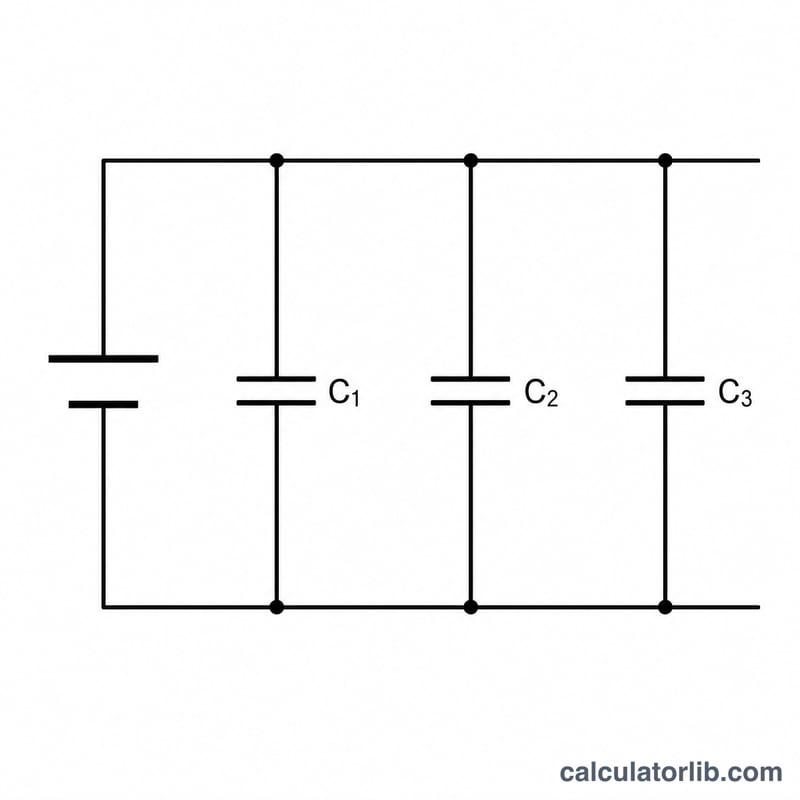
This calculator finds the total capacitance of two or more capacitors connected in parallel. When capacitors share the same two nodes, they are in parallel, and their capacitances simply add together. The result is always larger than the largest single capacitor in the group.
How to Use It
Enter the value of each capacitor in microfarads (µF) in the fields provided. You can fill in anywhere from two to six capacitors; leave unused fields blank. The calculator adds the entered values and returns the total capacitance. Because the units are consistent, you can also enter all values in nanofarads or picofarads and read the result in that same unit.
The Formula Explained
For a parallel combination, the equivalent capacitance is:
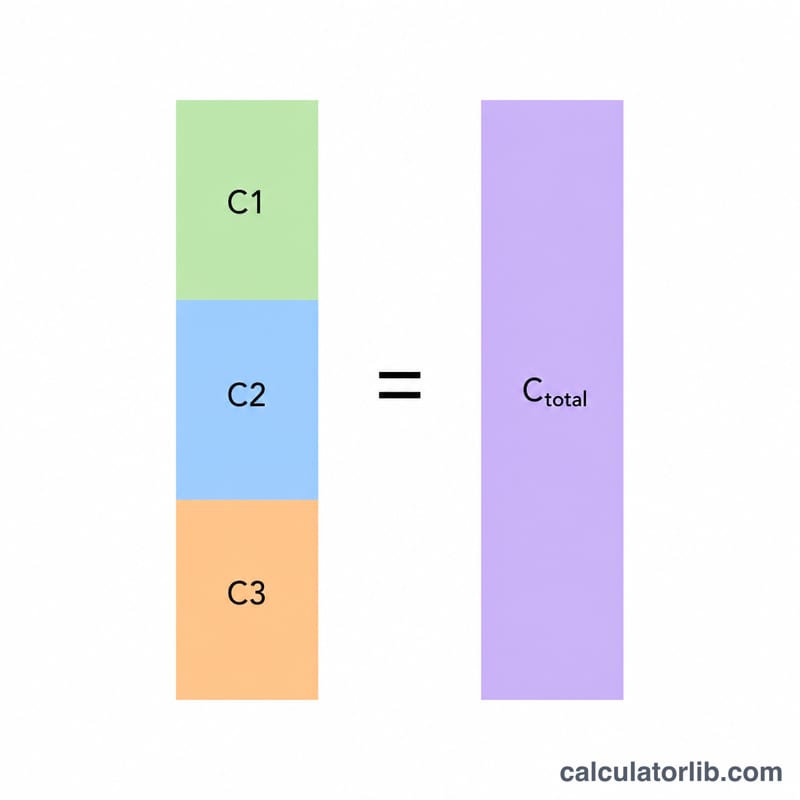
$$C_{\text{total}} = C_1 + C_2 + \ldots + C_n$$
This is the opposite of the series rule (where reciprocals add). Physically, placing capacitors in parallel increases the total plate area available to store charge, so the capacitances add directly.
Worked Example
Suppose you connect a 10 µF, a 20 µF, and a 4.7 µF capacitor in parallel. The total is simply $$10 + 20 + 4.7 = 34.7\ \mu\text{F}.$$ Notice the total exceeds the largest single value (20 µF), which is always true for parallel connections.
FAQ
Do voltage ratings add in parallel? No. In parallel, every capacitor sees the same voltage, so the safe working voltage is limited by the lowest-rated capacitor, not the sum.
What if I mix units? Convert all capacitors to the same unit first (e.g., all to µF). The calculator does not convert units for you.
How is this different from series? In series, capacitances combine like resistors in parallel using reciprocals, and the total is smaller than the smallest capacitor. In parallel, they add and the total grows.