
What is an RC Circuit?
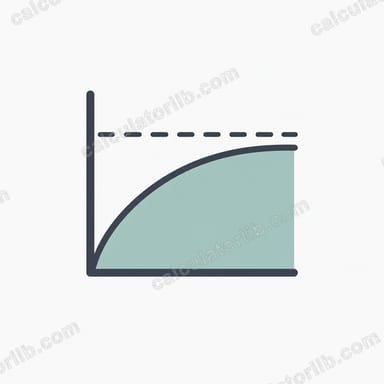
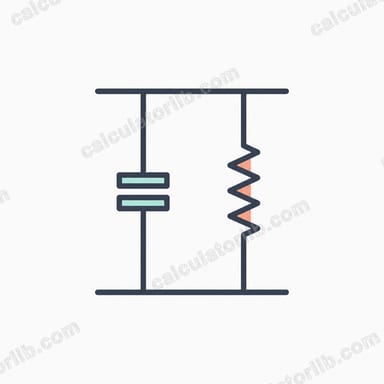
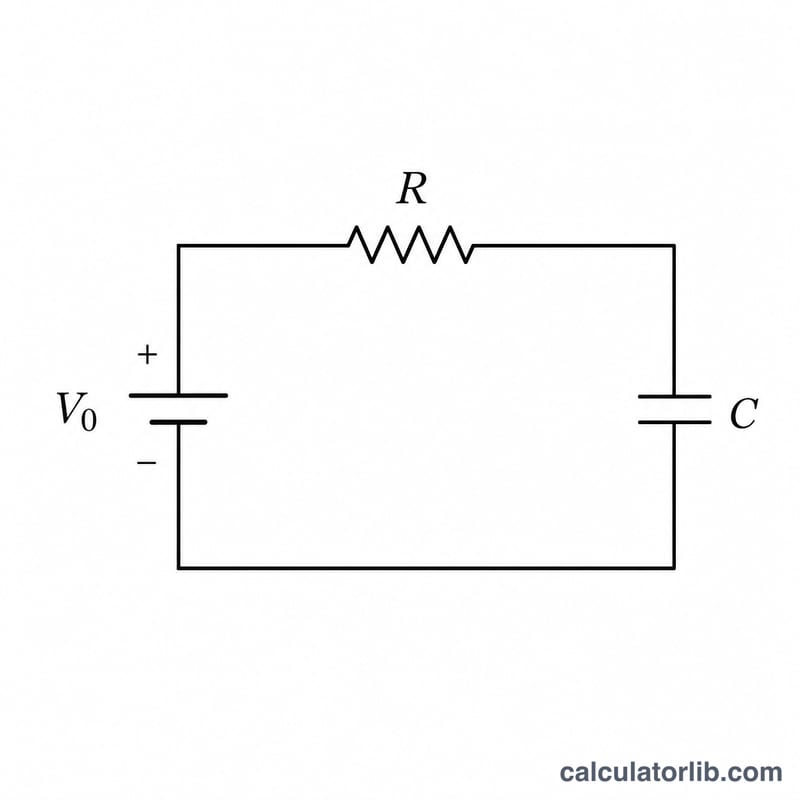
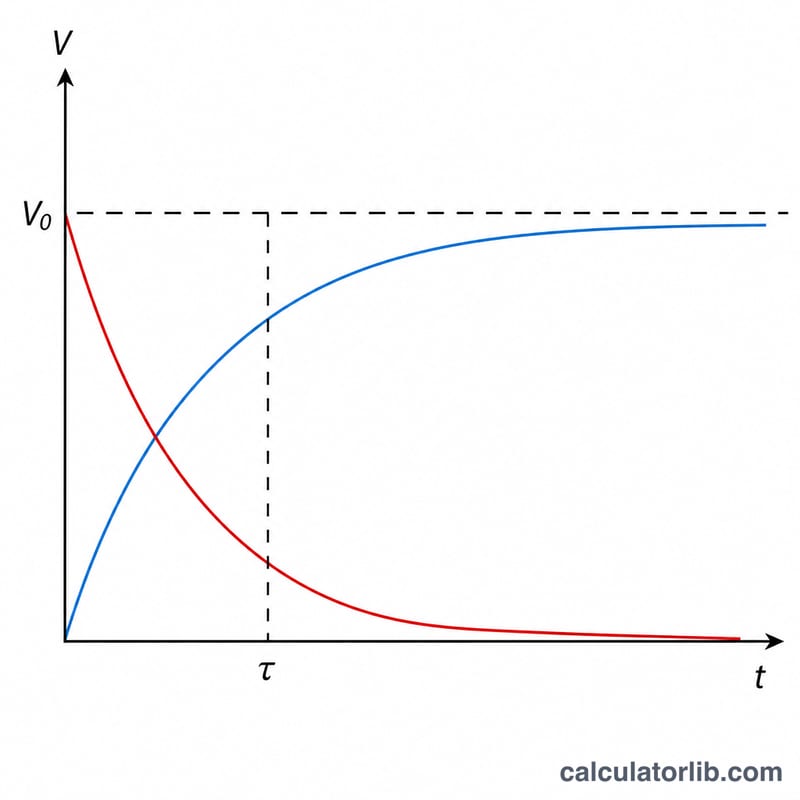
An RC circuit pairs a resistor (R) with a capacitor (C). When connected to a voltage source, the capacitor charges through the resistor along an exponential curve; when the source is removed, it discharges the same way. The single most important parameter is the time constant \(\tau = \text{R} \times \text{C}\), which sets how fast these changes happen.
How to Use This Calculator
Enter the resistance in ohms (Ω), the capacitance in microfarads (µF), the supply voltage V₀ in volts, and the elapsed time t in seconds. The calculator returns the time constant τ, the capacitor voltage while charging and while discharging at time t, and the percentage of full charge reached.
The Formula Explained
The time constant is \(\tau = \text{R} \times \text{C}\). Because capacitance is entered in µF, it is converted to farads (\(\times 10^{-6}\)) before multiplying. The charging voltage follows $$V(t) = \text{V}_0 \left( 1 - e^{-t/\tau} \right)$$ and discharging follows $$V(t) = \text{V}_0 \, e^{-t/\tau}$$ After one τ the capacitor reaches ≈63.2% of V₀; after 5τ it is essentially fully charged (≈99.3%).
Worked Example
With R = 1000 Ω and C = 100 µF, \(\tau = 1000 \times 0.0001 = 0.1 \text{ s}\). For V₀ = 5 V at t = 0.1 s (exactly one τ): $$V(t) = 5 \times \left( 1 - e^{-1} \right) = 5 \times 0.6321 = 3.161 \text{ V}$$ so the capacitor is 63.21% charged. The discharging value would be \(5 \times e^{-1} = 1.839 \text{ V}\).
FAQ
How long until fully charged? Practically, after about 5 time constants (5τ) the capacitor reaches ~99.3% of supply voltage.
Why convert µF to farads? The base SI unit is the farad; \(1 \text{ µF} = 10^{-6} \text{ F}\). Using farads keeps τ in seconds.
Does this work for AC? This tool models the DC transient (step) response. AC analysis uses reactance and phase instead.