
What is the Resistor Wattage Calculator?
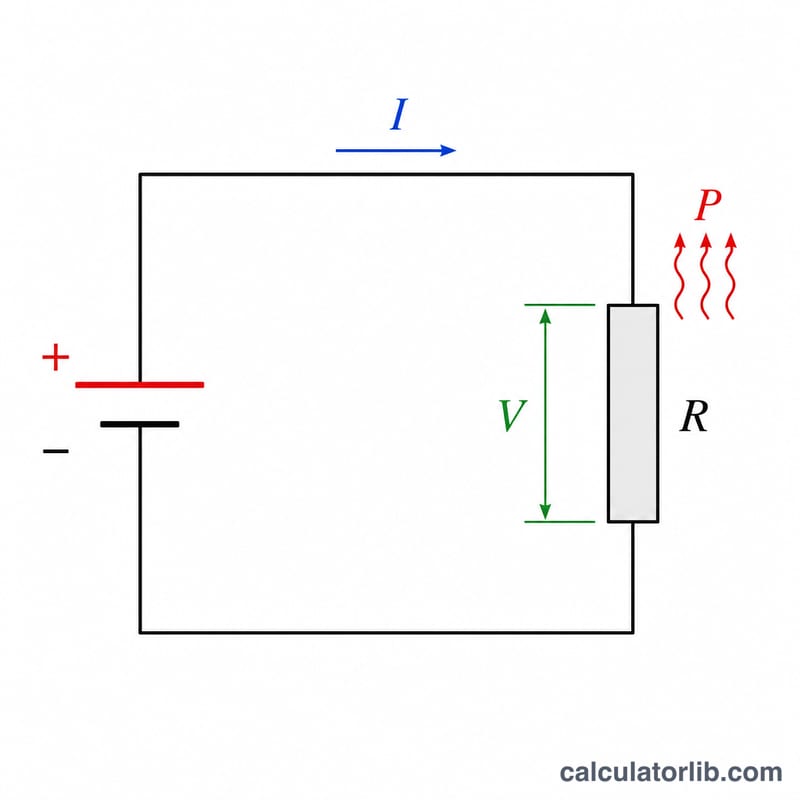
This calculator determines how much power (in watts) a resistor dissipates as heat when current flows through it. Choosing a resistor with an adequate power rating is critical — if a resistor dissipates more power than its rating, it will overheat, drift in value, and eventually fail or burn. Enter any two of voltage, current, or resistance and the tool computes the dissipated power and a safe recommended rating.
How to use it
Provide any two of the three quantities: the voltage across the resistor (V), the current through it (A), and its resistance (Ω). The calculator fills in the missing value using Ohm's Law and returns the power in watts. It also suggests a part rated for at least twice the calculated power, a common derating rule of thumb that keeps the component cool and reliable.
The formula explained
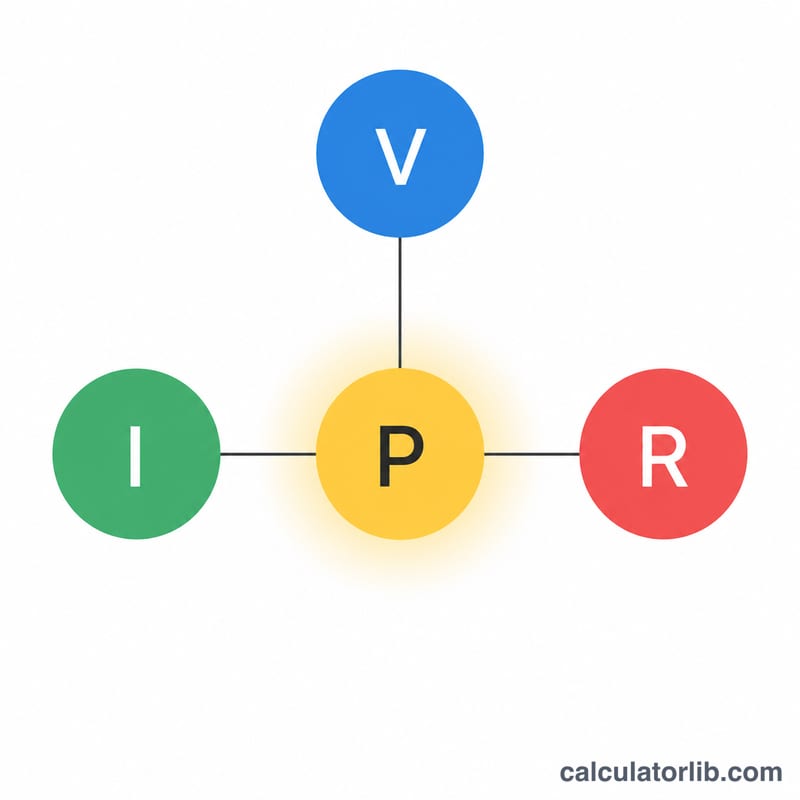
Power dissipation follows from Joule's law combined with Ohm's Law (\(V = I \times R\)). The three equivalent forms are:
\(P = I^{2} \times R\) — when current and resistance are known.
\(P = V^{2} / R\) — when voltage and resistance are known.
\(P = V \times I\) — when voltage and current are known.
All give the same answer because they are algebraically equivalent through Ohm's Law.
Worked example
Suppose a 100 Ω resistor carries 0.12 A of current. Using \(P = I^{2} \times R\):
$$P = 0.12^{2} \times 100 = 0.0144 \times 100 = 1.44\ \text{W}$$A 1/4 W or 1/2 W resistor would burn out here — you would choose at least a 3 W part, comfortably above the 2× recommended 2.88 W.
FAQ
Why use a 2× safety margin? Resistor ratings assume free airflow at room temperature. Operating well below the maximum rating reduces heat, prolongs life, and improves stability.
What if I only know two values? Two of the three quantities are enough — Ohm's Law derives the third automatically.
Does this apply to AC? For purely resistive loads, yes, using RMS voltage and current values.