
What this calculator does
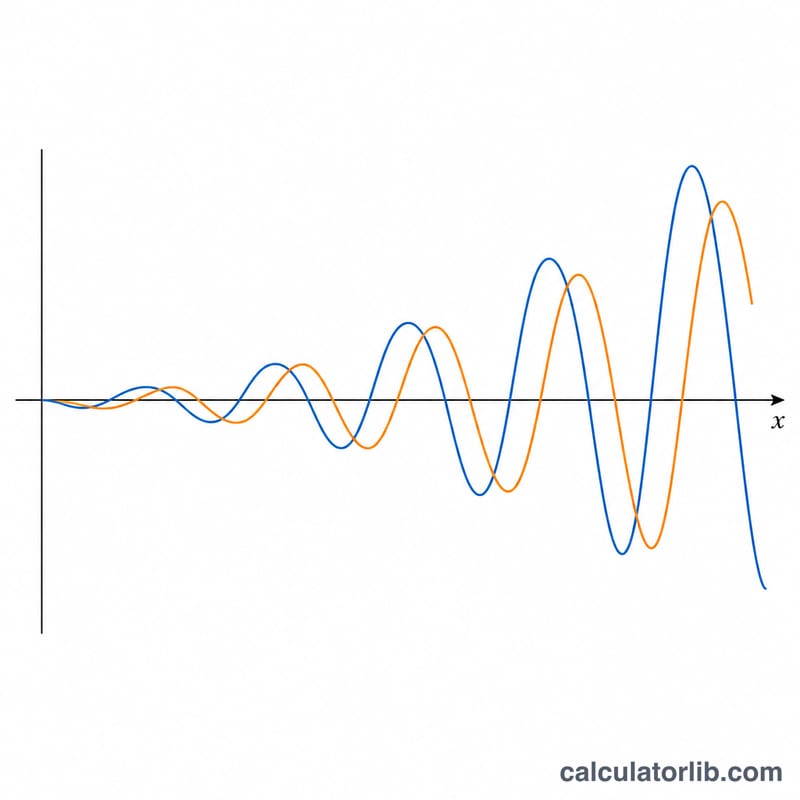
This tool builds a table (and a line graph) of the first derivatives of the Kelvin functions of the first kind, written \(\operatorname{ber}_v'(x)\) and \(\operatorname{bei}_v'(x)\), over a range of \(x\) for any real order \(v\). The Kelvin functions arise in electrical engineering (skin effect in conductors), heat conduction, and the analysis of oscillating viscous flow. Their derivatives appear whenever you differentiate field or current-density profiles described by Kelvin functions.
How to use it
Enter the order \(v\) (default 0), the initial value of \(x\), the increment between successive \(x\) values, and the number of repetitions (rows). The calculator generates \(x\) values \(x_i = \text{startX} + i\cdot\text{stepX}\) for \(i = 0, 1, \dots, \text{count}-1\), evaluates both derivatives at each point, and renders a scrollable table plus a comparison graph of the two curves.
The formula explained
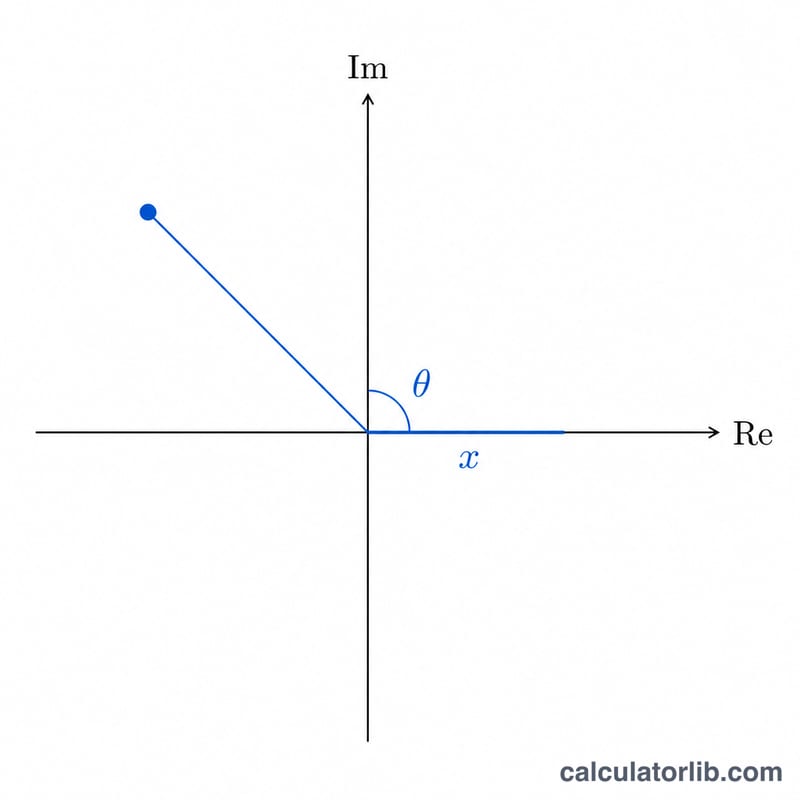
The Kelvin functions are defined by $$\operatorname{ber}_v(x) + i\cdot\operatorname{bei}_v(x) = J_v\!\left(x\cdot e^{3\pi i/4}\right).$$ Letting \(z = x\cdot e^{3\pi i/4}\) and using the Bessel derivative identity \(J_v'(z) = \tfrac{1}{2}\left(J_{v-1}(z) - J_{v+1}(z)\right)\) together with the chain rule (\(dz/dx = e^{3\pi i/4}\)), we get $$\operatorname{ber}_v'(x) + i\cdot\operatorname{bei}_v'(x) = e^{3\pi i/4}\cdot\frac{1}{2}\cdot\left[J_{v-1}(z) - J_{v+1}(z)\right].$$ The real part is \(\operatorname{ber}_v'(x)\); the imaginary part is \(\operatorname{bei}_v'(x)\). The Bessel values are computed by summing the power series in complex arithmetic, advancing each term by the ratio \(t_{m+1} = t_m\cdot\dfrac{-(z/2)^2}{(m+1)(v+m+1)}\) for stability.
Worked example
For \(v = 0\) and \(x = 1\), the real series gives $$\operatorname{ber}_0'(1) \approx -0.06245 \quad\text{and}\quad \operatorname{bei}_0'(1) \approx 0.49740.$$ At \(x = 0\) both derivatives are 0 for \(v = 0\).
FAQ
Does it handle negative \(x\)? Yes. The complex Bessel series is used, so the default range starting at \(x = -10\) is fully supported.
What orders \(v\) are allowed? Any real number, including non-integer and negative orders, evaluated with a Lanczos gamma approximation.
How accurate is it for large \(|x|\)? The direct series is reliable on roughly \(x \in [-20, 20]\); beyond that, cancellation in the series can reduce precision.